ABS Brake Repair: Diagnosis and Repair Options
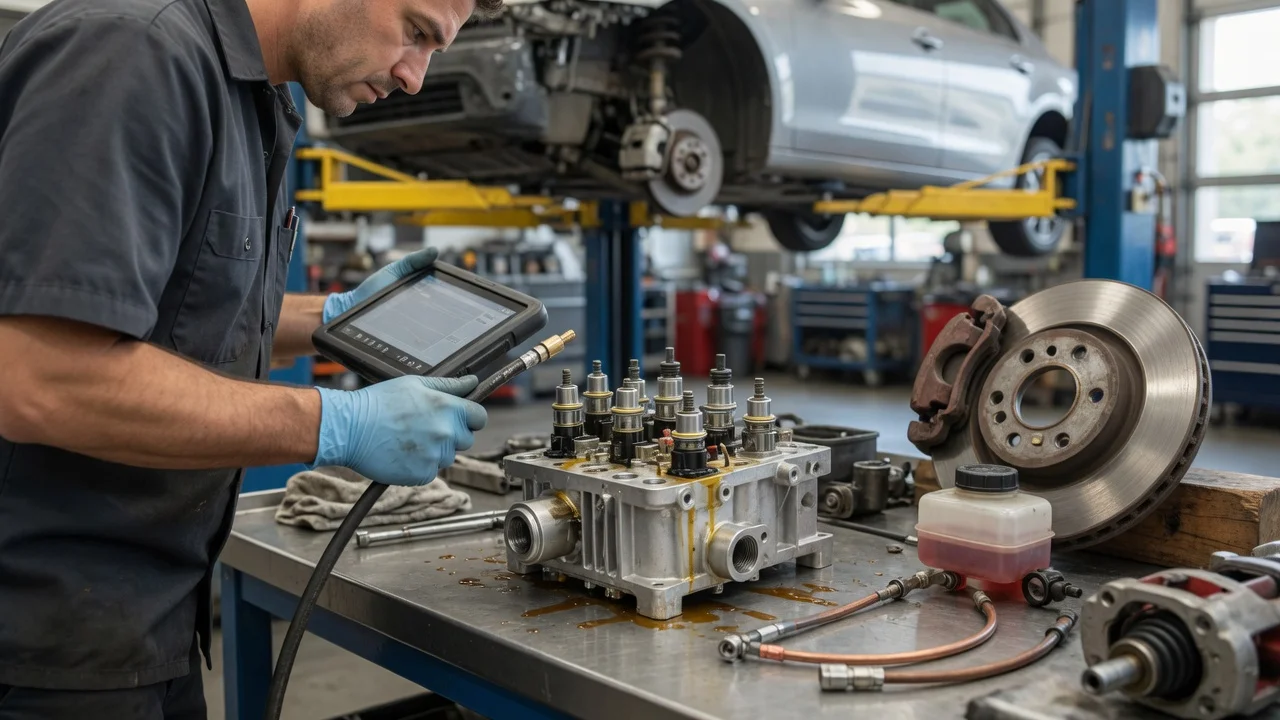
What ABS brake repair actually involves
ABS brake repair means restoring the anti-lock braking system to proper operation. The anti-lock braking system prevents wheel lockup during hard braking by rapidly modulating brake pressure at individual wheels. Repair scope ranges from a simple wheel speed sensor replacement to repair of the hydraulic control unit, wiring or the electronic control module. The exact repair depends on which part has failed, because ABS is a separate electronic and hydraulic layer added to the conventional service brakes. The base brakes usually still stop the vehicle when ABS is faulty, but the anti-lock function may be unavailable.
How ABS works and why repairs differ from normal brake work
An ABS system monitors wheel rotation with wheel speed sensors and compares the signals. When one wheel decelerates faster than the others, the ABS control module commands the hydraulic control unit to release, hold or reapply brake pressure many times per second. This keeps the tire near the limit of available grip instead of skidding. Ordinary brake repair covers pads, rotors, calipers, fluid and lines. ABS repair adds electronic components, sensor rings, wiring, connectors and the hydraulic modulator, so diagnosis and labor can be substantially different.
Common ABS symptoms and what they may indicate
The most common sign is an illuminated ABS warning light. The light usually indicates a stored fault code, but the code identifies a circuit or condition rather than automatically proving that one part has failed. A brake warning light that comes on with the ABS light may indicate low brake fluid, a hydraulic fault or another base-brake problem. Pulsation through the brake pedal during ABS activation is normal, but unusual noise, pedal feel changes or ABS activation during light braking deserves investigation.
Wheel speed sensor failure or debris on the sensor or tone ring; Damaged or corroded tone ring teeth; Chafed, corroded or broken wheel speed sensor wiring; Blown fuse or poor relay supplying the ABS module; Low brake fluid or air in the hydraulic system; Faulty ABS pump motor, valve block or module
Diagnosis: what to check next
Start with the easy observable checks. Confirm the brake fluid level and condition, inspect the wheels and tires for compatible sizes and pressures, and look for damaged sensor wiring or loose connectors. A scan tool that reads ABS fault codes is the next practical step because the code points to the affected wheel or circuit. Record the exact code and freeze-frame data, then clear it only as part of a controlled test. If the fault returns immediately, the problem is likely still present; if it returns only after driving, look for an intermittent wiring or sensor signal issue.
A diagnostic result is not proof that a specific component is bad. A wheel speed sensor code can also be caused by wiring, a connector, a damaged tone ring, excessive wheel bearing play or debris. Before replacing a sensor, compare its live signal with the other wheels if the scan tool supports live data. If the signal is missing, erratic or inconsistent with road speed changes, test the circuit continuity and the sensor resistance according to the vehicle service information. If the signal is plausible, inspect the tone ring and bearing.
Stop driving and seek professional diagnosis immediately if the brake warning light is on with a loss of brake fluid, the pedal is low or sinking, braking distance is noticeably increased, or there is noise from the base brakes. ABS warning alone does not always require parked-vehicle action, but the vehicle should be treated as having reduced safety margin in an emergency stop.
Repair options and how to compare them
The practical alternatives are component replacement, circuit repair or replacement of a larger assembly such as the ABS hydraulic unit. A wheel speed sensor or tone ring replacement is usually the least expensive repair and is often justified when diagnosis isolates a faulty signal at one wheel. Wiring repair can be cheaper than a sensor when the harness is visibly damaged near the connector. Replacing the hydraulic control unit or ABS module is the most expensive option and should follow testing that excludes the external sensors, wiring, fuses and fluid issues.
Comparison of common ABS repair directions; Option;Typical situation;Main advantage;Main limitation; Wheel speed sensor replacement;Confirmed faulty signal from one wheel with sound wiring and tone ring;Lower part cost and straightforward access on many vehicles;Fails to fix the problem if the tone ring, bearing or wiring is at fault; Wiring or connector repair;Visible chafing, corrosion or open circuit near the sensor or module;Targets the proven circuit fault;Intermittent faults can require careful connector inspection; Tone ring or wheel bearing repair;Damaged teeth, rust expansion or excessive bearing play;Addresses the rotating signal source;May require hub or bearing replacement on some designs; ABS module or hydraulic unit repair;Internal valve, pump or module fault after external causes are excluded;Restores centralized hydraulic/electronic function;Higher cost, possible fluid bleeding and module programming
Choose the smaller, confirmed repair when diagnosis points to an external part. Choose module or hydraulic unit replacement only when the fault is isolated to that assembly, because replacing it will not correct a damaged tone ring, bad sensor wiring or poor fluid condition. After any repair, the system should be scanned again, the fault codes cleared and the vehicle road-tested to confirm that ABS activation is normal and no warning light returns.
Quality, cost and compatibility factors
Replacement parts must match the vehicle application, including model year, generation, powertrain, trim and market where the ABS configuration differs. A used hydraulic unit or module may require the correct part number and possibly programming or initialization. Brake fluid must meet the specification listed for the vehicle, and any hydraulic repair requires proper bleeding. Using an incompatible fluid can damage seals and internal ABS components.
Cost comparisons should use the same repair scope and market. A low sensor price is not directly comparable with a complete hydraulic unit replacement that includes programming, fluid and bleeding labor. Editorial judgment based on published service experience suggests that most ABS repairs are external sensor or wiring faults rather than internal module failures, but individual diagnosis should determine the repair on the vehicle in question. No universal price or failure rate can be stated without a specific vehicle, region and dated parts quote.
When ABS repair must be left to a professional
Professional diagnosis and repair are appropriate when the scan tool lacks ABS coverage, when the hydraulic unit or module is suspected, when brake lines must be opened under pressure, or when the symptom affects stopping ability. Brake hydraulic repairs and ABS modulator bleeding can require special scan-tool functions. If the vehicle must remain usable but the ABS condition is unresolved, treat it as a vehicle with conventional brakes and no verified anti-lock protection until the system has been properly diagnosed and repaired.