7.3 Powerstroke Wastegate Actuator: Identification and Function
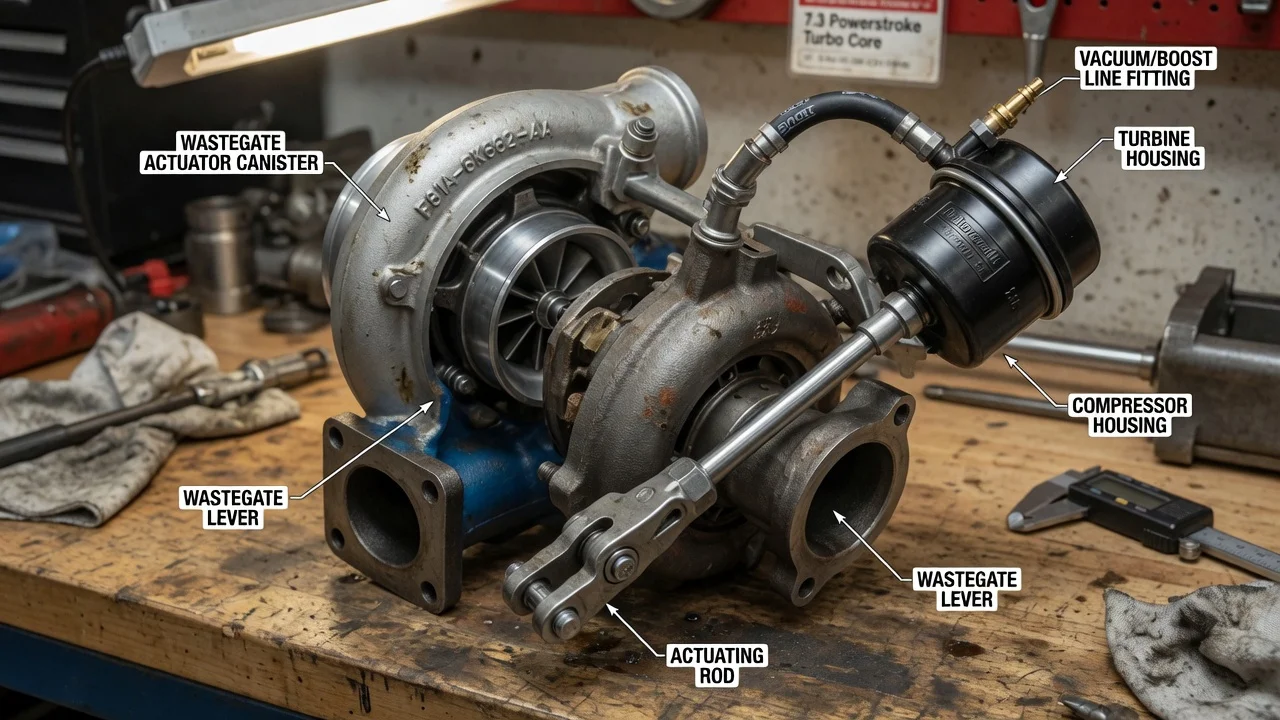
The wastegate actuator on a 7.3 Powerstroke is the small canister mounted on the turbocharger that limits boost by opening a bypass valve for exhaust gas. Owners often confuse it with other parts in the same area, and boost complaints are frequently blamed on it when the real cause is elsewhere. This guide explains how to identify the actuator, how it works, what differs between truck configurations, and which checks make sense before replacing anything.
What the 7.3 Wastegate Actuator Is
The 7.3L Power Stroke uses a Garrett turbocharger mounted on a pedestal in the engine valley, with an internal wastegate built into the turbine housing. The wastegate actuator is a round, diaphragm-type canister attached to the turbo by a bracket. A rod runs from the actuator to a lever arm on the turbine housing, and a small hose supplies the actuator with a boost pressure signal. When pressure in the canister reaches the level the actuator is built for, the diaphragm pushes the rod, the lever rotates, and the wastegate valve opens to let some exhaust bypass the turbine wheel.
Its job is boost control, not engine braking or warm-up. The 7.3 also has an exhaust back pressure valve at the turbine outlet, a butterfly valve operated by an oil-pressure-driven actuator and used mainly to speed warm-up in cold weather. That valve and its actuator are a separate system. Before ordering a part or diagnosing a fault, confirm which device you are actually looking at: the wastegate actuator is the diaphragm canister with a linkage rod and a small pressure hose, not the oil-fed piston assembly at the exhaust outlet.
How Boost Control Works
Exhaust flow spins the turbine wheel, which drives the compressor wheel that pressurizes intake air. As engine load and exhaust energy increase, boost rises. Without a way to limit it, boost could climb past what the engine and turbo are designed to handle. The wastegate provides that limit by diverting part of the exhaust around the turbine once boost reaches the actuator's opening point, which slows further turbine speed increase.
Inside the actuator, a spring holds the diaphragm and rod in the closed-wastegate position. Boost pressure fed through the hose acts against that spring. Once the pressure force overcomes spring tension, the rod moves and the wastegate begins to open. The opening point therefore depends on the spring, the diaphragm condition, the rod length and linkage geometry, and whether the pressure signal reaches the canister without leaks or restrictions. A torn diaphragm, a disconnected or cracked hose, or a seized wastegate pivot can all prevent the valve from opening as intended.
What Changes the Answer for Your Truck
The 7.3 Power Stroke was offered over several model years in pickups, vans and the Excursion, and the turbocharger is not identical across all of them. Earlier trucks and later Super Duty trucks use different Garrett turbo models, so actuator part numbers, brackets and hose routing can differ. On some configurations the actuator receives boost pressure more or less directly, while on others the powertrain control module can influence the pressure signal through a control solenoid. Because these details depend on the exact vehicle configuration, use the VIN, build date and the turbo identification tag to confirm which actuator and control arrangement your truck has.
Modifications also change the picture. Aftermarket turbos, adjustable or stiffer actuators, tuning that alters solenoid control, and altered intake or exhaust plumbing all affect how and when the wastegate opens. Operating conditions matter as well: heavy towing, high altitude and sustained grades put the turbo near its control limit more often, so a weak actuator may only show symptoms under those loads. A truck's service history, including any previous turbo work or rod adjustment, can explain behavior that would otherwise look like a failed part.
What the Owner Can Check
Start with symptoms measured on a boost gauge or scan tool rather than feel alone. Boost that climbs higher than normal for your truck suggests the wastegate is not opening, which points toward a leaking diaphragm, a disconnected or split pressure hose, a seized pivot or a control fault where a solenoid is used. Low boost with sluggish response can come from a wastegate stuck open or a misadjusted rod, but it is far more often caused by intake or exhaust leaks, a leaking boot or intercooler connection, or fuel system problems unrelated to the actuator.
With the engine off and cool, a visual inspection is straightforward. Check that the hose is attached at both ends, not cracked, collapsed or oil-soaked, and that the rod clip and lever are present and secure. Look for heat damage to the canister and signs that the rod has been bent or the adjustment nut moved. You can apply gentle pressure to the actuator with a hand pressure pump and watch whether the rod moves smoothly and whether the canister holds pressure; a canister that will not hold pressure likely has a failed diaphragm. Do not pry or force a seized wastegate lever, since the pivot is in the turbine housing and binding there is a separate repair.
Avoid adjusting rod length or swapping in an adjustable actuator without the correct manufacturer specifications for your turbo. Changing preload changes the boost limit, and guessing can lead to overboost or poor performance. If you replace the actuator, match the part to your turbo model, record the work in the truck's maintenance records and recheck boost behavior under the same operating conditions that produced the original complaint.
Limitations and When to Get Help
There is no universal replacement interval for the wastegate actuator, and it is not normally a scheduled maintenance item; it is inspected or replaced based on symptoms and condition. Boost targets, actuator opening pressure and rod adjustment values are specific to the turbo model and configuration, so rely on factory service information for your truck rather than general numbers. Diagnostic trouble codes related to boost or a control solenoid also need to be interpreted against the correct service procedure for your model year.
Get professional help if boost is significantly higher than normal, if the wastegate pivot is seized, if you see oil in the turbo plumbing, or if symptoms persist after the hose and actuator check out. A technician with a scan tool and the correct service manual can test control solenoid operation, measure boost against specifications and separate a wastegate fault from turbo wear, exhaust back pressure valve problems or fuel delivery issues.