7.3 Glow Plug Relay Fuse Location: Where to Find It and How to Check It
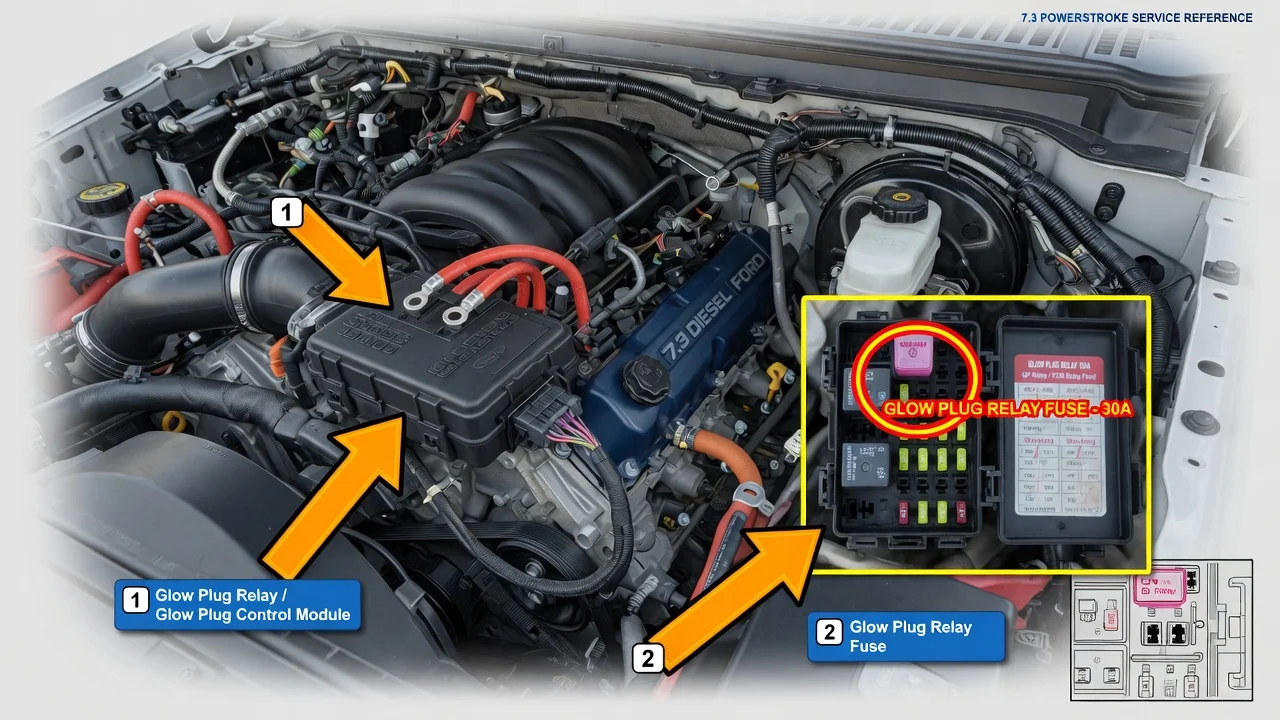
On the 7.3L Power Stroke, the glow plug relay is not plugged into a fuse box. It is a separate heavy-duty relay mounted on the engine. The high-current feed that powers it is usually protected by fusible link wire, not a blade fuse you can pull and replace. This guide covers where to look, how the circuit is arranged, what changes by model year, and how to check it safely with basic tools.
Where the relay and its fuse protection are located
On 1999 to 2003 Super Duty trucks and Excursions with the 7.3L, the glow plug relay is bolted on top of the driver-side valve cover. It has two large terminal studs and a small connector for the control wires. One large stud receives battery power. The other sends current through the harness to the glow plugs on both cylinder banks. On 1994.5 to 1997 trucks, the relay is also on the driver's side of the engine, but its exact position differs. The quickest way to confirm it on any year is to follow the heavy cable from the glow plug harness back to a square relay with two large studs.
Most owners searching for a glow plug fuse are really looking for the fusible link. This is a short section of special wire in the main feed between the battery positive side and the relay, usually near the battery or starter connection, depending on the year. When it fails, the insulation may look swollen or melted, or the wire may feel soft and stretchy when gently pulled. The relay's low-current coil circuit is fed from the ignition through a fuse in a fuse panel. The exact position and fuse rating vary by year, so read them from the fuse panel cover legend or the owner's manual rather than guessing.
How the glow plug circuit works
The powertrain control module decides how long the glow plugs need to heat, based mainly on engine temperature. When heat is needed, it switches the relay's control circuit. The relay contacts close and connect battery power to all eight glow plugs at the same time. Together, the plugs draw a large current, which is why the feed uses heavy cable and fusible link protection instead of a small fuse. The wait-to-start lamp on the dash is timed separately from the relay. The lamp often goes out before the plugs stop heating, so a click several seconds after the lamp turns off is normal.
While the plugs are energized on a cold morning, system voltage drops noticeably. That dip is expected and should recover once the relay opens. A relay that sticks closed is a different problem. It keeps the plugs powered after they should have shut off, which can overheat and damage them. If it stays closed with the key off, it drains the batteries overnight and shows up as a parasitic draw.
What changes the answer
Body style and model year determine where the relay sits and how the feed is routed, so the older trucks and the Super Duty generation should not be treated as identical. Previous repairs also matter. Some trucks have an aftermarket relay, a spliced harness, or a fusible link replaced with an inline fuse. If you find a substituted fuse, it should provide protection equivalent to the original circuit and should never be upsized to stop it from blowing. Engine temperature changes what you observe as well. On a warm engine, the computer may not energize the relay at all, so no click and no voltage at the output stud can be normal.
The 7.3L is a conventional 12-volt diesel with two starter batteries wired in parallel. It has no high-voltage traction system, so no hybrid isolation procedure applies. That does not make the circuit harmless. The batteries can deliver enough current through the relay studs to arc, burn skin or weld a wrench to a bracket. Before touching the relay terminals, disconnect the negative cable at both batteries, since disconnecting only one leaves the circuit powered.
What the owner can do
Start with a visual check while both batteries are disconnected. Inspect the relay studs for loose nuts, corrosion or heat discoloration, and check that the cable ends are tight and undamaged. Trace the main feed back toward the battery and examine the fusible link section closely. Clean and tighten the battery terminals while you are there, because a poor connection at the posts produces symptoms that look like a relay fault.
For an electrical test, reconnect the batteries and work with a cold engine. Place a voltmeter between the relay's output stud and a clean engine ground, then turn the key on. While the relay is energized, the reading should be close to battery voltage, then fall to zero when the relay opens. Next, compare voltage at the input stud with voltage at the battery posts during the same cycle. A large voltage drop between the battery and the input stud points to the fusible link or cable connections. A large drop from the input stud to the output stud points to worn relay contacts. If the input stud has no voltage at all, the feed or fusible link has failed. If the input has power but the output never switches, check the coil fuse and the control signal using a wiring diagram for your year. If the output stays live with the key off, the relay is stuck and should be replaced.
Also confirm battery health and charging output. Weak batteries or a struggling alternator can make normal glow plug load look like a failure and lead to hard cold starts even when the relay works correctly.
Limitations and next step
Wire colors, routing and fuse assignments differ across production years and trim levels, so a year-specific wiring diagram is the reliable reference when the visual check does not match what you expected. A blown fusible link is a symptom, not a root cause. Before repairing it, look for the short that caused it, such as a shorted glow plug, a chafed harness or a damaged under-valve-cover connection. Otherwise, the new link can fail the same way.
A scan tool can read glow plug or wait-to-start circuit codes that the engine computer may have stored, which helps separate a control problem from a power problem. If you are not comfortable working near high-current battery cables, if the link keeps failing, or if the fault involves the glow plugs or harness under the valve covers, have a shop with diesel electrical experience diagnose the circuit.