6.7 Powerstroke Wastegate Actuator: Identification by Turbo Configuration
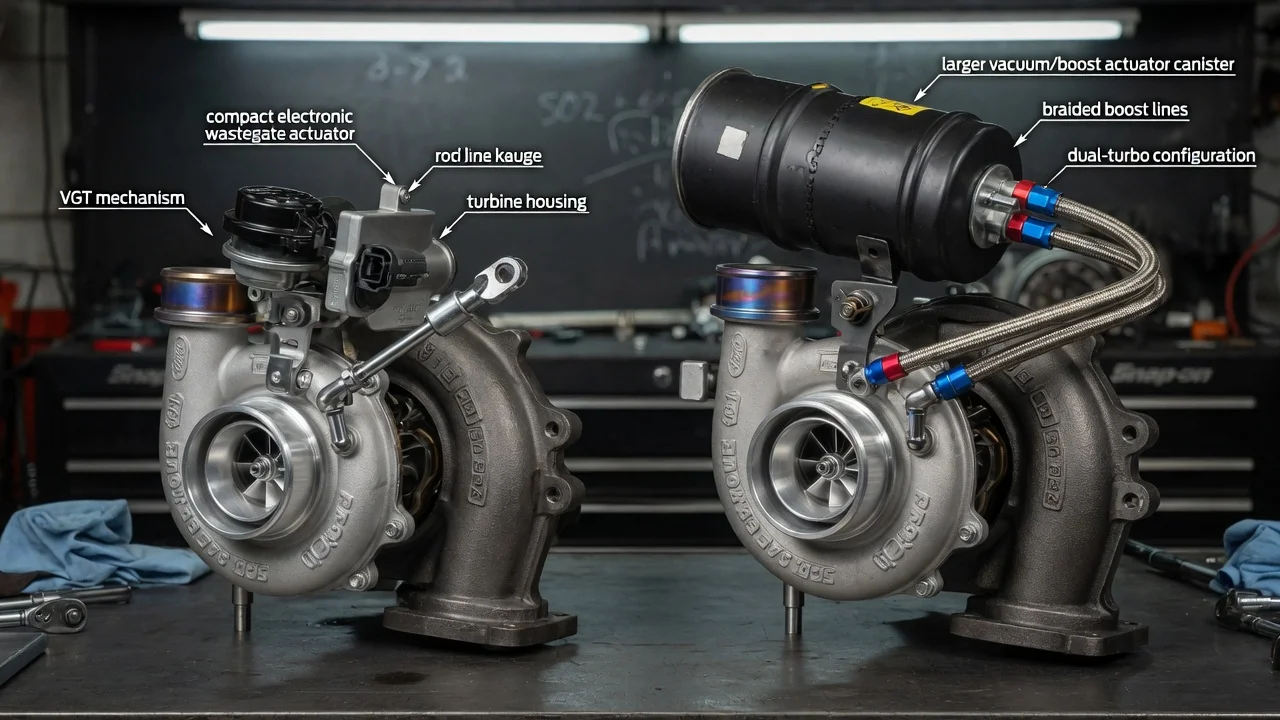
If you are shopping for a 6.7 Powerstroke wastegate actuator, first confirm whether your truck's turbocharger actually uses a wastegate. The 6.7-liter Power Stroke relies primarily on a variable geometry turbocharger, so the part many owners call a wastegate actuator is often the electronic actuator that moves the turbine vanes. Identifying the turbo configuration on your specific truck prevents ordering the wrong part and keeps your boost diagnosis on the right track.
Short Answer: Identify the Turbo Before the Actuator
Most 6.7 Power Stroke engines control boost with a variable geometry turbocharger, often shortened to VGT. Instead of bypassing exhaust around the turbine, the engine control module commands an electronic actuator that changes the angle of vanes inside the turbine housing. For many trucks, a parts listing labeled as a wastegate actuator really refers to this VGT actuator. Some configurations, particularly certain later high-output versions, are reported to combine variable geometry with a separate wastegate, and that wastegate would have its own actuator. Because of this, the engine name alone is not enough to pick a part. The reliable approach is to confirm the turbo by VIN, the identification tag on the turbocharger and a visual inspection.
The turbocharger has also changed across generations of the engine. Earlier trucks used a compact turbo with a double-sided compressor wheel, while later generations moved to a larger unit with a conventional single-sided compressor. Actuator design, mounting points, linkage and electrical connectors can differ between these turbos, so do not assume an actuator from one generation fits another simply because both engines displace 6.7 liters.
How Boost Control Works on the 6.7
In a variable geometry turbo, a ring of movable vanes surrounds the turbine wheel. Closing the vanes narrows the passage, speeding up exhaust flow against the turbine and building boost quickly at low engine speed. Opening them reduces restriction and limits boost at higher load. The actuator moves those vanes on command from the engine computer and reports its position back, so the computer can compare commanded and actual position. When the vanes stick, often from soot and carbon buildup, or when the actuator's motor or electronics fail, the result can be low boost, overboost, sluggish response or a fault code that puts the truck into reduced power.
A wastegate works differently. It is a valve that opens to let part of the exhaust bypass the turbine wheel, capping turbine speed and boost. Its actuator may be a pressure or vacuum diaphragm canister or an electric motor, connected to the valve by a rod and lever. This distinction matters for diagnosis: a sticking vane mechanism and a stuck wastegate flapper can produce similar complaints, but they are checked, serviced and replaced in different ways.
What Changes the Answer
Vehicle configuration is the biggest variable. Model year and engine generation determine the original turbocharger, and pickup, chassis cab and high-output versions may carry different calibrations or hardware. A truck that has had its turbo replaced may now have a remanufactured, upgraded or aftermarket unit whose actuator does not match the factory catalog listing for that VIN. Service history therefore matters as much as the build sheet when you are identifying parts.
Operating conditions affect how the actuator and vanes behave over time. Extended idling, frequent short trips and repeated low-load operation tend to encourage soot buildup in the turbine housing, while heavy towing exposes the actuator and its wiring to sustained heat. Aftermarket tuning or modified emissions equipment can also change how boost is commanded and how faults appear, which can make a healthy actuator look defective or hide a real problem.
How to Identify Your Actuator by Inspection
Work only on a fully cooled engine, since turbo and exhaust components stay hot long after shutdown. The 6.7 Power Stroke uses an inboard exhaust layout, so the turbocharger sits on top of the engine between the cylinder heads. Look at the turbine side of the turbo for an electronic actuator body with an electrical connector, mounted to the housing and linked to the vane mechanism. If the turbo also has a wastegate, you will typically see a separate rod or arm leading to a valve lever on the turbine housing, along with its own canister or electric actuator. Also locate the identification tag on the turbo, which carries the part and serial information.
Write down or photograph the tag, the actuator, its connector and the VIN. Use those details with a dealer parts department or a reputable supplier's VIN-based lookup to confirm the exact actuator. If the tag does not match what the catalog expects for your VIN, treat that as evidence the turbo was replaced and identify the part by the installed unit rather than the original specification.
What the Owner Can Do
Start with a scan tool that reads stored and pending codes and, ideally, shows live data. Comparing commanded and actual vane position along with boost pressure helps separate a failing actuator from other causes. Inspect the actuator connector and nearby harness for heat damage, corrosion or loose pins, and check the intake and charge air system for leaks, since a split boot or loose clamp can mimic an actuator fault. Note when the symptom appears, such as cold start, towing or highway cruise, because that pattern helps a technician narrow the cause.
If replacement is needed, confirm whether your actuator is sold separately or only as part of a turbocharger assembly, and whether a calibration or learn procedure is required after installation; on many electronic actuators it is, and it may need a capable scan tool. Follow the manufacturer specifications for fasteners and connector seating, and record the work in the truck's service history. There is no universal maintenance schedule for the actuator itself, so periodic inspection during regular service is more useful than a fixed replacement interval.
Limitations and Next Step
This guide explains general identification and diagnosis; it cannot confirm which actuator your particular truck uses. Boost-related symptoms overlap with sensor faults, EGR and aftertreatment problems, fuel delivery issues and internal turbo wear, so a fault code alone does not prove the actuator is bad. Seek professional help if codes return after basic checks, if the learn procedure requires dealer-level software, or if you find oil in the intake, shaft play or other signs of turbo damage. Your next step is to gather the VIN, turbo tag details, codes and live data observations, then confirm the correct part before buying.