6.4 Powerstroke Turbo Boost Control Position Sensor Location
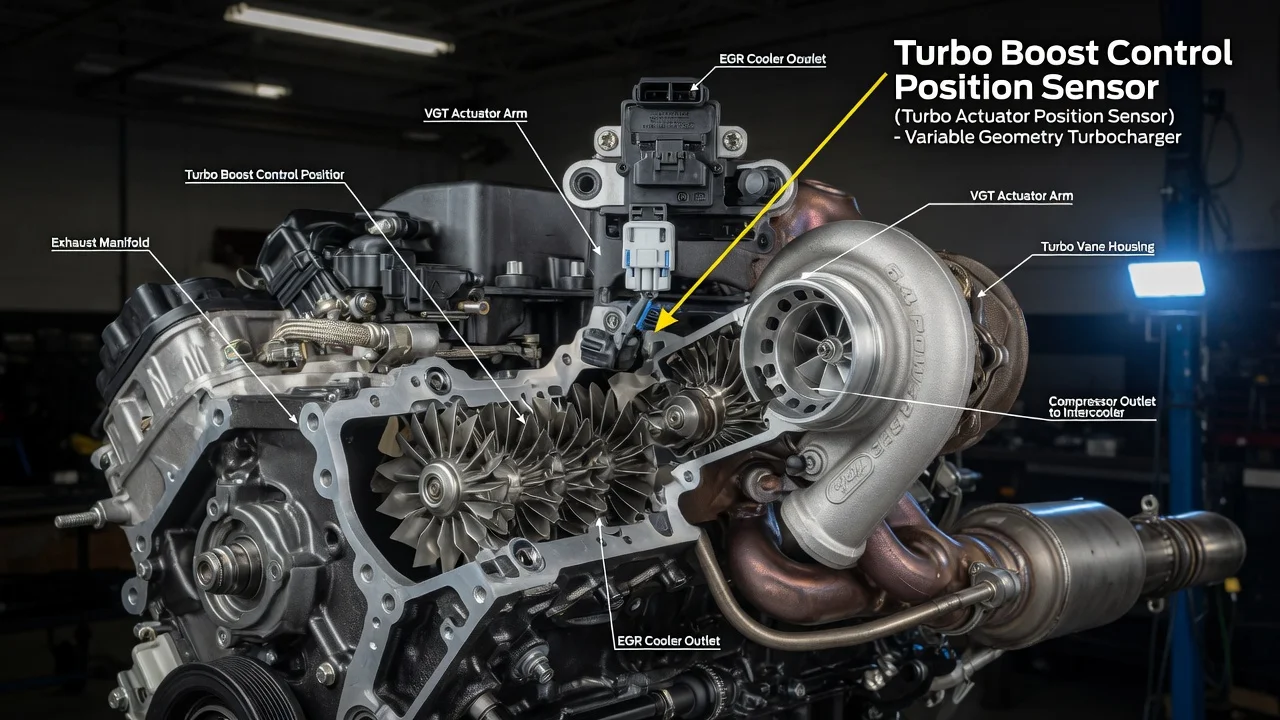
A turbocharger boost control position code on a 6.4L Power Stroke sends many owners looking for the sensor itself. On these 2008 to 2010 Ford Super Duty diesels, the position feedback belongs to the variable geometry actuator on the high-pressure turbocharger, at the top rear of the engine. Below you will find where that is, how the sensor works, what varies between trucks, and what to check before ordering parts.
Where the sensor sits on the 6.4L Power Stroke
The 6.4L Power Stroke uses a compound turbocharger arrangement: a smaller high-pressure turbo with variable geometry and a larger low-pressure turbo. The boost control position sensor reports the position of the variable geometry mechanism, so it is part of the high-pressure turbo's actuator system rather than something mounted on the intake manifold or intercooler piping. Owners searching near the front of the engine or the air filter are usually confusing it with a boost pressure sensor.
The turbo assembly is packed close to the firewall, with the high-pressure unit positioned below the low-pressure unit. That placement is the main difficulty. Depending on the truck and the job, intake ducting, heat shielding and surrounding hardware may need to come off just to see the connector, and many shops lift the cab for turbocharger work on this engine. Whether the position sensor is sold and replaced separately or only as part of the actuator assembly should be confirmed with Ford parts and service information for your VIN.
How vane position feedback works
A variable geometry turbo changes how exhaust gas reaches the turbine wheel. Closing the vanes speeds up exhaust flow and builds boost quickly at low engine speed; opening them reduces restriction and limits boost at higher load. On the 6.4L the powertrain control module commands the actuator through a control valve, and the actuator uses engine oil pressure to move the mechanism. The position sensor tells the module where the vanes actually are, so it can compare that with where it asked them to be.
When the reported position is missing, out of range or does not match the command, the module sets a fault. Generic codes such as P2563, P2564 and P2565 describe range/performance, circuit low and circuit high conditions for a turbocharger boost control position sensor circuit. A range or performance code does not prove the sensor itself has failed; a sticking vane mechanism, an actuator problem or a wiring fault can create a mismatch that the sensor is merely reporting.
What changes the answer for your truck
Vehicle configuration matters. Pickup and chassis cab versions share the engine family, but the routing of ducting, brackets and harnesses can differ, which changes what has to be removed for access. Replacement parts installed during earlier repairs, warranty work or recalls can also differ in actuator or connector design, so the parts catalog for your VIN is more reliable than a generic photo.
Service history and modifications are the other big variables. Aftermarket tuning, replacement or upgraded turbochargers, and changes to emissions equipment can alter how vane position is commanded and reported, and some aftermarket turbo kits do not use the factory actuator at all. Operating conditions play a role as well: frequent short trips, extended idling, heavy towing and overdue oil changes are commonly associated with soot and carbon buildup that can make the variable geometry mechanism sluggish, which may trigger a position fault even when the sensor is healthy.
What you can check before replacing parts
Start with the exact code numbers, freeze frame data and whether the fault is current or stored. If your scan tool displays commanded and actual vane position, watch both during a warm idle and a gentle load test where it is safe to do so. A sensor or circuit fault often shows an implausible or frozen reading, while a mechanical problem tends to show the actual value lagging behind or failing to follow the command.
With the engine cold, inspect what you can reach: the harness near the turbo for melted insulation, chafing against brackets or oil contamination, and the connector for corrosion or a loose lock. Confirm engine oil level and condition, and compare recent oil changes against the maintenance schedule in your owner information, because the actuator depends on clean oil at proper pressure. Note symptoms such as low power, slow boost build, overboost or a reduced power mode. Clearing the code and recording how quickly it returns, and under what conditions, gives a technician useful evidence.
Limits of a location guide and when to get help
A general description of where the sensor sits cannot replace Ford service information for your specific truck. Manufacturer specifications for the circuit, connector pinout, test values and removal steps are what a proper diagnosis relies on. Without them, it is easy to replace a sensor or actuator that was not the cause of the code.
Work around the turbochargers involves hot exhaust components, tight clearances and seals and emissions parts that are easy to disturb. If the wiring checks out and the code returns, or if you lack a scan tool that can read vane position, a diesel technician with dealer-level software is the practical next step. Bring the code history, symptom notes and service records so the diagnosis starts from evidence rather than guesswork.