6.4 Powerstroke Glow Plug Control Module Location
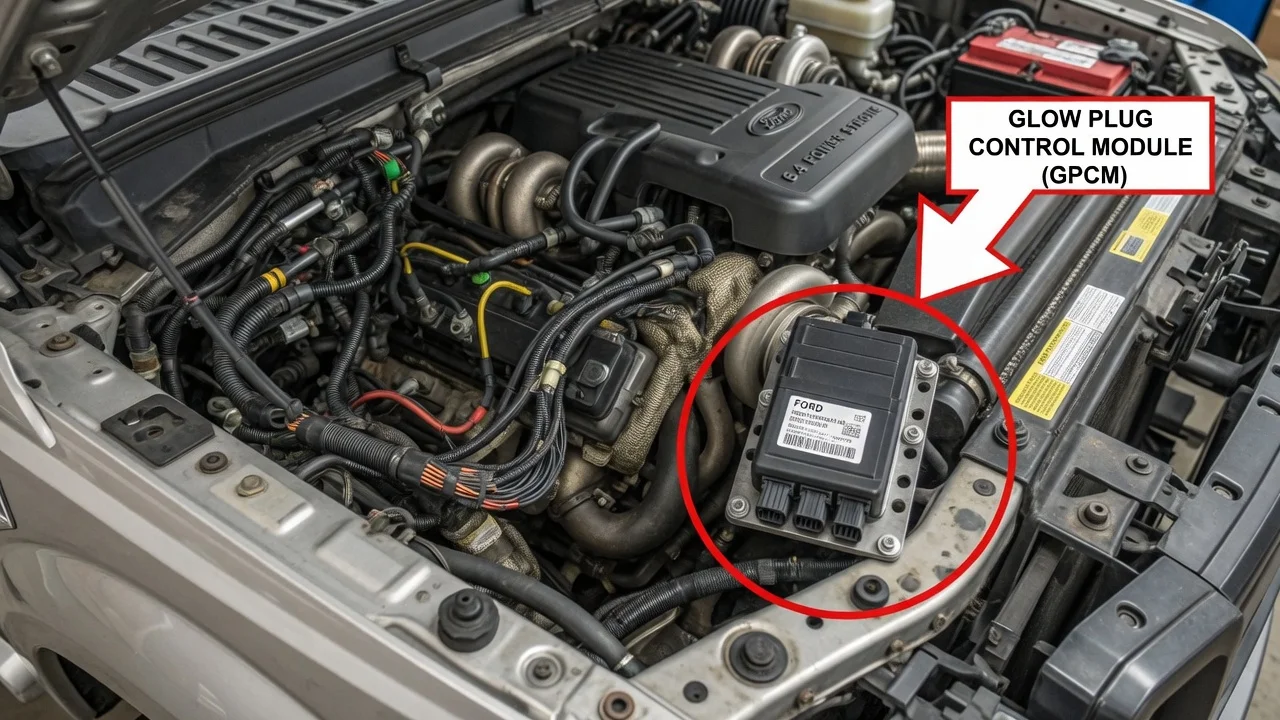
On the 6.4L Power Stroke used in 2008–2010 Ford Super Duty trucks, the glow plug control module is not under the hood with most of the other electronics. It is mounted under the truck, where water, road salt and debris reach it. Knowing where to look saves time when the wait-to-start lamp stays on too long, cold starts get rough, or a scan tool reports glow plug circuit codes.
Where the module is mounted
On most 6.4 trucks, the glow plug control module is bolted to the driver's side frame rail, beneath the cab. It is usually below the driver's door, behind the front wheel. You cannot see it from the engine bay. Look along the frame rail from underneath the truck. The module is a small, flat, metal-cased unit with a main harness connector and connections for the wiring that feeds the glow plugs on each cylinder bank. Its exact position can vary slightly between trucks, so look along that section of the rail instead of expecting it at a fixed measurement.
Do not confuse it with the horizontal fuel conditioning module, which is also mounted on the driver's side frame rail on these trucks. That unit holds the frame-mounted fuel filter, the water separator and the electric fuel pump, and fuel lines connect to it. The glow plug module has only electrical connections. If the part you are looking at has fuel hoses attached, you have found the fuel module.
How the glow plug system works
A diesel ignites fuel through compression heat instead of a spark. In cold weather, the cylinder walls and intake air absorb so much heat that the injected fuel may not ignite cleanly. The 6.4 is a V8, so it has eight glow plugs, one per cylinder. Each plug preheats its combustion chamber so the injector spray lights reliably during cranking and the first moments of running.
The powertrain control module decides when glow plugs are needed and for how long, based on engine temperature and other inputs. It commands the glow plug control module, which switches high current from the batteries to the plugs. The module also monitors each plug circuit and reports faults back, so the powertrain module can set diagnostic codes and control the wait-to-start lamp. Glow time is longer in cold conditions and may be very short in warm weather. The plugs can also stay on briefly after the engine starts to smooth the idle and reduce white smoke. The glow system does not control fuel pressure or injector timing, but a weak glow system can make a cold start look like a fuel delivery problem.
What changes the answer
The location above applies to the 6.4L diesel in 2008–2010 F-250 through F-550 models. Other diesel generations use different layouts. The 6.0L before it and the 6.7L after it are not reliable references for the 6.4, so do not follow a guide written for either one. Gasoline Super Duty engines have no glow plugs at all, so this module exists only on diesel trucks. Cab configuration, bed length and chassis cab versus pickup body can change the clearance around the frame rail and the angle you see the module from.
Aftermarket equipment often hides the module or changes its surroundings. Step bars, frame-mounted toolboxes, auxiliary fuel tanks, skid plates and relocated harnesses are common examples. Previous repairs can matter too. A replaced module may have been mounted with different hardware, or its wiring may have been rerouted. In regions that salt their roads, heavy corrosion can make the module and its connectors hard to recognize. Corrosion is also one of the main reasons this module fails.
What the owner can do
Park on level ground, set the parking brake and chock the wheels. Use ramps or jack stands rather than working under a truck held only by a jack. Before unplugging any connector, disconnect both batteries. The 6.4 uses two, and the glow plug circuit carries high current. Then inspect the module and its connectors. Look for green or white corrosion on the terminals, cracked connector locks, chafed or stretched wiring, and missing mounting fasteners. Reseat the connectors only if they are clean and undamaged. If you use a small amount of dielectric grease on the seals, do not pack the terminal cavities with it.
Read the stored codes with a scan tool that supports diesel functions, and write them down before clearing anything. Generic codes such as P0670 point to the module control circuit. P0671 through P0678 refer to individual cylinder glow plug circuits, and P0683 indicates a communication problem between the glow plug module and the powertrain control module. If the truck starts well when warm but struggles when cold, and these codes are present, the glow system is the likely focus.
If the engine is hard to start at every temperature, or you notice extended cranking or a fuel smell, check the fuel side first. That means the service interval on the fuel filters, water in the separator, and whether the frame-mounted fuel pump runs at key-on. A scan tool can also show fuel pressure readings without opening any lines. Never loosen injector lines or high-pressure fittings to bleed or test the system. Pressurized diesel fuel can penetrate skin and cause serious injury. If you suspect a leak, limit yourself to a visual leak check and leave the rest to a professional. Fuel additives are not a proven fix for starting problems and will not repair a failed glow plug circuit.
Limitations and next step
A general description cannot confirm the exact mounting point, connector layout or part number for every truck. Use service information specific to your truck's VIN when you need precise procedures, wiring diagrams or test values. Telling a failed module from a bad glow plug or a damaged harness requires proper electrical testing. Replacing the module based only on a code can waste money if the fault is actually a plug or a wire.
Glow plug replacement on the 6.4 can require significant disassembly on some cylinders, and a seized plug can damage the cylinder head if forced. A shop experienced with diesels is the right next step in that case. The same applies to a no-start with a fuel smell, visible fuel leakage, or warning lights you cannot explain from the stored codes.