6.0 Powerstroke Turbo Lag and Black Smoke: What to Check
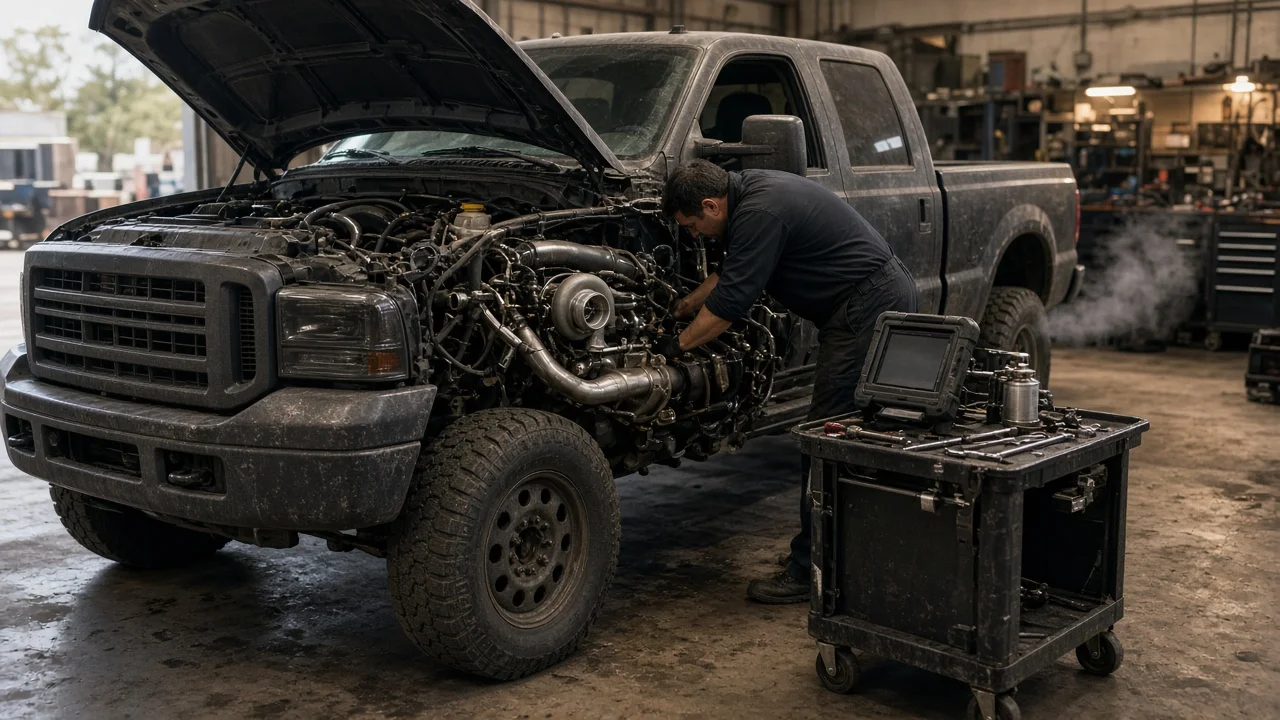
When a 6.0 Powerstroke hesitates before boost builds and puffs black smoke, the engine is usually getting more fuel than its available air can burn. On this diesel the common suspects are the variable geometry turbocharger, the sensors and valves that control it, the EGR valve and leaks in the intake tract. Injectors and tuning contribute less often. This guide helps you record what the truck is doing, narrow down the causes and decide what needs a qualified technician before any parts are replaced.
Establish the symptoms
Start by writing down exactly when the problem appears. Note whether the lag happens only when the engine is cold or also at full operating temperature, whether it is worst pulling away from a stop at low rpm, and whether it shows up mainly while towing or climbing. Record whether the hesitation clears once the turbo spools up, or whether power also surges, cuts out or feels like overboost at higher rpm. For the smoke, note whether it appears only under hard throttle, continuously, or even at idle. Be careful with color: black or dark gray smoke points to a rich mixture, while white smoke, especially with a sweet smell, suggests coolant entering the combustion chamber and calls for a different diagnosis.
Next, list associated signs: a check engine light and any stored codes, hissing or whistling under boost, rough idle, hard starting, falling coolant level or a change in oil level. Then review recent changes and the service history. Aftermarket tuning, a new air filter or intake, turbo or EGR work, a change in oil type and a recent fuel fill-up can all matter. Also note the operating conditions the truck usually sees. Long periods of idling and short trips let soot build up in the turbo and EGR system, which is relevant to several of the causes below. Finally, confirm the vehicle configuration, including the model, body style, mileage and any modifications, because service information and test values depend on it.
Distinguish plausible causes
Sticking turbo vanes are the classic cause on this engine. Soot and carbon can bind the vanes and the unison ring that moves them, so the turbo responds slowly at low rpm and may overboost or surge once it does move. A truck that runs better after a long, hard drive, or that is worst after short trips, fits this pattern. The VGT control valve is another suspect. It is an oil-pressure-operated solenoid that positions the vanes, and a sticking valve or a contaminated screen can produce similarly erratic boost. The PCM relies on the exhaust backpressure sensor to command the turbo, so a plugged sensor tube or a faulty sensor can make a healthy turbo behave badly. VGT or backpressure codes support these causes. Consistent behavior regardless of temperature or driving style weakens the sticking-vane theory.
An EGR valve stuck open lets exhaust displace fresh air. This typically causes sluggish response, black smoke, rough idle and sometimes stalling, and the symptoms are often most noticeable at idle and light load. Boost leaks from loose clamps, split charge air boots or a damaged intercooler starve the engine of air under load. They often produce a hiss and leave oily residue at the joints. Restrictions such as a clogged air filter, collapsed intake ducting or a blocked exhaust reduce airflow in a similar way. A leaking or sticking injector can cause smoke, but it usually brings misfire or uneven running, so it is a weaker fit when lag is the main complaint. Aggressive tuning alone can also create black smoke if it adds fuel beyond what the airflow supports.
Checks in a useful order
Begin with checks any owner can do safely with the engine off and cool. Inspect the air filter and any restriction indicator, the intake ducting, and every charge air boot and clamp for looseness, cracks or an oily film. Look for soot trails around exhaust joints near the turbo, which can point to leaks. Check the oil and coolant levels and the condition of both fluids. Read all stored and pending codes with a scan tool and save the freeze frame data. Then repeat the conditions that trigger the problem on a controlled drive, with a passenger noting rpm, temperature and when the smoke appears, rather than watching instruments yourself.
The next stage requires a capable scan tool, the manufacturer specifications and some experience. Live data worth capturing includes commanded versus actual boost, exhaust backpressure, VGT duty cycle, commanded versus actual EGR valve position, injection control pressure and FICM voltage. Compare these readings with the values in the service information for your exact configuration, not with general figures. A boost leak test requires proper adapters and regulated air pressure. Turbo actuation tests, control valve and screen inspection, clearing the backpressure sensor tube, EGR valve removal and injector contribution tests are best left to a qualified technician or a well-equipped owner working from the official procedures.
Interpret the findings
Each result narrows the field without necessarily naming a single part. A gap between commanded and actual boost confirms an airflow control problem. If the VGT duty cycle changes as commanded but boost does not follow, suspect the vanes, the control valve or its oil supply. If the backpressure reading barely changes with load, look at the sensor and its tube before blaming the turbo. A mismatch between commanded and actual EGR position, or EGR codes, supports a sticking valve. A boost leak test that holds pressure largely rules out intake leaks. Normal air filter condition and an unrestricted intake remove restriction from the list.
Confirm the finding before buying parts. A trouble code often reports a circuit or plausibility fault rather than a failed component, and wiring, connectors or a clogged passage can produce the same code. Sticking vanes are often confirmed only by physical inspection, and whether cleaning or replacement is appropriate is a judgment for the technician. Low FICM voltage or injection control pressure problems can mimic airflow faults, so rule them out separately. Faults also overlap. For example, carbon from the EGR system can foul the turbo, so fixing one may not cure the symptom. Recheck the original symptom after each correction instead of replacing several parts at once.
Urgency and next action
Stop driving and arrange an inspection if you see white smoke with a sweet smell, unexplained coolant loss, a pressurized coolant reservoir, oil in the coolant, oil leaking around the turbo, or smoke coming from under the hood. The same applies to grinding or siren-like noises from the turbo, overheating, flashing warning lights, or sudden power loss or stalling in traffic. Heavy black smoke under load can raise exhaust temperatures, so avoid towing and sustained heavy loads until the cause is found. Because the fault and its progression vary from truck to truck, no distance can be given as safe to drive.
To speed up the repair, bring the shop a clear record: model year, body style, mileage, modifications and tuning, stored codes with freeze frame data, any saved live data, and a description of when the lag and smoke occur. Add recent repairs, the service history, how closely the maintenance schedule has been followed, and typical operating conditions such as towing, idling or short trips. With this information, the technician can focus the inspection on the most likely systems and confirm the fault before recommending parts.