6.0 Powerstroke Transmission Cooler Line Routing Diagram
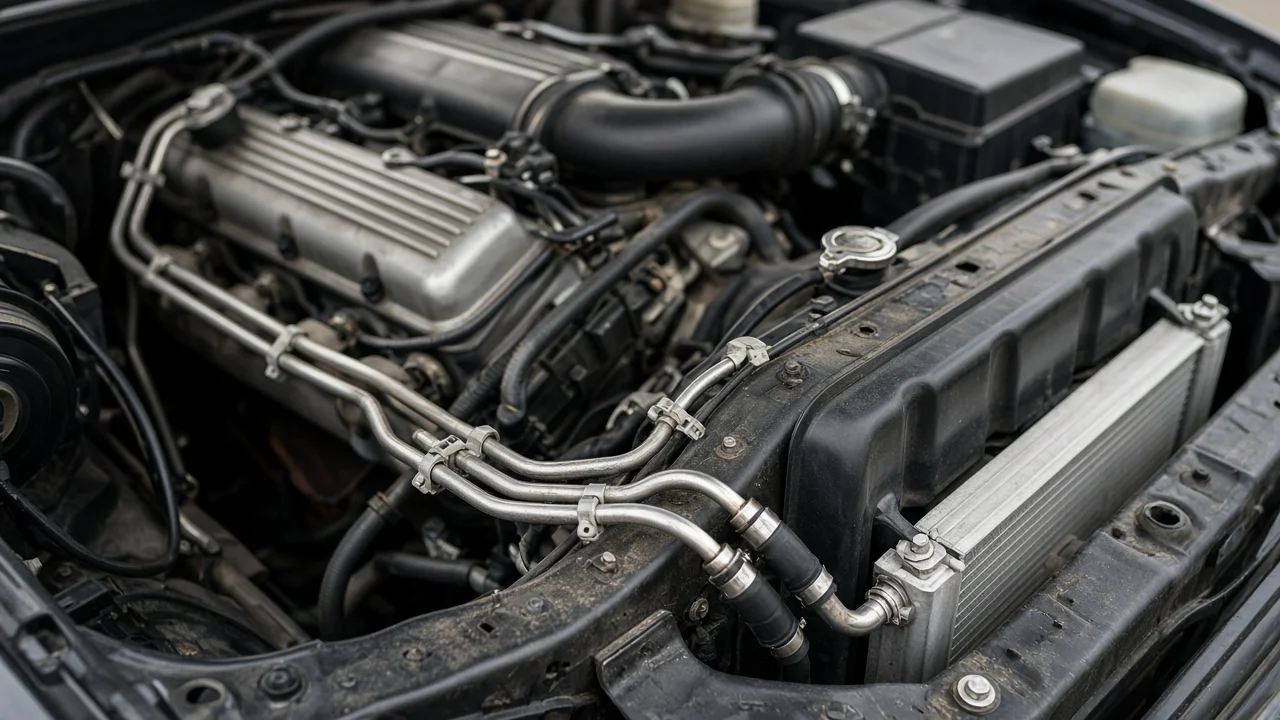
If you are replacing a leaking line or reinstalling a cooler on a 6.0L Power Stroke truck, routing matters as much as the parts. This guide explains how transmission fluid typically travels from the gearbox to the cooler and back on these trucks, what changes the layout from one vehicle to another, and how to confirm the correct path before you loosen a fitting. It does not replace the factory diagram for your exact build.
Short answer: where the cooler lines run
On Super Duty pickups with the 6.0L diesel and the 5R110W TorqShift five-speed automatic, the cooler circuit is a closed loop of two lines, mostly formed steel tubing, often with flexible hose sections near the cooler. Fluid leaves fittings on the transmission case, travels forward along the engine and frame toward the front of the truck, passes through the cooler mounted ahead of the radiator, and comes back to the transmission along a roughly parallel path. Depending on model year and equipment, the loop may also include a thermostatic bypass valve. There is no single universal drawing. Pickups, chassis cabs, the Excursion and E-Series vans package the front end differently, so exact bends, clips and connection points have to come from the service diagram that matches your VIN.
Two common mix-ups are worth clearing up first. Trucks with the six-speed manual transmission do not use the automatic transmission cooling loop, so a cooler line diagram for the automatic will not apply to them. And the 6.0L engine oil cooler, which gets a lot of attention on these engines, is a separate coolant-cooled component for engine oil. Its problems are not transmission cooler line problems, even though both sit in the same crowded engine bay.
How the transmission cooling loop works
An automatic transmission makes heat, mainly in the torque converter and in clutch packs during engagement. Towing and long climbs add a lot more. The transmission pump circulates fluid through the converter, and hot fluid leaves the case through the outgoing cooler line. After giving up heat at the cooler, it returns through the second line. In most automatics the returning fluid also feeds the lubrication circuit, so a restricted or kinked return line can do more than raise temperature. It can reduce lubrication to gears, bushings and bearings.
Where a thermostatic bypass valve is fitted, it sends fluid around the cooler while the transmission is cold so it reaches operating temperature sooner, then opens the path through the cooler once the fluid warms up. A valve stuck in bypass can let the transmission run hot under load, while one stuck open can make warm-up slow in cold weather. Factory connections on Ford cooler lines are commonly quick-connect fittings held by retaining clips and sealed with O-rings. Bent clips, damaged seals or a fitting forced apart without the correct release tool are frequent causes of leaks after a repair.
What changes the routing on your truck
Body style is the biggest variable. F-250 and F-350 pickups, F-450 and F-550 chassis cabs, the Excursion and E-Series vans each have their own front-end layout, so line length, bend shapes and clip locations differ. Production changes during the 6.0L years and towing or upfitter packages can also affect cooler size, valve presence and line shapes. Drivetrain matters too: a two-wheel-drive and a four-wheel-drive truck may not take the same line set, because the front axle and transfer case change the available space.
Previous work often changes the answer more than the factory build does. An aftermarket auxiliary cooler, a rerouted line, or a section replaced with hose and clamps means the truck in front of you no longer matches any factory diagram. Ask for or review the service history if you have it, and inspect the whole path before ordering parts. When buying replacement lines, confirm fitment for the exact model year, body style, drivetrain and transmission, not just the engine size.
What the owner can do before and during line work
Start by confirming the transmission type. The presence of a clutch pedal settles manual versus automatic, and the certification label on the driver's door jamb carries a transmission code that a dealer or parts counter can decode. Before removing anything, photograph the full route from the transmission to the cooler, including every bracket, clip and spot where a line passes close to the exhaust, steering components or the frame. Those photos often turn out to be the most useful routing diagram you will have, because they show your truck as it actually is.
Identify which line carries fluid out to the cooler and which brings it back by tracing each one from its fitting on the case and comparing with the factory diagram. Do not assume. Crossing the lines may reverse flow through the bypass valve and the cooler, which can keep the cooler from being used as intended. Replace damaged clips and O-rings rather than reusing them, secure lines in their original brackets so they cannot rub through, and keep them clear of exhaust heat.
After the repair, refill with fluid that meets the fluid specification listed in the owner's manual or Ford service information, since recommendations for this transmission have been updated over time. Check the level using the procedure for this transmission, which depends on fluid temperature, then recheck after a drive. Look over every fitting for seepage, and if you have a scan tool, watch transmission fluid temperature and note any change in shift behavior on the road.
Symptoms, codes and what they do not prove
Signs of a cooler line problem include red or brown fluid on the frame rail or under the front of the truck, a low fluid level, high transmission temperature readings when towing, and harsh or delayed shifts after fluid loss. Diagnostic codes such as P0218 for a transmission fluid over-temperature condition, or codes in the P0711 to P0713 range for the fluid temperature sensor circuit, point to a condition worth investigating. They do not identify a failed part on their own. High temperature can come from low fluid, a restricted line or cooler, a bypass valve that will not open, heavy loads, torque converter clutch behavior or an inaccurate sensor reading. Confirm the cause with inspection and testing before replacing anything.
Limitations and next step
This article describes the general layout and logic of the cooling loop. It gives no torque values, line dimensions or part numbers, and it cannot account for every production change or previous modification. For exact routing, use the factory transmission cooler line diagram for your VIN from Ford service information or a dealer parts department. Repair options range from replacing a single damaged section to a complete line set, a new bypass valve or a new cooler, and the right choice depends on what inspection actually finds.
Get professional help if the transmission ran low or overheated before the leak was found, if the fluid smells burnt or contains debris, or if slipping or erratic shifts continue after the level is corrected. When a transmission has suffered internal damage, debris can collect in the cooler and lines, so they usually need to be flushed or replaced along with the transmission repair. A transmission specialist can measure line pressure and cooler flow to confirm the circuit is working rather than relying on symptoms alone.