6.0 Powerstroke Coolant Leak Diagnosis
What the question is really asking
A 6.0 Powerstroke coolant leak can mean several different complaints: a visible puddle or drip, a falling degas bottle level, white residue, a sweet smell, or coolant loss without an obvious external leak. The direct answer is that you need to locate whether the coolant is leaving the cooling system externally, entering a combustion chamber, or crossing into another fluid before you choose a repair. Treat the visible symptom as the starting point, not as proof of which component has failed.
Know the common leak points
On these engines, coolant commonly appears near the degas bottle cap or degas bottle, upper or lower radiator hose connections, water pump, engine oil cooler housing and its cover gasket, EGR cooler hose connections, heater hose connections, radiator end tanks, and freeze plugs. Less visible losses can come from the head gaskets or the EGR cooler when coolant enters a cylinder or the exhaust instead of reaching the ground.
Start with evidence you can see
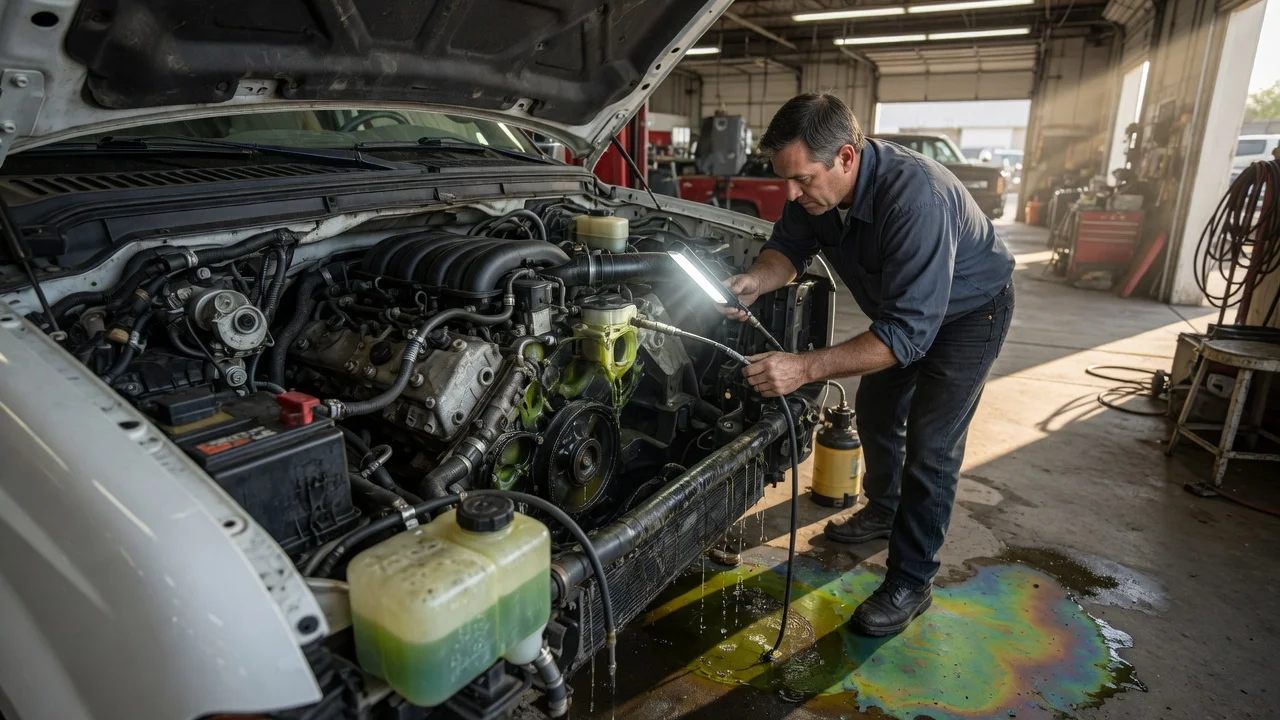
Begin with a cold-engine inspection of the ground area, the degas bottle level and its cap, and the hoses and housings that are accessible. Coolant may leave a white, crusty or chalky residue after the liquid evaporates. A wet hose, a stained seam, or residue following a path downward from a fitting can narrow the search. If the vehicle has recently been driven, remember that air movement can blow coolant rearward from the actual source.
Degas bottle and cap
A degas bottle that is cracked, or a cap that no longer holds the intended pressure, can release coolant only when the system is hot and pressurized. If the level drops after a loaded or high-temperature drive but the area is dry when cold, inspect the cap seal and the bottle seams before assuming a deeper engine leak. However, a bottle that repeatedly vents can also be a downstream result of excess pressure in the cooling system, so do not replace the cap alone and call the diagnosis finished.
Hoses, clamps and heater lines
Coolant at a hose end is often a clamp or sealing-surface issue, but a soft, swollen or oil-contaminated hose can also fail intermittently. If the leak is traced to a hose, note whether the hose is damaged or whether the connection is simply weeping. Replacing an oil-soaked hose without addressing an oil source can lead to the same failure again.
Water pump and oil cooler area
The water pump can leak from its vent hole or gasket. The engine oil cooler housing and its cover gasket are also common sources in this engine family. Coolant found at the front or just above the crank area may come from either source or from a hose above it. Clean the area, run or pressurize the system, and watch for the first point where liquid appears. That result is more useful than assuming the lowest wet component is the source.
When there is no visible external leak
Coolant loss without an obvious drip can be caused by combustion pressure entering the cooling system and forcing coolant out of the degas bottle, by coolant entering a cylinder and being burned, or by coolant entering the exhaust through the EGR cooler. A cooling system pressure test can help find external leaks, but it does not by itself prove an internal leak or condemn a head gasket.
EGR cooler as a possible internal path
The EGR cooler can fail internally and allow coolant into the exhaust stream. This may produce white exhaust vapor, a sweet smell from the exhaust, or coolant loss that is difficult to find externally. The result can look similar to a head gasket failure, so use the available checks rather than assigning blame from the smell alone.
Head gaskets and system pressure
A head gasket concern on these engines often shows up as the degas bottle puking coolant after hard use or when towing, sometimes with a rising bottle level or pressure remaining after shutdown. White exhaust vapor, misfire on a cold start, or a cylinder that appears to consume coolant can support the suspicion, but none of those is enough by itself. A diagnostic should separate combustion pressure from a simple hot-venting cap, an overheat condition, or a separate EGR cooler leak.
Checks that help separate the causes
A cooling system pressure test helps locate external seepage at hoses, gaskets, the radiator, the water pump, and the oil cooler housing. It is most useful after a visual inspection and after the suspect area is cleaned. A pressure drop alone is not a diagnosis; the drop only means the system is not sealing or coolant is moving somewhere. Inspect for the wet point during the test.
For internal combustion-side leaks, the applicable checks depend on the available equipment and the exact symptom. A cylinder that ingests coolant may show misfire, fouling, or a clean area on a spark or glow plug, but these are supporting observations. Cooling system pressure can be checked while interference from combustion is considered. Where available, a combustion-gas test of the cooling system can add evidence of exhaust gas in the coolant, but it has limits and does not identify the failed cylinder or the specific gasket location.
Do not treat a fault code or a single sensor reading as proof that a specific component must be replaced. Overheat-related codes may be caused by low coolant, air in the system, a stuck thermostat, restricted airflow, a failed fan clutch, or a faulty sensor, as well as by a real gasket or cooler failure. Confirm the operating conditions and the measured coolant level before acting on a code.
Order the diagnosis sensibly
1) Confirm the complaint: is coolant visibly leaking, disappearing without a trace, or being expelled from the degas bottle? 2) Inspect the bottle, cap, hoses, water pump area, oil cooler area, radiator seams and heater lines when the engine is cold. 3) Clean the suspicious area and use a pressure test or a controlled warm-up to find the first wet point. 4) If no external leak appears, evaluate the EGR cooler and head gasket paths with the checks appropriate to the symptom rather than replacing parts on suspicion. 5) After any repair, refill and vent the cooling system properly, then recheck for both leaks and overheating behavior.
What the evidence can and cannot tell you
A visible drip identifies a path but not always the failed part, because coolant can travel along hoses, brackets or block surfaces. A clean degas bottle and dry engine bay after a pressure test make an external leak less likely, but do not eliminate a small leak that opens only under heat or load. A vehicle that pukes coolant from the degas bottle under hard use points toward excess cooling system pressure, but the underlying cause still needs to be separated from cap and overheat possibilities.
Useful precision when discussing this system
EGR stands for exhaust gas recirculation. The degas bottle is the pressurized coolant reservoir and fill point, sometimes also called an expansion tank or surge tank. The oil cooler is mounted in the valley area on this engine family and is a common leak source that can be mistaken for a rear main or transmission leak because the fluid runs down the back of the engine.
When to stop and get more information
If the loss is small, intermittent, or only occurs under load, the diagnosis may require observing the vehicle under controlled operating conditions rather than relying on a cold pressure test. If the evidence is conflicting, say so plainly and continue with the discriminating check. The goal is to avoid replacing a head gasket for an oil cooler housing leak, or replacing a cap for a combustion pressure problem.