4L30E Transmission Shift Solenoid Location
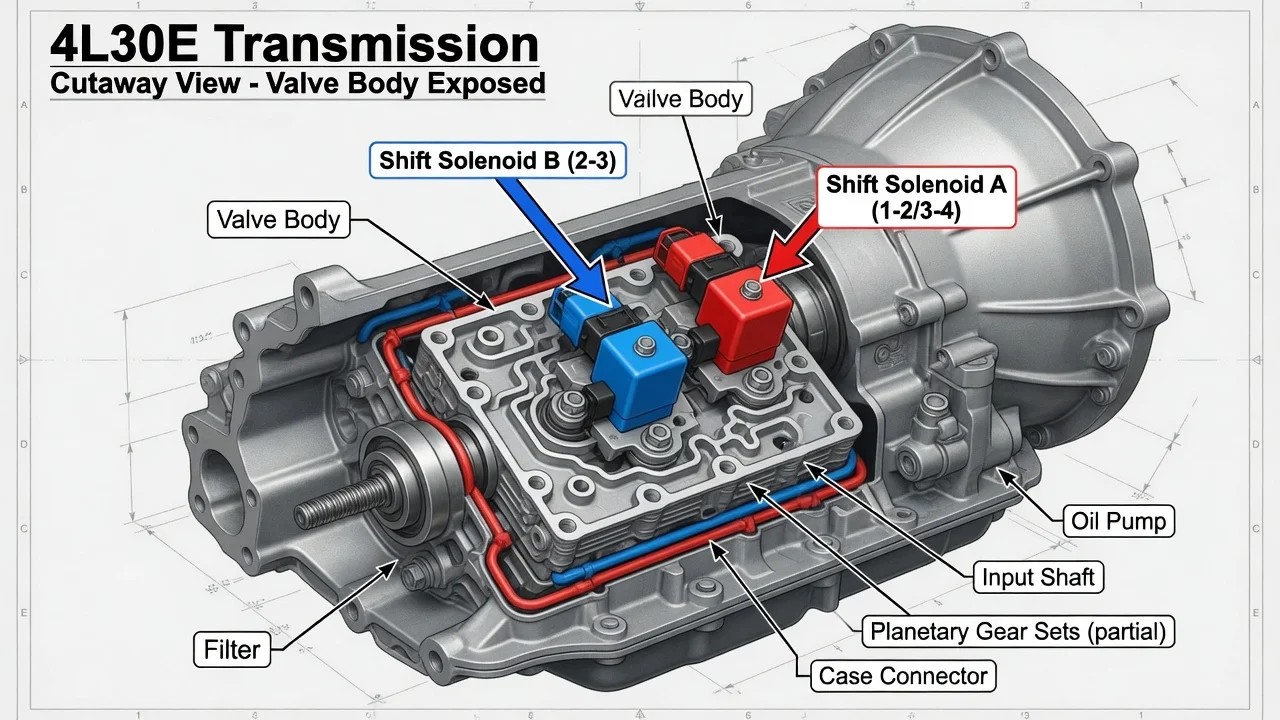
On the 4L30E, the shift solenoids are not mounted on the outside of the case. They sit inside the transmission, attached to the valve body at the bottom of the unit, behind the oil pan. This four-speed automatic was fitted to rear-wheel-drive and four-wheel-drive vehicles from several brands, so access, wiring and service details depend on the vehicle. Here is what to expect before you drop the pan.
Where the shift solenoids sit
Remove the transmission oil pan and the shift solenoids are on the valve body, which is bolted to the underside of the case. The 4L30E uses two on/off shift solenoids, usually called shift solenoid A and B or 1 and 2. They work alongside other electrical parts on the valve body, such as a pressure control force motor and a torque converter clutch solenoid. These components share an internal wiring harness that runs to a connector on the outside of the transmission case, where the vehicle harness plugs in. On some applications the filter may need to come out before you can reach every solenoid or its retaining hardware.
You cannot inspect or replace a shift solenoid without draining fluid. From outside you can reach only the case connector and the wiring leading to it, and that is where an electrical check usually starts. Confirm the exact solenoid positions, identification and retaining hardware in the service information for your vehicle. The layout drawing is the only reliable way to tell one solenoid from another before you unplug anything.
How the solenoids control shifts
The transmission control module, or the powertrain module on some vehicles, decides when to shift. It uses inputs such as vehicle speed, throttle position and engine load, then switches the shift solenoids on or off. Each solenoid opens or blocks a hydraulic passage in the valve body. The combination of their states moves shift valves, which route fluid to the clutches and bands for the selected gear. The shift solenoids do not apply clutches directly. They work as electrically controlled switches for hydraulic signals.
The pressure control device manages line pressure, which affects shift firmness, and the converter clutch solenoid controls lockup. This matters for diagnosis. Harsh or soft shifts are not automatically a shift solenoid problem. A wrong-gear or no-shift condition can also come from wiring, the control module, fluid condition, a sticking valve or internal wear. If the module loses control of the solenoids, the transmission generally falls back to a fixed default gear so the vehicle can still be driven gently. Confirm which gear that is in the service information.
What changes the answer
Start by confirming the transmission type. The 4L30E is a General Motors design that appeared in several makers' vehicles, including various BMW models, Isuzu and Honda SUVs, the Cadillac Catera and Opel models. Some of these vehicles were also offered with other automatics, depending on year, engine and market. Check the identification tag on the case or the vehicle's build data rather than assuming from the model name.
Configuration changes the job more than it changes where the solenoids are. On four-wheel-drive Isuzu and Honda applications, a transfer case sits behind the transmission, and you may need to deal with crossmembers, exhaust parts or skid plates before the pan comes off. BMW applications route wiring differently and use their own diagnostic software and fault descriptions. Model year also matters. Earlier vehicles may rely on manufacturer-specific diagnostics, while later OBD-II vehicles can store generic diagnostic codes such as P0750 or P0755 for shift solenoid A or B circuits, along with manufacturer codes. Fluid specification, pan gasket type, bolt torque and solenoid fitment can differ between applications. A part listed for one 4L30E vehicle is not automatically correct for another.
What the owner can do first
Gather evidence before draining anything. Read stored and pending codes with a scan tool that can access the transmission module, not just generic engine codes, and note any freeze-frame data. Record the shift behavior: which shifts are missing or late, whether the problem appears cold or hot, and whether it is constant or intermittent. Check fluid level and condition using the procedure for your vehicle. Some applications require a specific temperature or a check-plug method rather than a simple dipstick reading. Review the service history for recent fluid changes, wiring repairs or earlier solenoid work.
Next, inspect the external connector and harness at the transmission case for damage, corrosion, loose pins or fluid contamination. If the service information gives resistance or circuit values, you can test through the connector without removing the pan. That helps separate a wiring problem from an internal one. A circuit code means there is an electrical fault somewhere in that circuit. It does not prove the solenoid has failed.
If testing points inside the transmission, support the vehicle safely, drain the fluid and remove the pan. Inspect the pan contents and filter before touching the valve body. Note the connector positions, release the solenoid you are replacing, and install the new part with the correct fitment and seals. Fit a new pan gasket or sealant as specified and tighten the bolts to the specified torque. Refill with fluid that meets the correct specification, verify the level by the vehicle's procedure, and confirm shift behavior on a test drive.
Limitations and next step
This is the general layout of the 4L30E, not a substitute for the diagram and specifications for your exact vehicle. Solenoid identification, test values, torque figures, fluid type and fill procedure all come from the manufacturer's service information. Guessing at any of them can turn a simple repair into a larger one. Heavy debris in the pan, burnt fluid, slipping or delayed engagement point to mechanical wear, and a new solenoid is unlikely to fix that.
Consider professional help in any of these cases: codes return after a repair, the problem is intermittent and wiring checks are inconclusive, your scan tool cannot reach the transmission module, or the pan contents suggest internal damage. A transmission shop can run module-level tests and command individual solenoids. It can then recommend a repair based on evidence rather than the symptom alone, whether that is a wiring fix, solenoid replacement, valve body service or overhaul.