Third-Generation Ram Adjustable Control Arms: Fitment and Selection
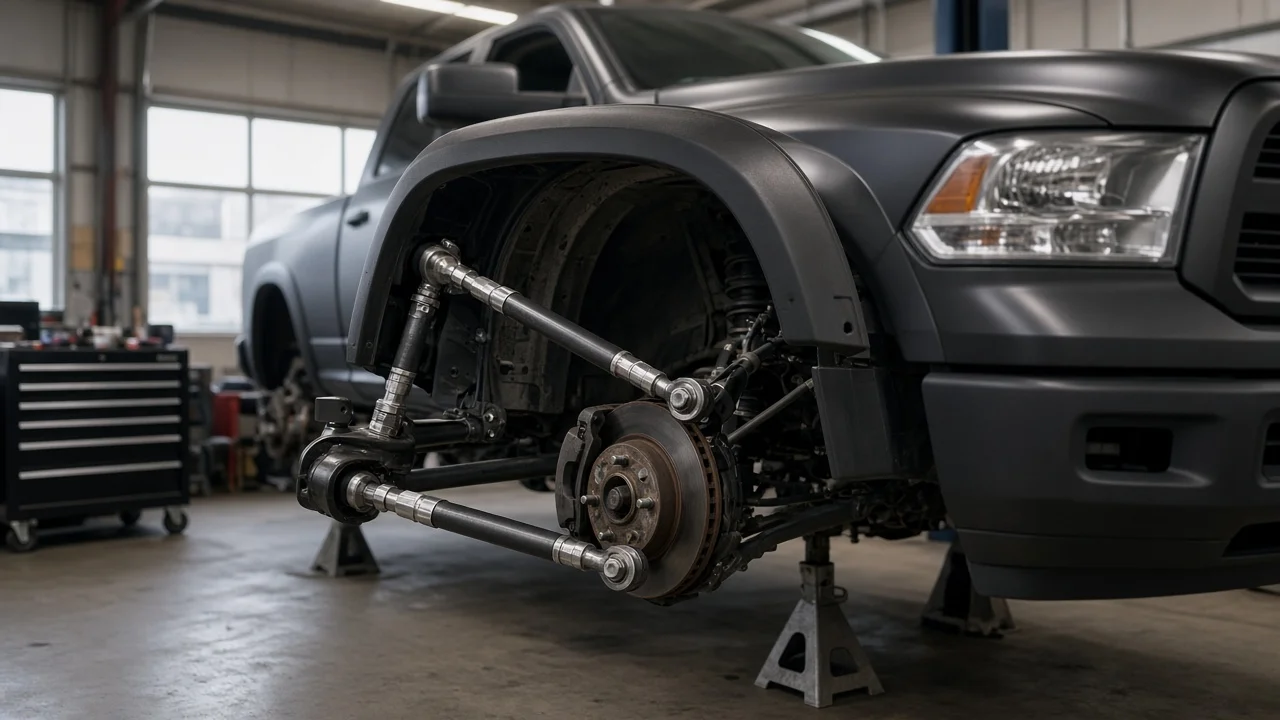
Adjustable control arms let a third-generation Ram owner correct front-end geometry after a lift, a leveling kit or worn factory arms have changed it. They are not a universal upgrade. Whether they help depends on which front suspension your truck has, how much ride height you have added and how you drive. This guide explains how to match 3rd gen Ram adjustable control arms to the truck, which features matter and what owning them involves.
Define the job the arms must do
Start with the problem you are solving. On solid-axle Ram 2500 and 3500 trucks, raising the front changes the angles of the factory links. That rotates the axle and typically reduces caster. Reduced caster can show up as light, wandering steering and a wheel that is slow to return to center. Adjustable arms let you change link length so the axle can be rotated back toward the specified caster range during a wheel alignment. Fixed-length aftermarket arms built for a specific lift can do a similar job if your lift matches their design, but they leave no room for fine-tuning.
Next, be clear about how the truck is used. A truck that tows heavy trailers and mostly stays on pavement benefits from quiet, low-maintenance joints and conservative geometry. A truck that sees trails, mud or rock needs articulation, ground clearance and joints that tolerate contamination. If the truck is at stock height and the factory arms are simply worn, replacement arms or new bushings may solve the complaint without adding adjustability you will never use. Before comparing products, note your lift or leveling height, tire size, typical load and budget.
Check compatibility with your Ram
The third generation covers roughly the 2002 to 2008 Ram 1500 and the 2003 to 2009 Ram 2500 and 3500, and suspension design differs within that span. Four-wheel-drive heavy-duty trucks use a solid front axle located by upper and lower control arms plus a track bar, and this is where adjustable arms are most common. The Ram 1500 uses independent front suspension, where aftermarket upper arms are usually sold to correct ball joint angle after leveling rather than to reposition an axle. Two-wheel-drive and special-edition trucks can differ, so confirm the front suspension on your own truck by inspection or from its build information rather than by model year alone. The rear of these trucks rides on leaf springs, so control arm kits are a front-end purchase.
Once the platform is confirmed, check the interfaces. The arm ends must match the bolt diameter and bracket width at the frame and axle mounting points, and the kit should state whether it reuses factory hardware or supplies its own. Confirm the intended lift range; many kits list a minimum and maximum, and extending an arm past the maker's thread-engagement limit is unsafe. Look for clearance notes covering brake lines, steering components, aftermarket bumpers and skid plates. If you run a particular lift kit, read its instructions, because some lifts already include arms or specify which arms work with them.
Features that affect the choice
Joint type has the biggest effect on how the truck feels. Rubber and polyurethane bushings are closest to the factory feel and isolate vibration, although polyurethane can squeak without lubrication. Spherical joints and rod ends allow free movement and precise location but transmit more noise and vibration into the cab and wear faster when exposed to grit. Many manufacturers use proprietary flex joints that fall between the two; judge them on rebuild parts availability and service instructions, not on the brand name. Some kits mix joint types, with a compliant joint at one end and a rotating joint at the other.
Adjustment design matters during setup. A single-adjuster arm usually has to be disconnected at one end to change length, while a double-adjuster arm with opposing threads can be turned in place, which makes caster fine-tuning easier. Check how the adjuster locks: a jam nut and a clear minimum thread-engagement guideline are basic expectations. For construction, the useful details are material, tube diameter and wall thickness or solid bar, joint housing design and weld quality. Labels such as heavy-duty or extreme are marketing; published dimensions, materials and a clear warranty are evidence. Greaseable joints, protective boots and corrosion-resistant coatings add value where roads are salted or wet.
Limitations and ownership costs
Adjustable arms do not fix every lift-related problem. On a solid axle, rotating the housing to restore caster also changes the front pinion and driveshaft angle, so the final setting is a balance rather than an independent adjustment. Lifting also shifts the axle sideways, which is corrected with a track bar, not control arms. Worn tie rod ends, a loose track bar, tired ball joints or loose steering gear mounts can cause wander that no control arm will cure, so check joint play across the front end before blaming geometry.
Installation requires proper vehicle support. Work on level, solid ground, chock the wheels and hold the frame and axle on rated jack stands, never on a jack alone. On solid-axle trucks, replacing one arm at a time helps keep the axle from shifting unexpectedly. Set each arm to the starting length given in the kit instructions, and final-tighten bushed joints with the truck at ride height so the bushings are not preloaded. Use the fastener specification from the arm maker or factory service information rather than guessing torque values, and schedule a professional alignment afterward.
Plan for recurring costs. Joints with grease fittings need periodic lubrication, bushings and rod ends eventually wear out, and fasteners and jam nuts should be rechecked after the first drives and at intervals the maker recommends. Budget for an alignment after installation and another whenever you later change tires, ride height or other suspension parts.
Build a practical shortlist
Narrow the field with a checklist before comparing prices. Confirm the arms are listed for your model, drive configuration and front suspension type. Match the stated lift range to your actual ride height. Choose single or double adjusters based on how often you expect to fine-tune. Pick joint types that suit your mix of towing, commuting and off-road driving. Compare published materials, tube dimensions and joint sizes rather than product labels.
Then weigh support and total cost. Favor kits that publish installation instructions, starting lengths and fastener guidance, sell rebuild components separately and state a clear warranty. Check whether a kit covers upper arms, lower arms or both, and whether your lift also calls for an adjustable track bar. Finally, include installation labor and alignment in the comparison, because an inexpensive set of arms can cost more over time if its joints are hard to service or replacement parts are unavailable.