3.6 Pentastar Serpentine Belt Diagram for Jeep and Chrysler
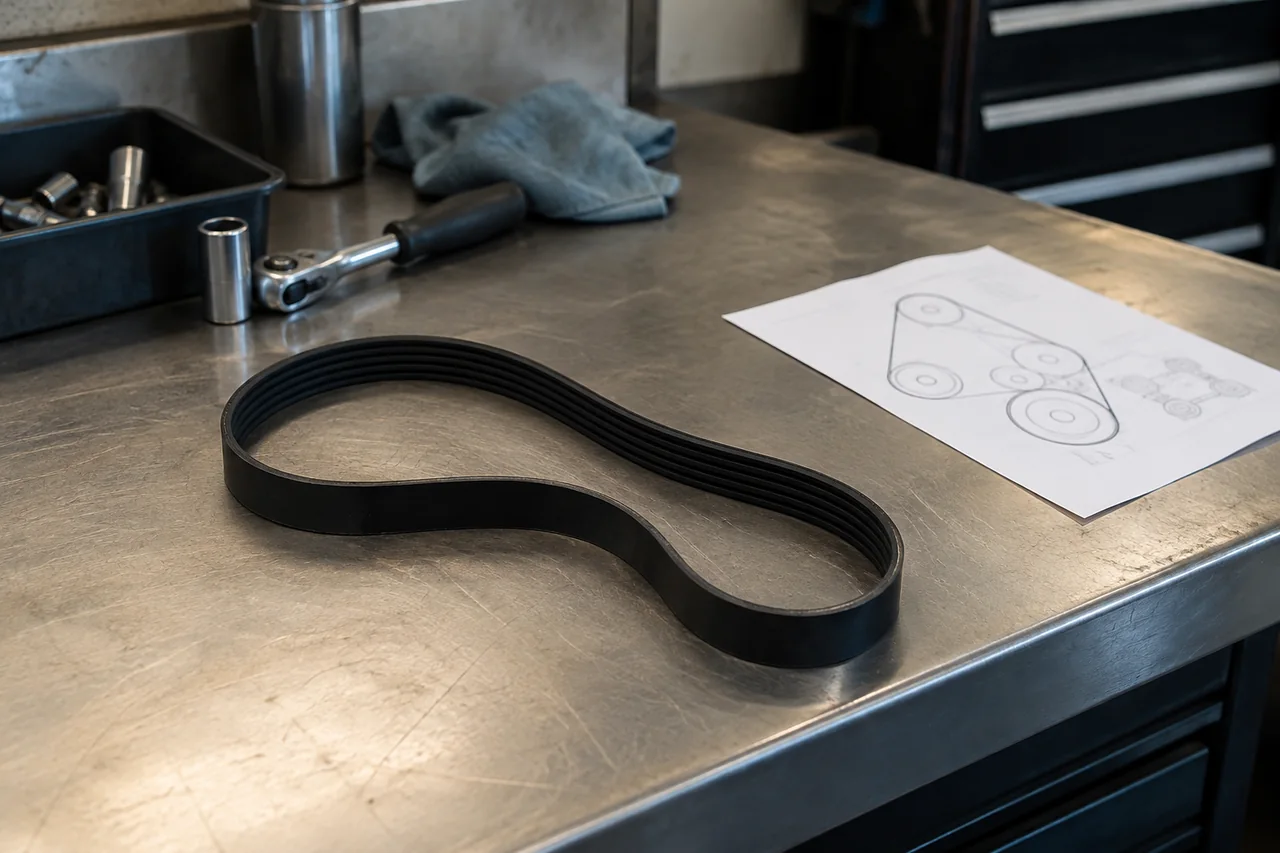
A 3.6 Pentastar serpentine belt diagram shows how the accessory drive belt wraps around that V6. Owners looking for a serpentine belt for Jeep Grand Cherokee still have to confirm routing and belt fitment through engine identification, model year, and accessory layout. Use the matching belt routing diagram, then inspect wear, confirm the replacement, and verify the path after installation.
Confirm the Grand Cherokee Has the 3.6 Pentastar
The Jeep Grand Cherokee has used more than one engine family, so a model name does not tell you which serpentine belt Jeep Grand Cherokee routing applies. Start with the model year and engine identification on the underhood label, build sticker, or service records. Confirm the 3.6 Pentastar V6 rather than assuming every Grand Cherokee shares the same accessory drive. Accessory configuration also matters: air conditioning, a second idler pulley, or a different tensioner package can change the path even when the engine family is the same.
When you request a routing diagram or a replacement accessory drive belt, have the year, make, model, engine, and VIN ready so the lookup can match belt fitment instead of a broad Grand Cherokee listing. Note whether the vehicle is a Jeep or a related Chrysler application with the same 3.6 Pentastar, because those platforms do not automatically share one belt. A parts counter or service writer still needs the engine code and any catalog notes about options. That information is what separates a useful diagram from a picture that only looks similar.
Find and Read the Correct 3.6 Pentastar Belt Diagram
Look first for an underhood belt routing diagram, often on a radiator support, fan shroud, or nearby label. If that sticker is missing, faded, or hard to read, obtain service information matched to the VIN and 3.6 Pentastar rather than a random internet image. Follow the continuous belt path from the crankshaft pulley through each labeled accessory, idler pulley, and belt tensioner until the loop closes. The diagram is a map of contact points, not a suggestion, so every wrap must correspond to a pulley shown for that specific application.
A 3.6 Pentastar serpentine belt diagram also shows which pulleys take the ribbed belt surface and which are a smooth pulley. Ribs typically drive grooved accessories, while the back of the belt often rides a flat idler or tensioner face; confirm that relationship against the applicable drawing instead of assuming a pattern. Jeep and Chrysler 3.6 Pentastar installations do not share one universal route. Accessory layout, pulley count, and tensioner placement can differ, so an unverified diagram from another vehicle can put the belt on the wrong pulley or reverse rib contact.
Check Replacement Belt Fitment Before Ordering
Replacement selection for a Jeep Grand Cherokee serpentine belt must follow model year, the confirmed 3.6 Pentastar, and any catalog-listed configuration notes, not a one-size listing. Belt length and rib count have to match the drive that the parts catalog assigns to that vehicle, and the part number should be confirmed against those fields before you order. Do not treat a nearby year or a similar Chrysler 3.6 as interchangeable without that confirmation. Catalog footnotes about air conditioning or extra idlers exist because those details change the belt the engine actually uses.
Markings printed on the installed accessory drive belt can be a useful starting reference, but they still need fitment verification. A prior owner may have installed the wrong length, a different rib count, or a belt intended for another 3.6 Pentastar layout. A listing labeled only for Jeep Grand Cherokee is not enough to confirm the correct belt, because that name covers multiple engines and accessory packages. Match the replacement to the same identifiers you used for the routing diagram: year, engine, VIN, and the catalog's configuration line, not the model name alone.
Recognize Belt Wear and Know What Symptoms Cannot Prove
Arrange inspection if the accessory drive belt shows fraying, missing rib material, glazing, or fluid contamination from oil or coolant. Those conditions reduce grip and can accelerate wear on the belt tensioner and nearby pulleys. Squealing, chirping, or belt damage can involve tension, pulley alignment, contamination, or pulley condition, so sound alone cannot identify the failed part. Treat noise as a reason to inspect the whole drive, not as proof that only the belt needs replacement.
Limit owner observations to an engine that is off and fully cool, and keep hands and tools away from belts, fans, and pulleys that can move. Do not probe a running drive to locate a chirp. If the belt is displaced or broken, temperature climbs, or a charging warning appears, stop safely and arrange assistance. The accessory drive can affect cooling and charging, so a lost serpentine belt for Jeep Grand Cherokee use is a reason to stop, not a reason to keep driving.
Plan Belt Replacement Around the Verified Routing
Plan replacement around confirmed belt fitment and the applicable 3.6 Pentastar serpentine belt diagram, then decide whether access or special tools call for a technician. Photograph the existing belt path before removal; that picture can help you compare wraps to the verified diagram, but it cannot prove the current installation is correct. A previous misroute can look orderly while still skipping an idler pulley or riding the ribbed belt surface on a smooth pulley. If the photo and the official routing disagree, follow the vehicle-specific diagram, not the belt already on the engine.
The belt tensioner stores spring force, and access around the 3.6 Pentastar can be tight, so improvised tools and unfamiliar procedures are a poor substitute for the correct method. If you cannot unload the tensioner without crowding fans or the radiator, schedule the work with a shop. During replacement, have pulley condition, pulley alignment, and contamination checked so a seized idler, a leaking accessory, or a cocked tensioner is not left to ruin the new belt.
Verify Routing and Investigate Problems After Replacement
Before startup, confirm that the final belt path matches the vehicle-specific 3.6 Pentastar serpentine belt diagram and that the belt is fully seated in every groove. Ribs should sit in grooved pulleys without hanging off an edge, and the back of the belt should track on each smooth pulley without twisting. After a brief, safe observation from a distance, a belt that walks off a pulley or slaps an idler needs shutdown and another comparison to the routing diagram.
Persistent noise, belt wandering, or fresh edge damage after a correctly specified belt is installed is a reason for further inspection, not another belt off the shelf. Pulley, tensioner, and accessory testing may be needed to find a bearing that is dragging, a tensioner that cannot hold alignment, or an accessory that loads the drive unevenly. Maintenance timing should follow the applicable vehicle guidance and the belt's observed condition. There is no single replacement interval that covers every Jeep Grand Cherokee serpentine belt, every Chrysler 3.6 Pentastar, and every climate or duty cycle.