2025 Ford F-150 Shift Lock Release: What to Check When It Won't Leave Park
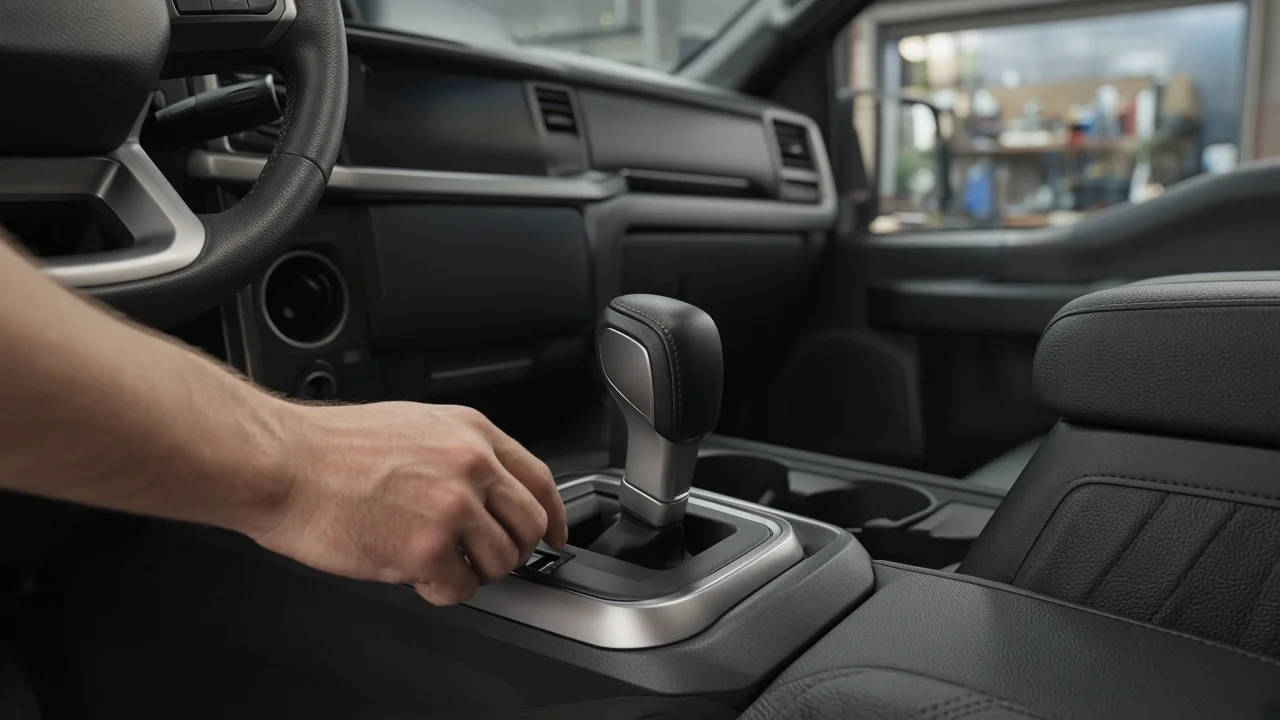
When a 2025 F-150 refuses to come out of Park, the transmission itself is rarely the first suspect. Usually the brake-shift interlock is blocking the request because a condition has not been met. The right release method depends on your powertrain, your shifter style and whether the 12-volt system has power. This guide explains how the interlock works, what changes the answer and what you can safely check before calling for help.
The short answer
Don't assume your truck has the small pry-slot override that many older mechanical shifters had beside the lever. Current F-150 shifters send an electronic request to the transmission. Any release or neutral procedure for your truck is described in the owner's manual for that specific build, and it may differ from what you have seen on older pickups or videos of other model years.
In most cases the truck stays in Park because one of three conditions is missing. The ignition must be fully on, not just in accessory mode. The brake pedal must be pressed firmly enough to register. The 12-volt system must supply enough voltage for the modules to act. Check those three things first. If the truck has to be moved while it cannot be powered, follow the manual's guidance for neutral or towing. Do not force the lever.
How the shift interlock works
The interlock is a permission check. The brake pedal switch tells the truck's control modules that your foot is on the brake. The ignition state tells them the vehicle is in run mode. Once both signals are present, the system lets the transmission release the park pawl, a mechanical lock inside the automatic transmission that holds the output shaft. On a shift-by-wire design, the lever or control you touch is essentially a switch. No cable runs from it to the transmission, so pulling harder on the lever cannot overcome the lock and can only damage the shifter.
Electronic shifters also add logic that a mechanical lever never had. Depending on configuration and conditions, the system may return the transmission to Park automatically, for example when the engine is switched off or certain door and seatbelt conditions suggest the driver is leaving. If the truck refuses a request, the instrument cluster usually shows a message explaining why. Read that message before doing anything else. It often names the missing condition directly.
What changes the answer
Transmission type comes first. Gas-engine F-150 models and the PowerBoost hybrid use a 10-speed automatic, with the hybrid version integrating an electric motor. The F-150 Lightning is a battery-electric truck with a different drive system, so its procedures come from its own documentation. Shifter style matters too. Depending on trim and seating, the truck may have a column-mounted lever or a console-mounted lever, and some console versions fold away. Each layout can have its own instructions for neutral, towing and power loss.
Operating conditions change the answer as well. A weak or dead 12-volt battery can stop the system from responding at all, and this applies to the hybrid too, because its high-voltage battery does not power the modules that handle the shift request. Cold weather, recent battery replacement and aftermarket accessories wired into the brake lamp circuit, such as trailer brake controllers or auxiliary lighting, can all disrupt the signals the interlock relies on. Towing rules also differ between two-wheel-drive and four-wheel-drive trucks and by transfer case type, so check your specific configuration before moving the truck with any wheels on the ground.
What the owner can do
Start with simple observations. Put the truck fully into run mode, press the brake pedal hard and hold it, then try the shifter again. Check whether the brake lights come on, either with a helper or by looking at their reflection in a garage door or window. Note every message on the cluster. If the truck cranks slowly, the screens flicker or the modules seem to reboot, treat low voltage as the likely problem. Charge or jump-start the battery using the jump points and steps shown in the owner's manual.
If the brake lights stay dark while the pedal is pressed, the problem probably sits somewhere in the brake pedal signal path, such as a fuse, the pedal switch or its wiring. That is a symptom, not a confirmed failed part. A scan tool that can read Ford module data will show stored diagnostic codes and the live brake switch status, and that narrows the cause before anyone buys parts. If a part does turn out to be faulty, confirm the replacement's fitment against your truck's build rather than matching by appearance.
If the truck must be moved before it is repaired, use only the neutral or tow procedure your manual describes for your shifter and drivetrain. When in doubt, a flatbed is the safest option. Dragging a truck that is locked in Park can damage the park pawl, the transmission and, on four-wheel-drive models, the transfer case.
Signs that point beyond the interlock
A truck that leaves Park normally but then shows unusual shift behavior has a different problem. Harsh engagement, delayed engagement into Drive or Reverse, flare between gears or a transmission warning message are not shift lock symptoms. They call for their own diagnosis. Transmission fluid condition and level, the correct fluid specification for your transmission and the truck's service history all become relevant then, along with any stored codes. Keep these issues separate. Fixing a brake switch will not cure a shift quality complaint, and a fluid service will not unlock a truck whose interlock never receives a brake signal.
Limitations and next step
This article cannot confirm the exact release procedure for your truck, because the details depend on trim, shifter, powertrain and software level. The owner's manual for your vehicle, or a dealer looking up its build, is the authoritative source. Depending on its in-service date and mileage, a 2025 F-150 is likely still within factory warranty coverage. A dealer visit also lets a technician check for applicable recalls or service updates that affect shifter or module behavior.
Your repair options depend on what the checks reveal. A fully discharged battery may need only charging or replacement. A brake signal fault or a shifter that keeps refusing requests with good voltage should be diagnosed with proper scan equipment, either at a dealer or at an independent shop that can communicate with Ford modules. If the truck is stuck somewhere unsafe or you cannot confirm the correct towing method for your configuration, call roadside assistance instead of improvising.