2019 Kia Sorento Shift Lock Release: How to Use It and Why the Shifter Sticks
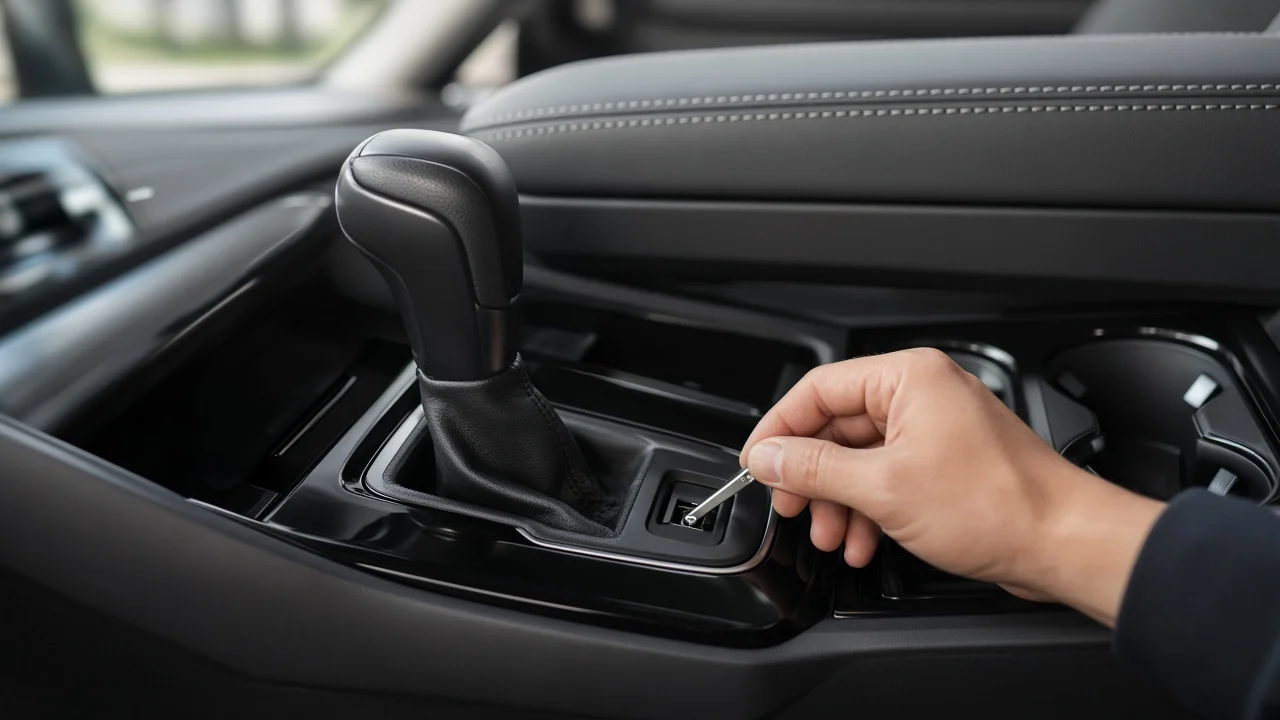
If the shifter on your 2019 Kia Sorento won't come out of Park even with the brake pedal pressed, the shift lock release lets you move it by hand so the SUV can be put in Neutral and moved. It overrides the lock but does not fix whatever caused it. This guide covers how to use the release, how the interlock works, what differs between Sorento configurations, and how to track down the cause without guessing at parts.
The short answer
On a 2019 Sorento with the conventional console shifter, the manual release is an access hole next to the shift lever. It is usually hidden under a small removable cap in the shifter trim. The general sequence is as follows. Park on level ground if you can and set the parking brake firmly. Put the ignition in the position your owner's manual specifies. Gently pry off the cap and insert a small flat-blade tool or similar into the opening. Press down on the tool and, with your foot on the brake, move the lever out of Park. Then remove the tool and refit the cap. The exact cap location and ignition position for your vehicle are in the shift lever section of the owner's manual, and that wording takes priority over any general description.
Use the release only to move the vehicle, for example to load it onto a flatbed or roll it out of a garage. It is not a normal way to drive. If the lever will only leave Park with the override, the interlock is either not receiving the signal it needs or cannot act on it. Diagnose that before the Sorento goes back into daily use.
How the shift interlock works
The interlock keeps the lever locked in Park until two conditions are met: the ignition is in the correct state and the brake pedal is pressed. A switch at the brake pedal reports pedal position. On many vehicles, including Kia models, the same switch circuit also feeds the brake lights and other systems. When the pedal signal arrives, a small solenoid in the shifter assembly pulls a lock pin out of the way and the lever can move. With the ignition on, you can often hear a faint click from the console when you press the pedal.
The manual release pushes that lock mechanism aside directly and bypasses the solenoid. It does not touch the transmission. So a lever stuck in Park points to the interlock circuit or the shifter, not to an internal transmission fault. Even so, a stuck lever alone does not prove which component has failed.
What changes the answer on your Sorento
The 2019 Sorento was sold with more than one engine, and the transmission type depends on the engine. Most US models paired the four-cylinder with a six-speed automatic and the V6 with an eight-speed automatic. Confirm yours from the owner's manual, the window sticker or a VIN decode. The release itself belongs to the console shifter assembly, so the transmission rarely changes how you use it. It does matter if diagnosis goes beyond the interlock, because fluid specification, service procedures and some parts differ between gearboxes. Confirm the fitment of any replacement part, such as a shifter assembly or brake switch, by VIN rather than by model year alone.
Conditions can make a lever seem locked when the interlock is working. Parking on a steep slope puts the vehicle's weight on the parking pawl, and the lever can then be very hard to pull out of Park even after the lock releases. That is not a shift lock fault. Press the brake firmly, make sure the parking brake is set, and in future set the parking brake before shifting into Park on a hill. A weak or dead battery is another case. The solenoid needs power, so when the vehicle will not power up, the manual release is often the only way to get the lever into Neutral.
What the owner can do
Start with simple observations. Have someone watch the brake lights while you press the pedal. If they stay dark, the brake light switch, its circuit or the stop-lamp fuse becomes a likely area to check, though not yet a confirmed failure. Look for related clues. On push-button start models, the engine may not start because the car does not detect the brake pedal. Cruise control may refuse to engage, or a warning may appear on the dash. If the brake lights work normally but the lever stays locked, the problem is more likely on the shifter side, such as the solenoid, its connector, its wiring or the signal that controls it.
Check the console for spilled drinks or debris around the shifter, since contamination can interfere with the lock mechanism. If the vehicle drives normally once released, note its shift behavior. Normal upshifts and downshifts suggest the issue is limited to the interlock. Read diagnostic codes with a scan tool that can access body and transmission modules, because a basic engine-code reader may miss relevant faults. Review the service history and ask a Kia dealer to check your VIN for open recalls or service campaigns. Depending on what testing confirms, repair options range from a fuse or brake switch to repairing the solenoid wiring or replacing the shifter assembly.
Limitations and next step
This guide describes the general approach, not the exact factory procedure for every trim. Rely on your owner's manual for cap location, tool and ignition position. If the lever still won't move while the release is held down, stop rather than forcing it. Forcing can break the lock pin, the trim or the shifter. The cause may be a binding cable or mechanism that the override cannot overcome. Before moving the vehicle in Neutral, follow the manual's towing guidance. All-wheel-drive versions generally should be carried on a flatbed instead of towed with wheels on the ground.
Get professional help if the brake lights are not working, because that is a safety problem and should be fixed before the vehicle is driven. Also seek help if the lever needs the override every time, or if you cannot isolate the cause with the checks above. A technician can view the brake switch signal in live scan data, check power and ground at the shift lock solenoid, and confirm the correct parts for your configuration before replacing anything.