2017 Ford Fusion Shift Lock Release
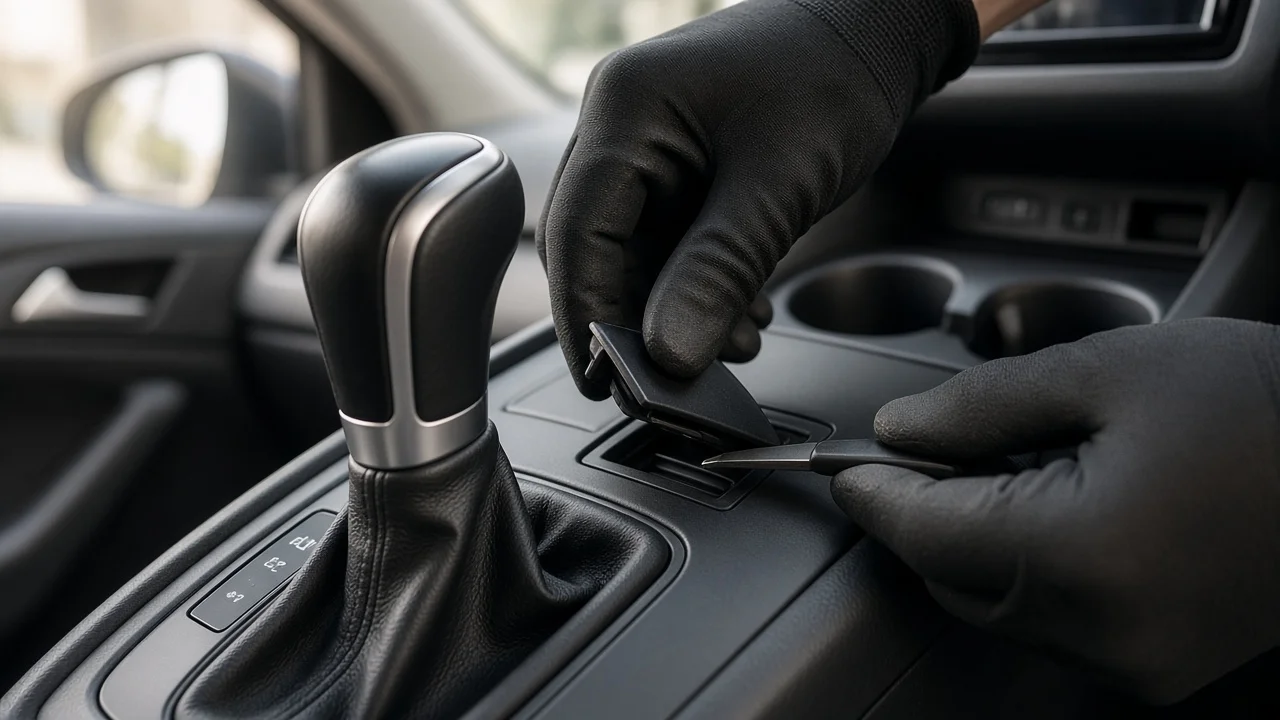
If your 2017 Ford Fusion won't come out of Park, the shift lock release is the built-in override that lets you move the selector without the normal brake-pedal signal. How you use it depends on whether your car has a console lever or the rotary gear dial. Using the override only gets the car moving or ready to tow. It does not tell you why the lock stayed engaged.
The short answer
On a 2017 Fusion with a traditional console shift lever, the shift lock release is a manual override built into the shifter assembly. Start by setting the parking brake firmly and switching the ignition off. Then find the small access cover in the console trim beside the lever and remove it. Push a narrow tool, such as a small flat screwdriver, into the opening to press the release. Hold the release down while you move the lever out of Park. The owner's manual for your car shows where the cover is and the order of steps. Read it before prying on trim, because a misplaced tool can crack clips or scratch the console.
Many 2017 Fusions have the rotary gear selector dial instead. The dial is an electronic switch, not a mechanical linkage, so there is no slot beside it that unlocks the transmission. Shifting out of Park on these cars depends on electrical power and on the control modules accepting the request. If the car is dead or the system will not respond, the owner's manual describes the approved way to put the transmission in Neutral for towing or moving. On shift-by-wire Fords this can involve a dedicated manual park release. Follow that procedure exactly rather than improvising.
How the shift interlock works
On a lever shifter, a small electric solenoid controls a blocking piece at the base of the lever. With the ignition on, pressing the brake pedal makes the brake pedal switch send a signal. The solenoid then pulls the block away, and the lever can leave Park. If any link in that chain fails, the lever stays locked even though the transmission itself may be fine. The manual release moves the blocking piece by hand, bypassing the electrical side. A cable connects the lever to the transmission's range selector, and the parking pawl inside the transmission is what actually holds the car still.
On the rotary dial, the brake signal, ignition state and other inputs go to the electronics. The electronics then command an actuator at the transmission to move it into or out of Park. Depending on conditions, these cars can also return to Park automatically, for example when the engine is switched off. That is why a weak battery or a module communication problem can make a dial-equipped Fusion act as though the shift lock is stuck. It is also why the design has no mechanical override at the console.
What changes the answer on your car
First, establish which shifter your car has, because that decides the whole procedure. Trim and options determine whether a 2017 Fusion has a console lever or the rotary dial, so look at the console rather than assuming from the model year. The transmission type also differs. Gasoline models use a six-speed automatic, while the Hybrid and Energi use an electronically controlled continuously variable transaxle. The interlock principle is similar across them, but wiring, module behavior and towing guidance are not identical, so follow the manual section for your powertrain. Fluid specification and fluid level have little to do with a shift lock that will not release, so a fluid change will not fix this problem.
Operating conditions matter as well. On a steep slope, the car's weight can load the parking pawl so heavily that the lever or actuator struggles to move it, even when the interlock works. A discharged battery leaves both shifter types unable to release normally. Service history is another clue. Each of these points the diagnosis in a different direction: a recent battery replacement, console or trim work, an aftermarket remote starter or other added wiring, or earlier shifter repairs. It is also worth asking a dealer to check open recalls and service campaigns by VIN, since coverage is tied to the individual vehicle.
What you can check and do
Before forcing anything, gather a few simple observations. Have a helper stand behind the car while you press the brake pedal, and check whether the brake lights come on. If they do not, the brake pedal switch circuit or a fuse becomes a strong suspect, though that is still not a confirmed diagnosis. Note whether the instrument cluster lights up normally, whether the engine starts, and whether any warning or shifter message appears. With a lever, listen for a faint click from the console when you press the brake with the ignition on. A click suggests the solenoid is at least receiving a signal. Also recall whether the problem started on a hill, in cold weather, or after a spill in the console, since sticky drink residue can bind a lever mechanism.
Then work through low-risk actions in order: 1) Press the brake pedal firmly before every attempt with the shifter. 2) If the battery may be weak, charge it or jump-start the car, following the steps in the owner's manual. 3) Check the relevant fuses using the fuse box legend in the manual. 4) If the lever still will not move, use the manual shift lock release as described above. On a dial car, use the manual's park release procedure instead. Once the car is out of Park, keep the parking brake applied whenever you are not actively moving it. In the future, set the parking brake before selecting Park on a slope, which keeps the car's weight off the pawl.
Getting out of Park is only the first step. A scan tool that can read body and transmission or shifter module data, not just engine diagnostic codes, gives a much better picture, especially on rotary dial cars. Codes and live data for the brake switch input, shifter position and module communication can separate a wiring or switch fault from a solenoid, actuator or software issue. Repair options range from replacing a switch or fuse to repairing a cable or the shifter assembly. Confirm parts fitment by VIN, because parts differ between lever and dial cars and between powertrains.
Limitations and the next step
This article gives the general approach, not the exact steps for every 2017 Fusion. The owner's manual for your car is the authority on the release location, the dial-equipped park release, towing limits and jump-starting. On the Hybrid and Energi, the high-voltage system calls for extra care around wiring and components, and work near it is best left to someone trained for it.
Using the override to move or tow the car is reasonable, but driving around on it long term is not. If the brake pedal switch is the cause, the same fault can affect the brake lights, which is a safety issue for traffic behind you. Have the car towed to a dealer or a transmission-capable shop instead of driving it if any of these apply: • The override does not work. • The shifter feels loose or disconnected. • The car will not hold in Park. • A dial car shows shift system warnings. Bring your observations and service history so the technician can start from evidence instead of guesses.