2016 Hyundai Tucson Wastegate Actuator: Identification
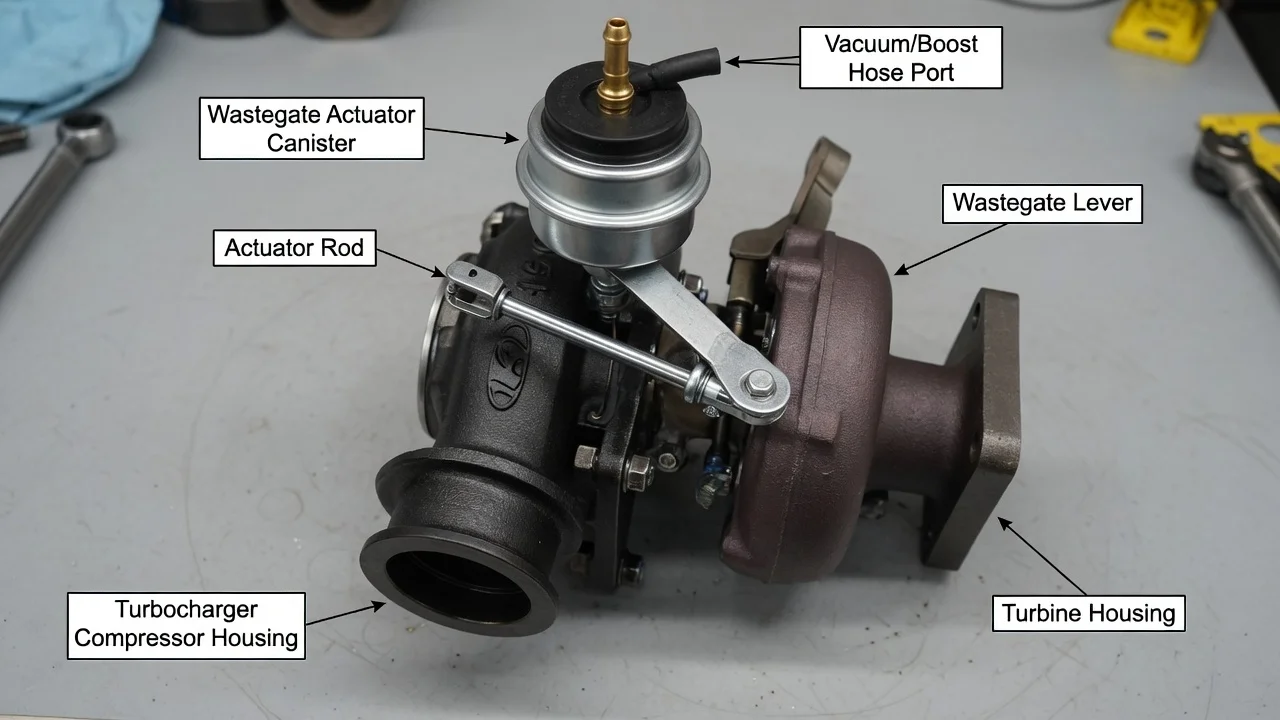
If you are trying to find or identify the wastegate actuator on a 2016 Hyundai Tucson, start with your engine. Only turbocharged versions have a wastegate, so the answer depends on your vehicle configuration. This guide explains how to tell whether your Tucson has one, what the part does, how to recognize it under the hood, and when a VIN-based parts lookup or a professional inspection is the better route.
Does Your 2016 Tucson Have a Wastegate Actuator?
In the US lineup, the 2016 Tucson was offered with two gasoline four-cylinder engines: a naturally aspirated 2.0-liter and a turbocharged 1.6-liter. Only the 1.6-liter turbo uses a wastegate, so only those vehicles have a wastegate actuator. The turbo engine was paired with the Eco, Sport and Limited trims, while the base SE used the 2.0-liter. Trim is a useful clue but not proof, because listings can be inaccurate and badges can be swapped or removed.
To confirm the engine, check the emissions label under the hood, which lists engine displacement, or have a Hyundai parts counter run your VIN. The original window sticker and many registration documents also state the engine. If your Tucson has the 2.0-liter engine, there is no wastegate actuator to find, and any part sold under that name will not fit your vehicle.
How the Wastegate and Its Actuator Work
A turbocharger is driven by exhaust gas flowing through its turbine. Without a way to limit that flow, boost pressure would keep rising as engine speed and load increase. The wastegate is a small valve in the turbine housing that lets part of the exhaust bypass the turbine, which caps boost at the level the engine computer wants. The actuator is the device that opens and closes that valve, usually through a rod connected to a lever on the turbocharger.
Turbo engines in general use one of two actuator designs. A pneumatic actuator is a round diaphragm canister with a hose attached, and its movement is controlled by pressure or vacuum, often regulated by a separate solenoid. An electronic actuator contains a motor and position sensor in a housing with an electrical connector and no hose. Hyundai's 1.6-liter turbo family of this period is commonly described as using electronic wastegate control, but the reliable way to know what your engine has is to look at the part itself.
What Changes the Answer
Engine choice is the deciding factor. Front-wheel or all-wheel drive and the transmission do not determine whether a wastegate actuator exists, although they can affect which parts catalog entries apply to your vehicle. Vehicles built for markets outside the US may have different engines entirely, so an imported or grey-market Tucson should be checked by VIN rather than by US trim names.
Service history matters too. If the turbocharger was replaced, the installed unit may be a remanufactured or aftermarket assembly whose actuator looks different from the original. Depending on the parts catalog, the actuator may be serviced only as part of the turbocharger assembly or offered separately, so do not assume a standalone part is available until a lookup confirms it.
Finally, identifying the actuator does not mean it is the cause of a problem. Low boost can also come from intake or charge pipe leaks, sensor faults, restrictions or the turbo itself, and operating conditions such as heat, altitude and load affect how symptoms appear.
What the Owner Can Do
With the engine off and fully cooled, locate the turbocharger on the exhaust side of the engine. Heat shields may partly cover it, so a flashlight and mirror help. Look for a component mounted on or beside the turbo with a rod or linkage running to the wastegate lever. An electrical connector and wiring harness indicate an electronic actuator; a hose and a canister indicate a pneumatic one. If a label or part number is visible, photograph it and bring it to the parts counter along with your VIN.
Record what you notice before any repair visit: whether the check engine light is on, any stored codes, reduced power or a limp mode, and noises such as a rattle from the turbo area at cold start or when lifting off the throttle. Generic codes such as P0299 for underboost, P0234 for overboost or P0045 for the boost control circuit are often associated with boost control faults, but the exact codes depend on the fault and the engine computer's logic. Noting when symptoms occur, such as cold or hot, cruising or under load, gives a technician useful starting information.
Avoid forcing the linkage, adjusting the rod, applying power directly to an electronic actuator or disconnecting it with the engine running. These actions can damage the unit or set additional faults. Some electronic actuators also need a calibration or learn procedure with a scan tool after replacement, which is part of the reason this job is often left to a shop.
Limitations and Next Step
This article can help you recognize the part, but it cannot confirm the exact component on your vehicle or diagnose a fault. Torque values, calibration steps, diagnostic procedures and manufacturer specifications must come from Hyundai service information matched to your VIN. There is no universal replacement interval for a wastegate actuator, and it is not a routine item on the maintenance schedule; it is replaced when inspection and testing show it has failed.
A practical next step is to confirm your engine, photograph the turbo area and have the codes read. A dealer can also check your VIN for open recalls, service campaigns or remaining warranty coverage. If boost-related codes or power loss are present, a technician can compare commanded and actual wastegate position and boost pressure with a scan tool, which separates an actuator fault from leaks, sensors or turbocharger problems before any parts are ordered.