Identifying a 2015 Chevy Impala Pressure Control Solenoid
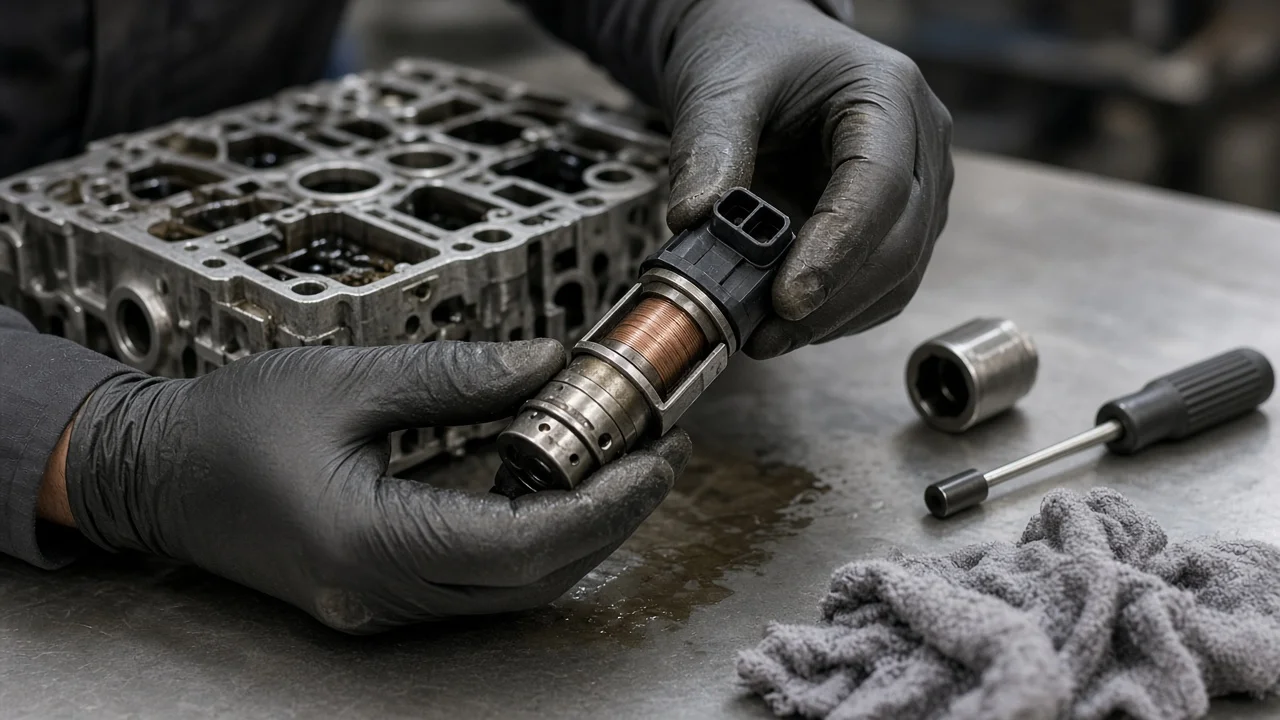
Your 2015 Chevy Impala may have a scan tool code for a pressure control solenoid, or the transmission may be shifting harshly, slipping or holding a single gear. Either way, the first job is to identify exactly which transmission and solenoid assembly the car has. This guide explains where the pressure control solenoids are, how they work, what changes the diagnosis, and what you can check before paying for parts. A code points to a circuit or a pressure problem. It does not prove that a solenoid has failed.
The short answer for the 2015 Impala
Most 2015 Impalas use a GM six-speed automatic from the 6T70 family. That covers the redesigned full-size car with either engine and the carryover Impala Limited, which was sold mostly to fleets. In this transmission the pressure control solenoids are not separate parts you can unplug from the outside of the case. They are built into the control solenoid valve body, an assembly that also contains the transmission control module. It sits inside the transmission behind a side cover.
This has two practical consequences. First, you identify the part by confirming the transmission type and the part number of the control solenoid body assembly, not by matching a single solenoid. Second, the usual repair replaces the whole assembly, which must then be programmed to the vehicle. Before ordering anything, check the Service Parts Identification label in the car or run a VIN-based parts lookup. Calibration and fitment are tied to the exact vehicle, not just the model year.
How pressure control solenoids work
An automatic transmission shifts by applying and releasing clutches with hydraulic pressure. The transmission control module decides when to shift based on vehicle speed, throttle position, engine load and fluid temperature. It then sends electrical commands to the pressure control solenoids, which regulate how much pressure reaches the main line and each clutch circuit. By varying the current to a solenoid, the module controls how quickly and firmly a clutch applies. That is what you feel as shift quality.
The 6T70 uses several pressure control solenoids alongside on/off shift solenoids. Diagnostic codes identify each solenoid by a letter or number. Some solenoids regulate line pressure, and others control individual clutches during shifts. The module sets a code when it sees an electrical fault in a solenoid circuit, or when a commanded shift does not happen as expected. It may also command a default gear to protect the transmission. That default mode explains a common symptom of solenoid-related faults: the car feels stuck in one gear, accelerates weakly and runs at high engine speed on the highway.
What changes the diagnosis
The diagnostic codes matter more than the symptom. Codes in roughly the P0960 to P0971 range and the P2714 to P2730 range generally relate to pressure control solenoids. The solenoid each code refers to, and its exact meaning, must be read from GM service information for your transmission. Electrical codes such as circuit open, low or high point toward wiring, connectors or the electronics inside the assembly. A performance or stuck-off code means the module saw the wrong result. A solenoid can cause that, but so can low or degraded fluid, a sticking valve, worn clutches or internal leaks.
When the fault appears also matters. A fault that shows up only when the transmission is cold, only after a long drive, or only after the battery was disconnected points in different directions. Low system voltage and poor battery or ground connections can set transmission codes on cars with electronic transmission control. After battery replacement or module work, the transmission may need to relearn its adaptive shift values. Harsh shifts during that period are not necessarily a failure.
Service history is the third variable. A unit with original fluid at high mileage behaves differently from a well-maintained one. So does a unit that had a recent fluid service with the wrong fluid or level, or previous valve body work. This transmission calls for Dexron VI or an equivalent licensed fluid. The owner's manual and service information confirm the fluid specification and capacity for your car.
What the owner can do
Start by gathering information rather than buying parts. Read and record all stored diagnostic codes with a scan tool that can access transmission data, including codes in other modules, and note whether each one is current or history. Write down the shift behavior in detail: which gear the car seems stuck in, whether shifts are harsh or delayed, whether the problem appears hot or cold, and which warning lights or messages appear. This record helps a technician tell an electrical fault from a hydraulic one.
Next, check the basics that commonly cause or mimic solenoid codes. Make sure the battery is healthy and the terminals and grounds are clean and tight. Look under the car for fluid leaks. The 6T70 has no conventional dipstick. Fluid level is checked at a check plug with the transmission at a specified temperature, so an accurate check usually requires a scan tool to read fluid temperature and the correct procedure. Overfilling or underfilling during an improvised check can create new shift problems.
If testing points to the control solenoid body assembly, compare your repair options. You can replace the assembly with a new or remanufactured unit programmed to the car, repair wiring or connector faults if any are found, or overhaul the transmission if it has internal mechanical damage. Ask the shop how it confirmed the diagnosis and how the replacement assembly will be programmed.
Limitations and next step
General guidance cannot confirm which solenoid, circuit or component has failed in a specific car. Code definitions, solenoid identification, wiring tests, the fluid check procedure and programming steps all depend on the exact transmission build and calibration. Vehicle-specific service information is the reference for any repair. A replacement assembly that is not correctly matched and programmed may not work properly, even if it looks identical to the original.
Get a professional diagnosis if the transmission is in a default gear, slipping, shuddering, overheating or setting multiple codes, and limit driving until it is checked. Driving with slipping clutches can turn a valve body or electrical repair into a full rebuild. Bring your recorded codes and symptoms. Ask whether any technical service bulletins or software updates apply to your VIN, since they can change both the diagnosis and the cost.