2014 Ford Escape Shift Lock Release: How to Get Out of Park
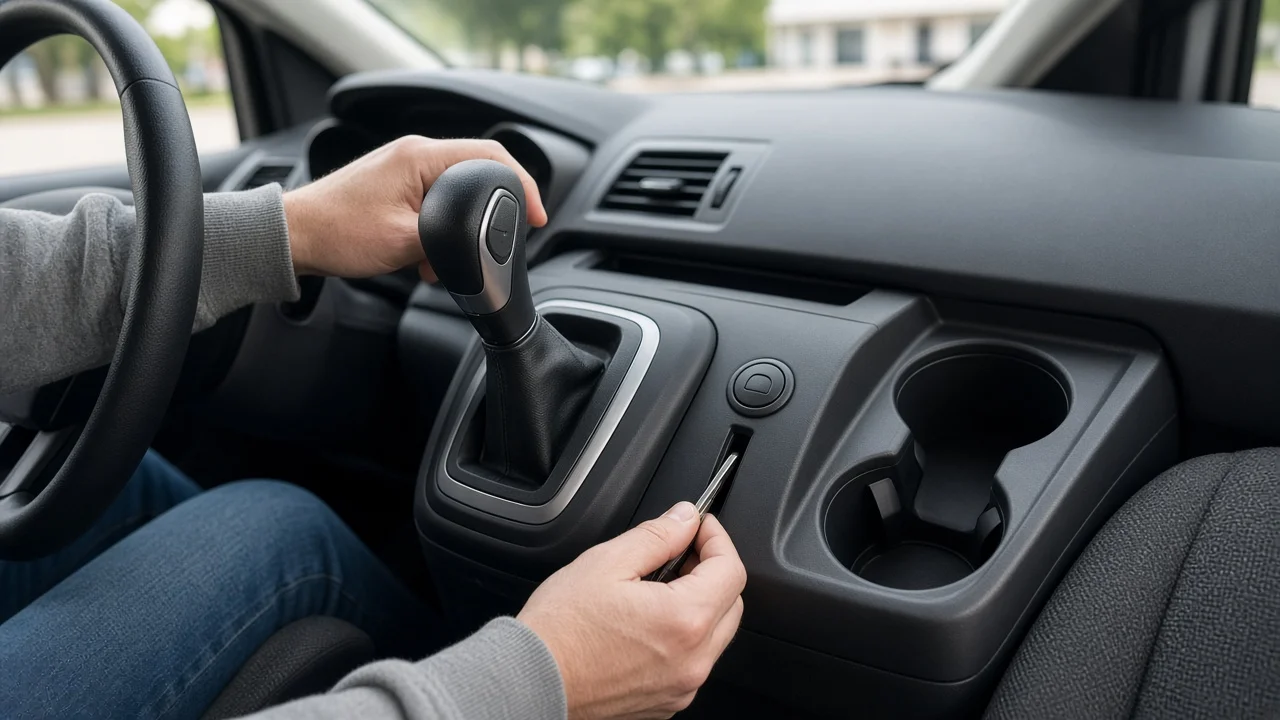
When a 2014 Ford Escape won't come out of Park, the shift lock release lets you move the selector by hand so the vehicle can be pushed, loaded for towing, or inspected. It is a temporary override, not a repair. This guide explains how the release relates to the Escape's six-speed automatic, what changes the procedure, what you can check yourself, and when the problem needs a technician.
Short answer: using the shift lock override
The 2014 Escape uses a brake-shift interlock. With the ignition on, the selector stays locked in Park until the brake pedal is pressed. If pressing the brake does not free the lever, use the manual override. The general sequence is: set the parking brake firmly, chock the wheels if there is any slope, and switch the ignition off. Then remove the small cover or trim piece near the shift lever that exposes the override access point. Insert a thin flat tool, press down and hold it, and move the lever to Neutral while pressing the brake. Refit the cover afterward. The exact access point and the order of steps are shown in the owner's manual for your vehicle. Confirm them there rather than prying at console trim by guesswork.
The override only bypasses the lock. If the lever moves normally once the override is held, the fault is most likely in the interlock side of the system. If the lever will not move even with the override engaged, or it moves but the transmission does not follow, the problem is somewhere else. Forcing the lever in that situation can break the shifter assembly or the cable.
How the Escape's brake-shift interlock works
The shifter assembly contains an electrically controlled solenoid that physically blocks the lever in Park. When the ignition is on and the brake pedal switch reports that the brake is applied, the solenoid changes state and frees the lever. The same brake pedal switch also controls the brake lamps, so a switch fault often shows up as brake lights that don't work. A cable connects the lever to the transmission's range selector. Inside the transmission, a parking pawl locks the output when Park is selected.
Because the lock depends on electrical power and a correct brake signal, several things can leave the lever stuck even when the transmission is healthy. These include a weak battery, a blown fuse, a failed switch, or an open circuit. The override is a mechanical path that lifts the block directly. That is why it works without power, and why it tells you nothing on its own about which component failed.
What changes the answer
Configuration matters. The 2014 Escape was sold with the 2.5-liter engine and the 1.6- and 2.0-liter EcoBoost engines. Each was paired with a six-speed automatic, in front-wheel or all-wheel drive. Depending on trim, it has either a keyed ignition or push-button start, and the manual words the ignition steps differently for each, so follow the version that matches your vehicle. Drivetrain matters once the lever is in Neutral. Towing rules differ between front-wheel and all-wheel drive, and all-wheel-drive models generally should not be moved any distance with wheels on the ground. Check the towing section of the manual before anyone hooks up the vehicle.
Operating conditions can mimic an interlock failure. On a steep slope, the vehicle's weight can bind the parking pawl, making the lever very hard to pull out of Park even when it is unlocked. Setting the parking brake before shifting into Park helps prevent this. Liquid spilled into the console can make the shifter mechanism sticky. Electrical changes can also disturb the brake signal, such as aftermarket trailer wiring, incorrect brake lamp bulbs, or recent console or battery work.
What the owner can do
Start with checks that need no tools. Have a helper confirm the brake lights come on when you press the pedal. If none work, the brake pedal switch, its fuse, or its wiring becomes a likely suspect, though only testing confirms it. Look at battery condition: a dim instrument cluster, slow cranking, or a no-start points to low voltage. With the ignition on, listen near the shifter while pressing the brake. A faint click suggests the solenoid is receiving a command. Silence points toward the signal or power side. Also look for signs of a spill around the shifter boot.
A scan tool that shows live data can confirm whether the powertrain control module sees the brake pedal being pressed. Interlock problems do not always set diagnostic codes, so a clean scan does not clear the system. Ask a Ford dealer to check for open recalls or service campaigns using your VIN. Avoid relying on the override day to day. Every time you return to Park, the lever locks again. A shifter that leaves Park without the brake pressed is a safety concern that should be repaired promptly.
Write down what you observe before visiting a shop. Note whether the brake lights work, whether there is a click, and whether the problem is constant or intermittent. Also record any recent service history involving the battery, console, or lighting. This shortens diagnosis and helps avoid replacing parts on a guess.
Limitations and when to get help
Symptoms in this system overlap, so a stuck lever does not by itself identify the failed part. See a qualified technician in any of these cases: the lever will not move even with the override, the gear indicator does not match the selected position, a transmission warning appears, or shift behavior changes once driving. Also get help if brake lights and battery check out but the lock persists. A technician can measure switch input, solenoid power and ground, and cable adjustment. Repair options range from replacing a brake pedal switch to replacing the shifter assembly or cable. Confirm part fitment by VIN, since components can differ across trims and build dates.