Choosing Transmission Cooler Lines for a 2014 F-150
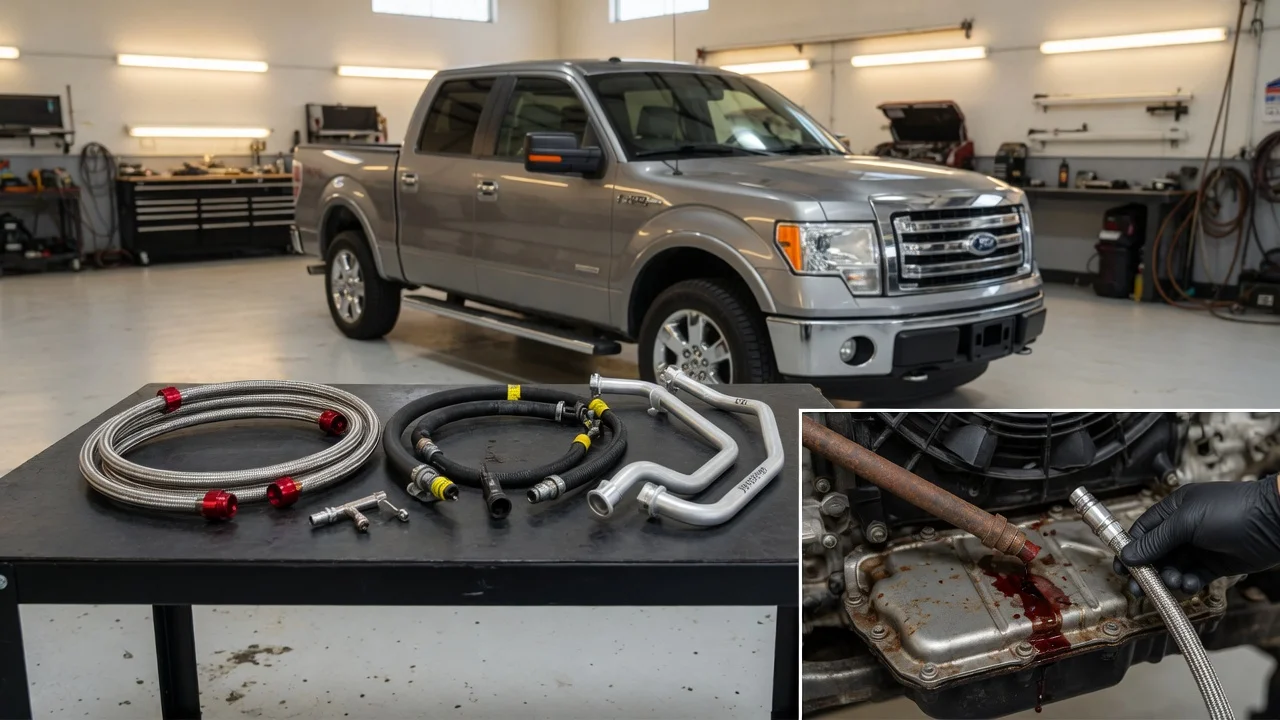
Transmission cooler lines on a 2014 Ford F-150 carry hot fluid from the transmission to the cooler and back. When they rust, crack or weep at a fitting, the truck can lose fluid faster than many owners expect. Choosing replacements depends less on brand names than on matching the routing, end fittings and cooler setup on your truck. This guide covers how to define the job, confirm fitment, compare options and plan the work.
Define the job the product must do
Start by confirming that the lines are actually the problem. Wetness near the front of the transmission or the radiator can come from a cooler line, the cooler itself, a quick-connect fitting, the transmission case or pan area, or even engine oil and coolant blown backward by airflow. Clean the area, bring the truck up to operating temperature and look for fresh, red-tinted fluid along the line path. On older trucks, especially in road-salt regions, the crimped joints where steel tubing meets rubber hose are worth close inspection. Still, a wet line near a leak is a symptom, not proof that the line is the failed part. Trace the leak to its highest wet point before ordering anything.
Next, decide what the repair needs to achieve. You might be replacing one leaking section, renewing the complete supply and return set because both are corroded, or restoring lines on a truck that tows or plows and runs hot fluid regularly. Your climate, your access to a lift and whether you plan to do the job yourself or hand it to a shop all affect which product makes sense. If shift behavior has already changed, such as slipping, flaring between gears or delayed engagement, note it now. That points to a fluid-level check and a scan for stored diagnostic codes as part of the job, not just a parts purchase.
Check compatibility
Automatic 2014 F-150s use the 6R80 six-speed transmission, but that does not mean one set of cooler lines fits every truck. Routing can differ by engine, including the 3.7L V6, 5.0L V8, 3.5L EcoBoost and 6.2L V8. It can also differ between 2WD and 4x4 trucks and depending on whether the truck has a factory auxiliary transmission cooler, which is often tied to towing equipment. Confirm your transmission type and configuration from the build label or a VIN decode. A listing that says only that it fits a 2014 F-150, with no engine or cooler notes, is not enough to rely on.
Then check the interfaces. The lines connect to the transmission and the cooler with quick-connect style fittings, so confirm whether the replacement includes the correct ends and any retaining clips, or whether you must transfer them from the old part. Supply and return lines are often sold separately, so make sure you order the side you need, or both. If possible, compare the new part against the removed one for bend count, overall length, bracket locations and hold-down clips. A parts counter that looks up by VIN is the most reliable way to confirm fitment before you buy.
Features that affect the choice
Replacement options generally fall into three groups. Factory-style pre-bent assemblies match the original routing most closely and usually install with the least fuss. They may cost more, and they may repeat the original steel-and-rubber design that failed on your truck. Aftermarket direct-fit lines are often cheaper, but bend accuracy and fitting quality vary, so compare product photos and fitment notes against your own lines. Universal repair kits splice new hose into the existing steel sections. They can be a reasonable fix for a localized leak, but only with hose rated for transmission oil cooler service, such as hose meeting SAE J1532, and fittings rated for the fluid's pressure and temperature. Fuel hose, heater hose and generic clamps are not substitutes.
Be skeptical of marketing labels like heavy duty, upgraded or OEM quality when nothing backs them up. Useful evidence includes the stated tubing material and coating, the hose standard, the type of end fitting, included brackets and clips, fitment notes that name the engine and cooler configuration, and clear warranty and return terms. Stainless or well-coated steel resists corrosion better in salt-belt climates. Braided outer covers protect against abrasion but can hide deterioration of the inner hose, so they still need periodic inspection.
Limitations and ownership costs
New cooler lines restore a sealed fluid path, and that is all they do. If the truck ran low on fluid for a while, internal wear may already have occurred, and fresh lines will not reverse it. Lines also cannot fix a leaking cooler. On trucks where the cooler is built into the radiator, an internal failure can mix coolant and transmission fluid, which points to a radiator or cooler replacement and a fluid flush rather than a line repair.
Plan for the full job, not just the part. Expect some fluid loss, so have a drain pan, quick-connect disconnect tools and line wrenches ready. You may also need to remove splash shields or a skid plate on 4x4 trucks. The refill must meet the fluid specification for the 6R80, which is Motorcraft Mercon LV or an equivalent that meets that specification. This transmission has no conventional under-hood dipstick, and the level is checked at the transmission at a specified fluid temperature, so some owners leave that step to a shop. Budget for fluid, possible replacement clips and labor if you are not doing the work yourself. Inspect the remaining lines while you are in there, since one rusted section often means others are close behind. Record the repair in your service history.
Build a practical shortlist
Before comparing prices, run each candidate through a short checklist. Confirm the VIN, engine, drive type and whether the truck has an auxiliary cooler. Identify exactly which line or section is leaking and whether you need the supply line, the return line or both. Check that the bends and ends match your original part and that fittings and clips are included or reusable. Choose a material suited to your climate and, for repair kits, use only transmission-cooler-rated hose and fittings. Add the correct fluid and the tools needed for disconnection and the level check. Finally, read the warranty and return policy so a fitment mismatch does not leave you stuck with the part.
Your repair options then come down to replacing a single section, installing a complete set, or having a shop handle the lines and the fluid service together. After the repair, drive the truck and recheck for leaks. If shift behavior is still abnormal or diagnostic codes return, have the transmission diagnosed rather than ordering more parts.