2013 Ford F-150 Transmission Output Speed Sensor Location
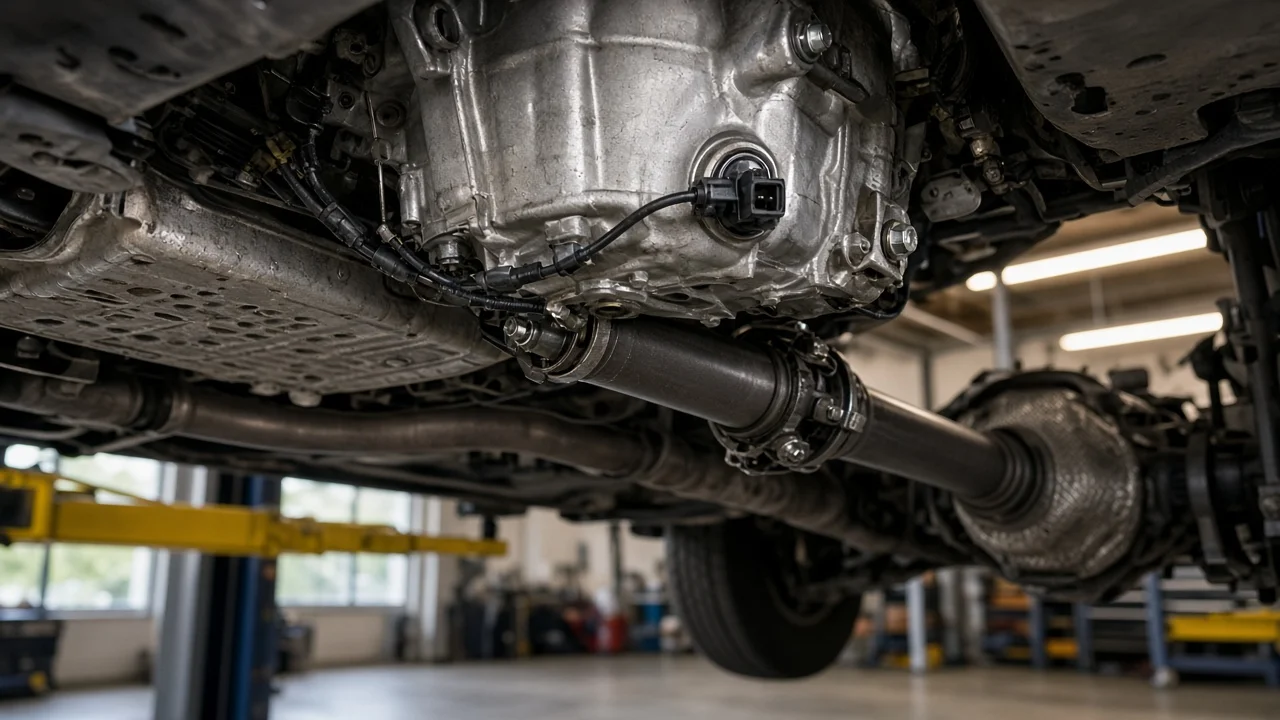
On a 2013 Ford F-150, the transmission output shaft speed sensor is not a bolt-on part you can unplug from under the truck. The 6R80 six-speed automatic used in this model year places it inside the transmission case, on the internal wiring assembly attached to the valve body. This guide covers where it is, how it works, what can change the answer for your truck, and what to check before you buy parts.
Where the output speed sensor is located
The 2013 F-150 used the 6R80 six-speed automatic with all of its engines: the 3.7L V6, 5.0L V8, 3.5L EcoBoost and 6.2L V8. In this transmission, the output shaft speed (OSS) sensor is internal. It is built into the internal harness, commonly called the lead frame. The lead frame also carries the turbine shaft speed sensor and the transmission fluid temperature sensor. It sits on the valve body inside the transmission pan.
Reaching the sensor means draining the fluid, removing the pan and, in most cases, removing the valve body to get the lead frame out. The sensor is usually serviced as part of the lead frame assembly, not as a separate component. Confirm the correct part and fitment with a VIN-based parts lookup. Before you start, check that your truck still has its original 6R80. The transmission identification tag on the case or the build information tied to the VIN will tell you. Do not confuse the transmission sensor with the wheel speed sensors at each corner or with sensors on the transfer case of a 4x4.
How the output speed sensor works
The OSS sensor reads a toothed or slotted target that turns with the transmission output. It sends a signal to the powertrain control module (PCM), and the frequency of that signal rises and falls with output speed. The PCM compares this reading with turbine shaft speed, which is the speed coming in from the torque converter. From the two values, it calculates the actual gear ratio.
The PCM uses that ratio to confirm each shift completed correctly and to detect clutch slip. It also uses it to time upshifts and downshifts and to control torque converter clutch apply. If the output signal drops out, turns erratic or stops making sense against turbine speed and vehicle speed, the PCM may set a code and change shift behavior. That can include a protective failsafe strategy. Depending on how a given truck calculates road speed, the speedometer may or may not react, so speedometer behavior alone is not a reliable test.
What changes the answer for your truck
The internal location of the OSS sensor is the same on 2WD and 4WD trucks with the 6R80. Four-wheel-drive models add a transfer case behind the transmission. Depending on the unit, the transfer case may carry its own speed sensing. A speed-related code or symptom on a 4x4 therefore needs to be traced to the right component. Wheel speed sensors feed the ABS and stability systems and can produce complaints that look like a transmission speed problem.
Service history also matters. A rebuilt, remanufactured or swapped transmission may already have a newer lead frame, or it may not be the original unit at all. Changes to tire size or axle ratio without recalibration can make calculated vehicle speed disagree with what the PCM expects. That kind of mismatch is not a sensor failure. Any record of previous transmission work, fluid service or wiring repairs helps narrow the diagnosis.
Codes and symptoms that point toward the sensor
Output speed sensor faults are normally logged as diagnostic codes in the P0720 to P0723 range. These cover circuit faults, range or performance problems, no signal and intermittent signal. Turbine speed sensor faults use P0715 to P0718. Because both sensors share the lead frame, codes for both at once are not unusual. Common complaints include harsh or erratic shifts, missed or delayed shifts, sudden downshifts and the transmission holding a single gear in a protective mode.
A code tells you the PCM saw an implausible or missing signal. It does not prove the sensor itself has failed. The same codes can come from a damaged connector at the transmission case, chafed wiring, low or degraded fluid, debris collecting on the sensor, a PCM issue or mechanical slip that makes speeds disagree. Treat the code as a starting point for diagnosis, not as a parts order.
What the owner can do
Start with a scan tool that can read transmission codes and live data, not just generic engine codes. Record the stored codes and freeze frame information before clearing anything. While driving safely or with a helper, watch output shaft speed, turbine shaft speed and vehicle speed together. A signal that drops to zero, spikes or flickers while the truck is moving steadily points toward the sensor circuit. Readings that track smoothly but show ratio errors point more toward slip or another mechanical cause.
Inspect the main transmission connector and nearby harness for damage, corrosion, loose locks or fluid inside the plug. Check the fluid level next. The 6R80 has no dipstick. Level is checked at a check plug with the engine running and the fluid at a specified temperature, which is usually read with a scan tool. The fluid specification for this transmission is Mercon LV. Using the wrong fluid or setting the wrong level can cause shift problems on its own.
If testing points to the internal circuit, the usual repair is replacing the lead frame. That job involves draining the fluid, removing the pan and valve body, installing the new assembly, reassembling to specification and refilling to the correct level. Some shops also reset the transmission adaptive values afterward. Your repair options include doing the job yourself with factory service information, using a general repair shop or using a transmission specialist.
Limitations and next step
This guide covers a 2013 F-150 with its original 6R80 automatic. It cannot confirm that a specific part has failed on your truck. Torque values, fill temperatures, connector pinouts and exact test procedures should come from service information matched to your VIN. Valve body work requires clean conditions and careful handling, because small debris or a misplaced component can create new shift problems.
Get professional help if the pan contains significant metal debris or the fluid is burnt. Do the same if codes return quickly after a lead frame replacement or if live data shows slip alongside the speed codes. These signs suggest internal wear that a new sensor assembly will not fix. A transmission shop can run pinpoint tests, check wiring and PCM inputs, and judge whether a sensor repair or more extensive work makes sense.