Diagnose the Check Engine Light on a 2012 Nissan Versa
The short answer
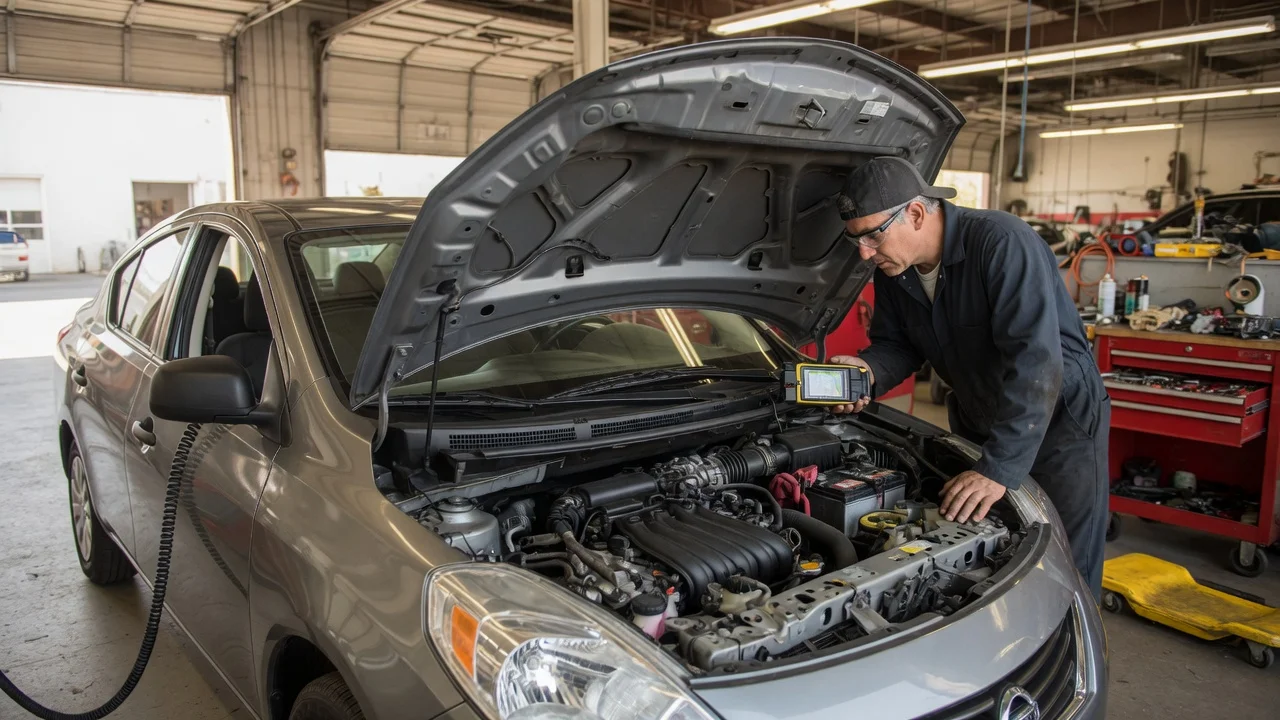
A check engine light on a 2012 Nissan Versa means the engine control module has stored a diagnostic trouble code (DTC). A DTC is a standardized fault code that records a condition the computer considered out of range. The light does not identify a failed part by itself. The first step is to read the stored code with an OBD-II scanner, which plugs into the diagnostic port under the dashboard on the driver's side. The code, together with any symptoms, tells you what to inspect next.
How the light behaves changes what you should do. A steady light usually allows careful driving to a place where the car can be diagnosed. A flashing light usually indicates an active misfire severe enough to overheat and damage the catalytic converter. If the light is flashing, reduce load right away and avoid continued driving where you can.
Which 2012 Versa you have matters
For the 2012 model year in North America, Nissan sold two different Versa platforms at the same time:
Sedan: the redesigned second-generation car, generally fitted with a 1.6-liter four-cylinder engine and either a manual gearbox or a CVT (continuously variable transmission). Hatchback: the carried-over first-generation car, generally fitted with a 1.8-liter four-cylinder engine and a manual, conventional automatic or CVT, depending on trim.
Engine, transmission and sensor layouts differ between these versions, and they may differ again in other markets. Confirm your body style, engine and transmission, which are listed on the vehicle emissions label under the hood or in the registration details, before you use any part-specific repair procedure. This article does not draw on Nissan service bulletins or recall data. Check with a Nissan dealer or recall lookup using your VIN for anything that applies to your specific car.
Step 1: Note the symptoms before reading the code
Write down what the car is doing, because symptoms help separate causes that share a code:
Is the light steady or flashing? Is the engine shaking, idling roughly, hesitating or losing power? Are there unusual smells, such as raw fuel or a sulfur (rotten-egg) odor? Does the transmission slip, shudder or flare in engine speed, or does the car go into a reduced-power mode? Are there other warnings, such as temperature, oil pressure or charging? Did the light appear soon after refueling?
Step 2: Read and record the code
Any generic OBD-II scanner will read the powertrain codes that turn on the light. Many auto parts retailers will also scan a car at no charge. Record every code exactly as shown, including any pending codes and freeze-frame data. Freeze-frame data is a snapshot of engine speed, temperature and load at the moment the fault was set. Do not clear the codes until you have recorded them. Clearing erases this evidence, and the readiness monitors that emissions inspections check will need time to reset.
Some transmission-specific or manufacturer-specific codes may not show up fully on a basic scanner. If the car has a CVT and you have shifting or drivability symptoms, a scan tool that can read Nissan transmission modules gives a more complete picture.
Step 3: Match the code family to the next check
The table below groups common generic OBD-II code families with sensible first checks. These are starting points for investigation, not confirmation that a part has failed. A sensor code, for example, can be caused by wiring, a connector or a separate engine problem that the sensor is correctly reporting.
Code family | What it generally indicates | Reasonable first checks | What a result suggests; P0440 to P0457 (EVAP) | A leak or fault in the evaporative emissions system, which captures fuel vapor | Make sure the fuel cap is present, undamaged and fully tightened; inspect the cap seal | If the cap was loose and the code does not return after several drive cycles, the cap was the likely cause. A returning code points to hoses, valves or the canister and usually needs a smoke test; P0300 to P0304 (misfire) | Random misfire (P0300) or a misfire on a specific cylinder | Check spark plug condition and age, ignition coil connections and any vacuum leaks; swap a coil between cylinders and see whether the code follows it | A misfire that follows the coil implicates the coil. One that stays on the cylinder points to the plug, injector or engine mechanical condition, which may need a compression test; P0171 / P0172 (fuel trim) | The engine is running lean (too much air) or rich (too much fuel) | Look for cracked intake hoses or vacuum leaks, a dirty or contaminated air-flow sensor and exhaust leaks ahead of the oxygen sensor | Lean codes often trace to unmetered air. Rich codes can point to fuel delivery or sensor input problems; P0130 to P0167 (oxygen sensors) | An oxygen or air-fuel sensor signal, heater or circuit fault | Inspect the sensor wiring and connectors near the exhaust for heat damage, and check for exhaust leaks | Heater-circuit codes often involve the sensor or its wiring. Slow-response codes can come from the sensor or from an engine condition; P0420 (catalyst efficiency) | The catalytic converter appears to be storing too little oxygen | Rule out exhaust leaks, misfires and oxygen-sensor faults first | Replacing the converter without fixing an underlying misfire or fuel problem can lead to a repeat failure; P0011 / P0014 and P0335 / P0340 (timing and position) | Valve timing control or crankshaft/camshaft sensor signal faults | Check the engine oil level and condition; inspect the sensor connectors | Low or degraded oil can affect variable valve timing. Persistent timing codes warrant professional diagnosis; P07xx and manufacturer transmission codes | Transmission or CVT control faults | Note any slipping, shudder or overheating behavior; have the transmission fluid condition and level checked by someone with the correct procedure | CVT faults generally need specialist diagnosis rather than parts swapping
Exact code definitions and which codes can set depend on the engine and model year. Confirm the meaning of your specific code against Nissan service information or a reputable code reference for your engine before you buy parts.
When to stop driving or get professional diagnosis
The check engine light is flashing, or the engine is shaking noticeably. You smell raw fuel, or there are signs of a fuel leak. The temperature warning or oil pressure warning is also on. The car has entered a reduced-power mode, or the transmission is slipping or shuddering severely. The same code returns after a repair, or several unrelated codes appear together. The diagnosis requires tests most owners cannot do safely, such as smoke testing, compression testing or reading transmission modules.
After the repair
Once the cause is addressed, you can clear the code. The light may also go out on its own after the fault has not recurred over several drive cycles. Before an emissions inspection, make sure the readiness monitors have completed. A car that has just had its codes cleared can fail inspection even after a correct repair. If the light comes back, scan it again rather than assuming it is the same fault. A new code may point to a different problem.