2012 Hyundai Sonata Turbo Boost Control Position Sensor Location
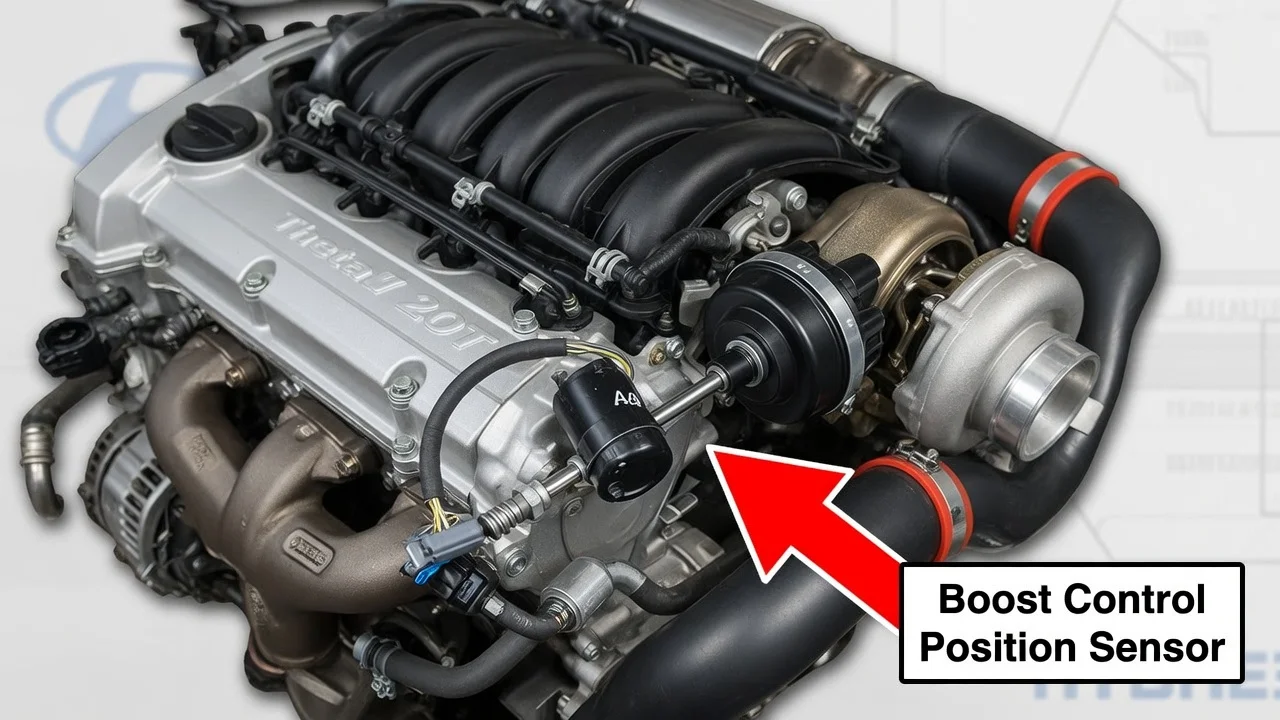
If a scan tool or a parts listing has you hunting for the turbo boost control position sensor on a 2012 Hyundai Sonata, the first step is to confirm what your car actually has. Only one engine in that model year is turbocharged, and the name a code reader gives a component does not always match how Hyundai built the system. This guide explains where to look, how the boost system works, and how to avoid buying the wrong part.
Where to Look on the 2012 Sonata 2.0T
The turbocharged 2012 Sonata is the 2.0T. On that engine, boost is limited by a wastegate on the turbocharger. A pressure-operated actuator opens the wastegate, and the engine computer controls that actuator through a boost control solenoid valve. Owners usually search for a boost control position sensor after a scan tool shows a code with that wording or after reading generic repair content written for many makes. The boost-related electrical parts you are most likely to find on this engine are the boost control solenoid, a boost pressure sensor in the charge-air piping, and the manifold pressure sensor on the intake manifold. Do not assume a separately replaceable wastegate position sensor exists on your car. Confirm it in a parts catalog looked up by your VIN before ordering anything.
To find the parts physically, start at the turbocharger on the exhaust side of the engine. The wastegate actuator is the canister mounted on the turbo housing, and its rod connects to the wastegate arm. Follow the small hose or hoses from that canister to find the boost control solenoid, which has an electrical connector. To find the boost pressure sensor, trace the charge-air piping from the intercooler outlet toward the throttle body and look for a sensor with a connector mounted in that path. The plastic engine cover and some intake ducting may need to come off for a clear view. Let the engine cool fully first, because the turbo and exhaust parts stay hot long after shutdown.
How Boost Control Works on This Engine
Exhaust gas spins the turbine, which drives the compressor that pushes extra air into the engine. Left uncontrolled, boost would keep rising with engine speed and load. The wastegate lets some exhaust bypass the turbine to hold boost at the level the engine computer wants. The computer reads boost and manifold pressure, compares them with its target for the current operating conditions, and pulses the boost control solenoid to change the pressure reaching the wastegate actuator.
Because this is a closed loop, a fault in one part often shows up as a problem somewhere else. A leaking actuator hose, a sticking wastegate, a failed solenoid, a boost leak in the intercooler piping, or a bad pressure sensor can all cause boost readings that differ from the target. A code that names a position sensor or a boost control circuit points to the area of the fault, but it does not on its own prove which part has failed.
What Changes the Answer
Vehicle configuration matters most. The 2012 Sonata was also sold with a naturally aspirated 2.4-liter engine and as a hybrid, and neither of those has a turbocharger or any boost control hardware. If your car is not a 2.0T, a boost-related part listing or code description does not apply to it, and the problem needs to be rechecked with the correct vehicle selected in the scan tool.
Code wording is the second variable. Generic code definitions are written to cover many manufacturers, including diesel and later gasoline engines that do use a position sensor on the wastegate or turbine vanes. A generic scan tool may show that standard description even when the Hyundai-specific meaning describes the boost control circuit differently. A scan tool with Hyundai enhanced data will give a more accurate description and live readings of target versus actual boost.
Parts changes and prior repairs also matter. Part numbers can be superseded, and a car with an uncertain service history may have aftermarket intake parts, boost controllers or a replacement turbo that do not match factory layout. Check for anything non-original before relying on factory locations.
What the Owner Can Do
Start by reading and saving the exact code number, its description and any freeze frame data. Confirm the engine by checking the VIN or the engine label, and note whether the code is current, pending or stored. Then do a visual inspection with the engine cold: look at the vacuum or pressure hoses between the solenoid and the wastegate actuator for cracks, splits or disconnected ends, check the solenoid and sensor connectors for damage, corrosion or loose locks, and inspect the charge-air piping and clamps between the turbo, intercooler and throttle body for oil residue or loose joints that suggest a boost leak.
If the scan tool supports live data, compare desired and actual boost during a safe, legal drive, ideally with a helper reading the screen. A consistent gap between them under load suggests a mechanical or leak problem, while erratic or implausible sensor readings at idle point more toward a sensor or wiring fault. Clear the code only after you have recorded it, and note whether it returns under the same driving conditions.
Avoid replacing parts based on the code name alone. If you buy a sensor or solenoid, order it by VIN and compare the connector and mounting with the part on the car before installing it. If the turbo has had overboost, underboost or limp mode symptoms, limit hard acceleration until the cause is found.
Limitations and Next Step
This guide describes the general layout and logic of the 2.0T boost system. It does not replace the factory service information for your exact car. Connector pin assignments, sensor test values, torque specifications and the official diagnostic procedure for a given code all come from the manufacturer specifications for that VIN, and they should be used before any electrical testing or replacement. No single maintenance schedule interval applies to these parts. They are serviced when testing shows a fault.
If the code returns after the hoses, connectors and piping check out, or if the car goes into reduced power, have a technician with Hyundai-capable diagnostic equipment test the boost control circuit and run the factory procedure. Also ask a dealer to check the VIN for open recalls or service campaigns. Those checks are the most reliable way to confirm which component is at fault and where it is mounted on your car.