Diagnose 2010 Chevy Impala reduced engine power
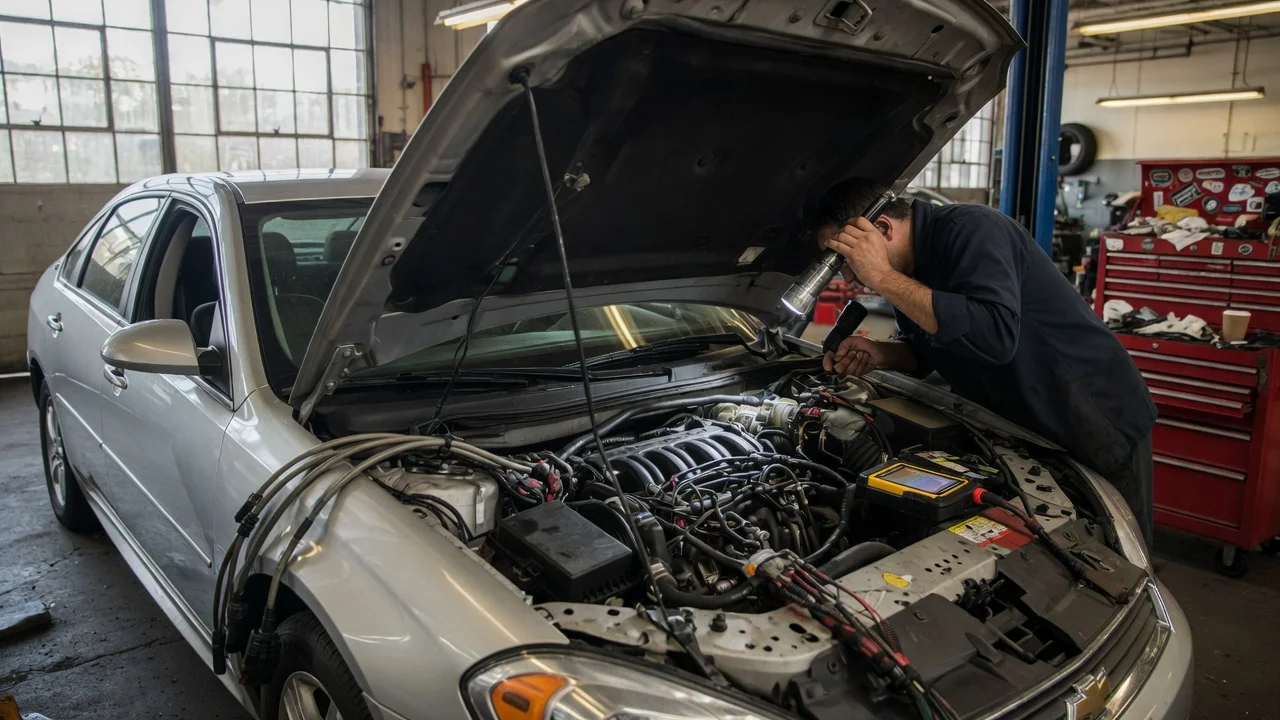
The short answer
On a 2010 Chevrolet Impala, a Reduced Engine Power message usually means the engine control module (ECM) has detected a fault it considers serious enough to limit throttle opening and protect the car. On GM vehicles of this era, the most common trigger is a problem in the electronic throttle control system: the throttle body, the accelerator pedal position sensor, the wiring and connectors between them, or the control module that reads them. The message describes a protective mode, not a specific failed part. Identifying the cause requires reading the stored diagnostic trouble codes and checking the components those codes point to.
Scope note: the 2010 Impala was sold with V6 engines, including 3.5-liter and 3.9-liter versions depending on trim. The general logic of electronic throttle control faults applies across these engines, but connector locations, wiring routing and specific test procedures can differ, so model-year and engine-specific service information should be used for any detailed testing. No model-specific service bulletin, recall or test data was supplied for this article, so those details are not stated here.
What reduced engine power mode does
The 2010 Impala uses electronic throttle control, sometimes called drive-by-wire. There is no cable between the gas pedal and the throttle. Instead, the accelerator pedal assembly contains position sensors that report how far the pedal is pressed, and the throttle body contains a motor that opens the throttle plate plus its own position sensors that report where the plate actually is. The ECM compares these signals constantly. Because each assembly uses more than one sensor, the module can detect when readings disagree. When the signals do not agree, or a circuit reads out of range, the ECM may restrict throttle opening and display Reduced Engine Power so the car cannot accelerate unpredictably.
In practice, owners typically notice very weak acceleration, a low top speed or a throttle that barely responds, often with the check engine light on. The car may still idle and move, which is intended to let the driver reach a safe stopping place.
Plausible causes and what each check tells you
Treat any fault code as a direction to investigate, not proof that a part has failed. A code reporting a throttle position correlation problem, for example, can be caused by the throttle body itself, a corroded connector, a damaged wire or a voltage supply problem. Replacing parts based on the code alone often wastes money.
1) Read and record the trouble codes
Connect an OBD-II scan tool before clearing anything, and write down every stored and pending code. Codes in the P0120 to P0123 range and P2135 generally relate to throttle position sensor circuits or their agreement; P0220 to P0223 relate to a second throttle position sensor circuit; P2120 to P2138 include accelerator pedal position sensor circuits and their correlation; P2101 and P2119 relate to throttle actuator control. Exact definitions should be confirmed against the scan tool or GM service information for the specific vehicle. If the codes do not relate to throttle or pedal circuits, the cause lies elsewhere and the checks below may not apply.
2) Note whether the problem is intermittent
If the message clears after the engine is shut off and restarted, then returns, an intermittent electrical connection is a strong possibility. Faults that appear over bumps, during rain or after a car wash, or when the engine is hot point toward wiring or connector problems rather than a sensor that has failed completely. A fault that is present every time is more consistent with a component that has failed outright, though wiring can still be responsible.
3) Inspect the throttle body and its connector
With the engine off and the key removed, remove the intake duct to view the throttle body. Heavy carbon buildup around the throttle plate can interfere with smooth movement, which may lead to a mismatch between commanded and actual throttle position. Check the electrical connector for corrosion, bent or pushed-back terminals, a broken locking tab or a loose fit. Cleaning carbon or reseating a connector can resolve some cases. If the codes point to throttle actuator or throttle position faults and the connector and wiring are sound, the throttle body may need replacement. Note that after cleaning or replacement, some GM vehicles need a throttle relearn procedure; check the procedure for this vehicle before driving normally.
4) Inspect the accelerator pedal assembly and its wiring
If the codes refer to accelerator pedal position sensors, inspect the connector at the pedal for damage or looseness and look for chafed or pinched wiring under the dash. A pedal assembly with an internal sensor fault is generally replaced as a unit.
5) Check the wiring harness between components
Follow the harness from the throttle body and pedal as far as is accessible, looking for rubbed insulation, damage near hot engine parts, broken clips or prior repairs. Wiggling the harness gently with the engine idling while watching live sensor data on a scan tool can reveal an intermittent break, but this requires a tool that displays live data and someone who can interpret it safely.
6) Confirm battery and charging system health
Electronic throttle systems depend on stable voltage. A weak battery, loose or corroded battery terminals, poor ground connections or a failing alternator can produce erratic sensor readings and trigger throttle-related codes. A battery and charging system test, which many parts stores and shops offer, is a reasonable early step, particularly if other electrical symptoms are present. Specific voltage thresholds for this vehicle were not supplied, so test results should be interpreted against the tester's or service manual's guidance.
7) Consider the control module last
An ECM fault can cause reduced engine power, but it is less common than sensor, wiring or connector problems and is difficult to confirm without proper testing. Module replacement on this vehicle may also require programming. This is usually a professional diagnosis after other causes have been ruled out.
Check for recalls and service bulletins
Before paying for parts, check whether any recall, special coverage program or technical service bulletin applies to the specific vehicle by entering its VIN with the manufacturer or a national safety regulator's recall lookup, or by asking a Chevrolet dealer. No information on recalls or bulletins for this model year was supplied for this article, so their existence or scope is not stated here.
When to stop driving or get professional help
Pull over safely as soon as the message appears in traffic; reduced acceleration can make merging, passing or highway speeds hazardous. Do not continue driving if the check engine light is flashing, which typically indicates a misfire that can damage the catalytic converter. Stop if the temperature gauge rises toward overheating, oil pressure warnings appear, or you notice smoke, a burning smell or fuel odor. Seek professional diagnosis if the throttle sticks open or responds erratically, if codes point to the control module, or if you lack a scan tool capable of reading live data. Get a professional inspection if the problem keeps returning after connector cleaning or part replacement, since an intermittent wiring fault can be hard to locate.
What this guide cannot confirm
No test results, failure-rate data, repair costs or model-specific service procedures were supplied, so this guide does not rank causes by frequency for the 2010 Impala, estimate repair prices or give electrical test values. The checks above describe a logical diagnostic order for a GM electronic throttle control fault; confirming the actual cause on a particular car depends on the stored codes, live data and the correct service information for its engine.