2009 Dodge Journey Transmission Limp Mode Diagnosis
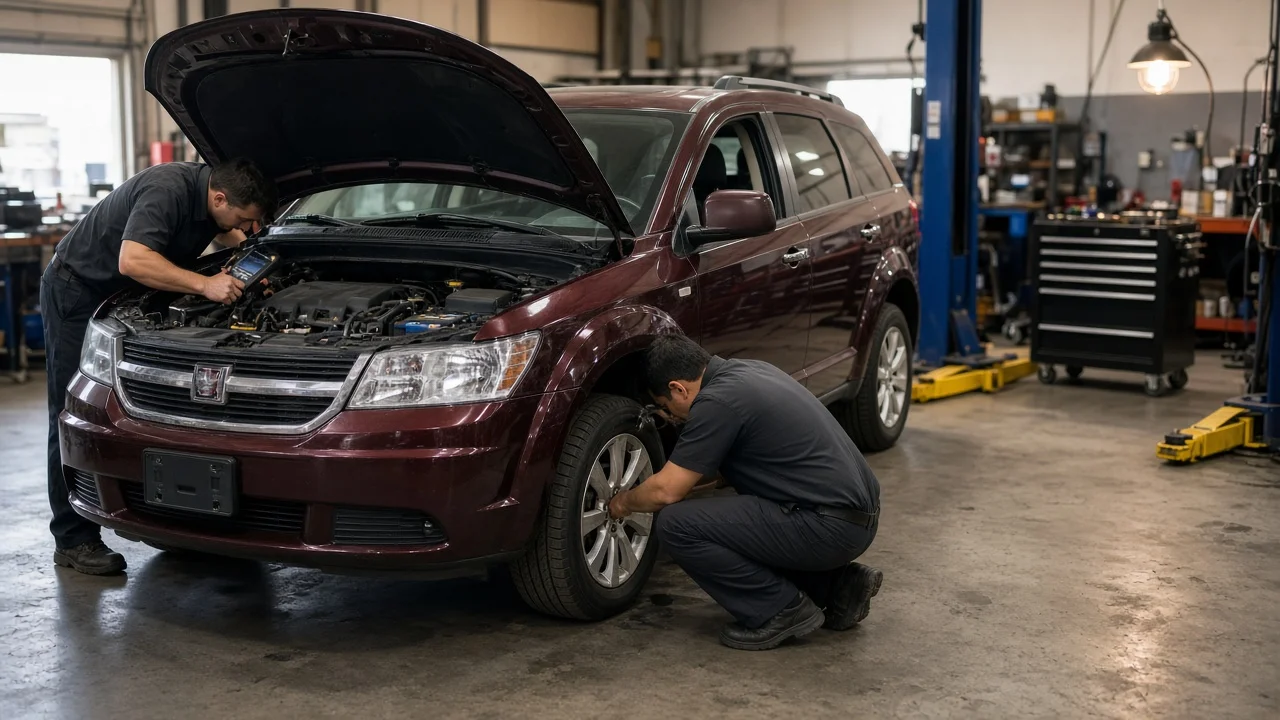
When a 2009 Dodge Journey goes into limp mode, the transmission control system has found a fault serious enough that it holds a fixed gear to protect the transmission. Acceleration and top speed are limited. A harsh shift followed by a refusal to upshift is a common first sign. Limp mode is a protective response, not a diagnosis. This guide explains how to document what is happening, separate the likely causes, and confirm a fault before any parts are replaced.
Establish the symptoms
Start by identifying the transmission type. On US-market 2009 Journeys, the 2.4-liter four-cylinder was paired with a four-speed automatic, and V6 models used a six-speed automatic. The two units differ in internal design, fluid check procedure, diagnostic data and parts fitment. A sensor, solenoid assembly or filter for one may not fit the other. Confirm the exact unit from the engine, the build data tied to the VIN, or the owner's manual before ordering anything or following a procedure.
Next, record the circumstances each time limp mode occurs. Note whether it happens cold or only after the transmission is fully warm. Note whether it follows a particular shift, such as the second-to-third upshift, or appears after hard acceleration, rough roads or wet weather. Describe the shift behavior: does the vehicle stay in one forward gear at all speeds, does reverse still work, and is there slipping, flare or a delayed engagement? Write down any warning lights and whether the transmission behaves normally again after the engine is switched off and restarted. Chrysler automatics of this era often return to normal after a key cycle, then fall back into limp mode once the fault reappears. That pattern is useful diagnostic information.
Finally, review recent service history. A fluid change, battery replacement, jump start, wiring repair, collision or transmission work shortly before the problem began can point the diagnosis in a specific direction. Record which fluid was used in any recent service, if known.
Distinguish plausible causes
Fluid problems come first because they are common and simple to rule in or out. Low fluid can starve the hydraulic system, causing slipping and pressure faults that trigger limp mode. Evidence for this includes visible leaks, symptoms that worsen when hot or during turns and stops, and fluid that smells burnt. Chrysler specifies ATF+4-type fluid for these automatics, so confirm the requirement on the dipstick or in service information. Incorrect fluid from a previous service can also affect shift quality. A correct level of clean fluid of the right type weakens this explanation, although it does not rule out an internal problem.
Electrical faults are another major group. These include input and output speed sensors, the transmission range sensor, the solenoid and pressure switch assembly, damaged wiring or corroded connectors, and low system voltage from a weak battery or charging problem. Circuit-related diagnostic codes support this direction, as does an intermittent fault linked to temperature, moisture or bumps. Normal operation after a restart also fits an electrical cause. Fault codes stored in several unrelated modules at once suggest a voltage or ground problem rather than a transmission component.
Internal mechanical wear includes worn clutch packs, torque converter problems and valve body faults. This becomes more likely when gear ratio codes appear without circuit codes, when the fluid level and condition are correct, and when the slip or engine flare can be felt during specific shifts. Significant debris in the fluid adds weight to this explanation. A symptom alone cannot confirm internal damage, so this conclusion should follow testing, not precede it.
Checks in a useful order
Owners can safely begin with simple observations. Look under the vehicle for fresh fluid at the transmission pan, cooler lines and axle seals. Check the battery terminals for corrosion or looseness, and note whether the battery is old or slow to crank the engine. Inspect any visible transmission connectors for damage, oil intrusion or disconnection, without unplugging them while the engine is running. Check the fluid level only by the procedure specified for your transmission. These units typically need a level surface, a running engine and a specific fluid temperature for an accurate reading. A reading taken at the wrong temperature is misleading, and overfilling causes its own problems.
Then retrieve the diagnostic codes. A basic generic reader may show only a general transmission code such as P0700, which means the transmission module has stored a fault, without identifying which one. A scan tool that communicates with the transmission module can show its specific codes, freeze-frame data and live readings. Useful live data includes input and output shaft speeds, commanded versus actual gear, fluid temperature, pressure switch states and system voltage. Write down every code and its freeze-frame conditions before clearing anything, because clearing erases evidence.
Deeper tests require a qualified technician with service information, wiring diagrams and specifications. These include circuit voltage and resistance checks, solenoid and pressure switch testing, line pressure testing, and a road test with data logging to capture the moment the fault occurs. These Chrysler transmissions use adaptive shift learning. After certain repairs, such as solenoid assembly or module replacement, a quick learn procedure through a scan tool is normally required for correct shift quality.
Interpret the findings
A circuit code shows that the module detected an electrical signal problem, not that a particular part has failed. For example, P0715 relates to the input or turbine speed sensor circuit, and P0720 relates to the output speed sensor circuit. Either can be caused by the sensor itself, a chafed wire, a corroded terminal or a connector problem. Confirm with circuit tests and live data that drops out when the fault occurs before replacing the sensor. The same applies to solenoid circuit codes in the P0750 range and to pressure switch codes.
Gear ratio codes, P0731 through P0736, mean the measured input and output speeds did not match the expected ratio for the commanded gear. This points toward slipping, but only once the fluid level is verified and the speed sensor signals are known to be accurate. A faulty speed signal can imitate a ratio error. If topping up low fluid resolves the symptom, the cause is partly identified, but the leak still has to be found and repaired.
Normal operation after clearing codes does not mean the fault is fixed. It may simply not have recurred yet. Before replacing a solenoid assembly, transmission module or complete transmission, there should be a test result that specifically supports that repair. Fluid condition is useful context but not proof: fine discoloration is common in older fluid, while metal fragments or clutch material in the pan indicate internal damage that needs a closer inspection.
Urgency and next action
Some signs mean the vehicle should not be driven until it has been inspected. These include no movement in drive or reverse, severe slipping with the engine racing, grinding or heavy clunking, a burning smell or smoke, a rapid fluid leak, or a transmission temperature warning. Even without these signs, limp mode limits acceleration, which makes merging and highway driving hazardous. Continuing to drive with active slipping can turn a repairable fault into one that requires an overhaul. There is no reliable safe distance to drive in limp mode, so keep driving to a minimum and arrange diagnosis promptly.
Bring the repair shop the VIN, engine and transmission type, mileage, all recorded codes with freeze-frame data, your log of when the problem occurs, and the service history, including the fluid used. Ask the dealer to check the VIN for open recalls or service bulletins. Repair options range from a wiring or connector repair, sensor replacement, correcting the fluid level or type, solenoid assembly replacement and module software updates, up to a rebuild or replacement transmission. Ask what test confirmed the recommended repair, particularly before approving major work.