2008 Ford F-150 Shift Interlock Solenoid Location
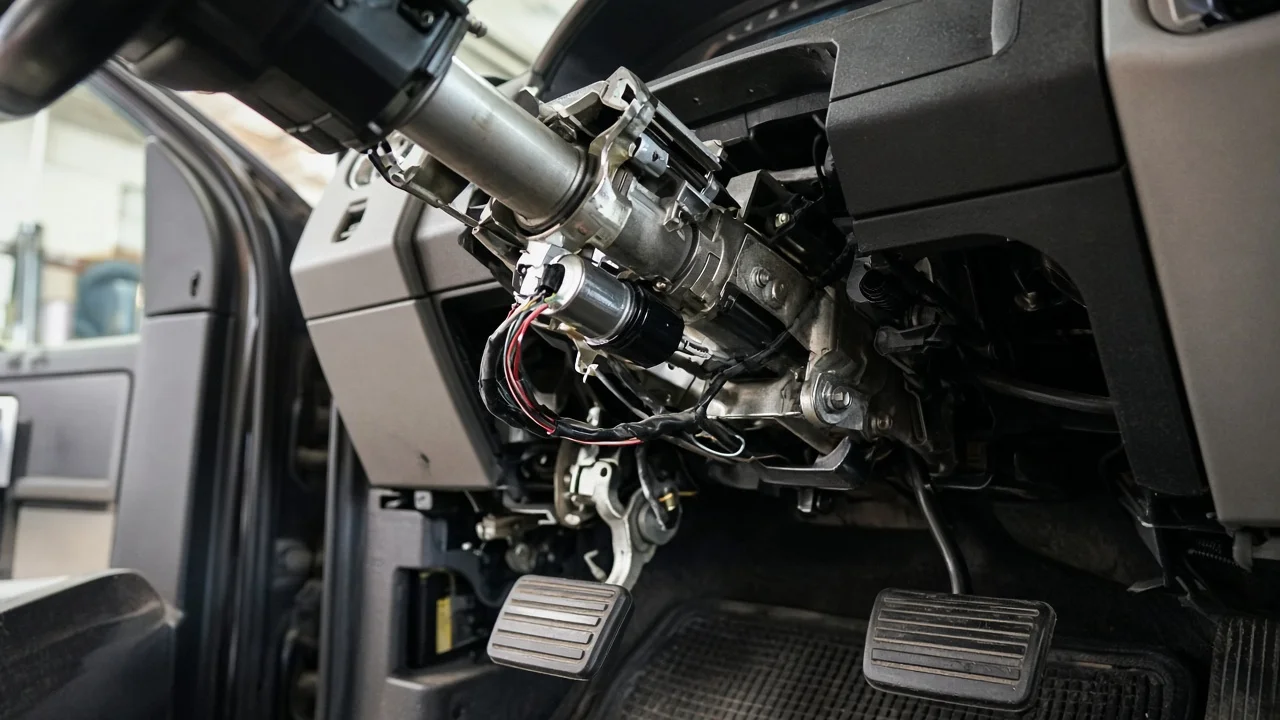
If your 2008 F-150 won't come out of Park even with your foot on the brake, the brake shift interlock is the usual suspect. Before you start pulling trim, it helps to know where the interlock solenoid is on your truck, how it decides when to release the shifter, and which simpler faults cause the same stuck-in-Park symptom. This guide covers the location, the logic behind it and a sensible diagnostic order.
Where the solenoid is on a 2008 F-150
On a 2008 F-150 with the common column-mounted shifter, the brake shift interlock solenoid is inside the steering column. It is mounted at the shift mechanism near the base of the column, below the steering wheel. The plastic column shrouds hide it, so you won't see it from the driver's seat. Removing the lower shroud exposes the solenoid and its connector. On some trucks you also need to remove the lower dash trim or knee panel beneath it. The solenoid acts on the shift mechanism inside the column, not at the transmission, so there is no reason to crawl under the truck to find it.
Trucks with a floor-mounted console shifter are different. On these, the interlock is part of the shifter assembly in the center console, and you reach it by removing the console trim around the shift lever. A 2008 F-150 with a manual transmission has no brake shift interlock at all. Confirm which shifter your truck has before ordering parts or removing panels, because the two designs use different components.
How the brake shift interlock works
The interlock is a safety feature. It keeps the shift lever locked in Park until two conditions are met: the ignition is in the run position and the brake pedal is pressed. The solenoid is a small electrically operated plunger or pawl that blocks the shift mechanism from leaving Park. When the brake pedal switch reports that the pedal is applied, the circuit changes the solenoid's state and the lever is free to move.
The system depends on the brake pedal signal, and it shares that signal with the brake lights. The pedal switch, the fuse feeding the circuit, the wiring through the column and the solenoid itself all have to work together. The interlock is purely electrical and mechanical. It has nothing to do with transmission fluid, fluid specification or the condition of the transmission's internals, so a shifter that won't leave Park is rarely a sign of transmission failure.
What changes the answer for your truck
Transmission type and shifter style matter most. Automatic 2008 F-150s use a four-speed unit, with the exact model depending on the engine, but the interlock location depends on the shifter rather than the transmission. Most bench-seat trucks have a column shifter. Many trims with bucket seats and a center console have a floor shifter. Trim level and options also change how much paneling sits between you and the solenoid, so the removal steps differ between a basic work truck and a higher-trim cab.
The symptom pattern changes the likely cause: • If the shifter is stuck in Park and the brake lights don't come on, the problem is upstream of the solenoid. Typical causes are a blown fuse or a faulty brake pedal switch. • If the brake lights work but the lever stays locked, the solenoid, its connector or the column wiring become more likely. • If the lever releases only sometimes, or only in hot or cold weather, suspect a loose connection or a sticking mechanism rather than a completely dead part. Fitment matters if you replace anything. Column-shift and floor-shift parts are not interchangeable, so match the part to your truck's configuration.
What the owner can do
Start with the easy checks. With the engine off and the key in run, press the brake and have someone confirm the brake lights come on. Then listen near the base of the steering column, or near the shifter on console trucks, while you press and release the pedal. Many interlock solenoids make a faint click as they change state. A click without release suggests a mechanical bind. No click, with working brake lights, points to the solenoid, its connector, or its power and ground. Check the relevant fuse using the fuse chart in your owner's manual or on the fuse panel cover.
If you need to move the truck before the repair, check the owner's manual for a shift lock override procedure for your shifter type, and follow it if one is described. Use an override only to move the truck for service. Keep the parking brake set until you are ready to move. Don't force the lever, because that can damage the shift mechanism inside the column or console.
If you go to the solenoid itself, disconnect the battery first. Work carefully around the steering column, which also carries airbag and clockspring wiring, and leave yellow airbag connectors alone. Remove the lower shroud, inspect the solenoid connector for looseness or corrosion, and check the harness for chafing. Before buying a new solenoid, test for power and ground at the connector with the brake pressed. That tells you whether the solenoid is getting its command.
Limitations and when to get help
This is a general guide to the 2008 F-150's layout, not a factory procedure. Exact shroud fasteners, connector colors, fuse numbers and the solenoid's command logic vary with configuration. Confirm them in the factory service information for your VIN. A stuck shifter is a symptom, not proof that the solenoid has failed, and replacing it without checking the brake switch, fuse and wiring can waste money. Scanning for diagnostic codes can help, but an interlock fault does not always set a code.
Get professional help in these cases: • The shifter moves out of Park without the brake pressed, which means the safety lock isn't working. • The repair requires partly disassembling the steering column. • Airbag-related warning lights appear after you worked near the column. A shop can test the circuit, review your truck's service history and recommend repair options, which range from a simple switch or connector repair to replacing the shifter assembly.