Identifying a 2007 Pontiac Grand Prix Pressure Control Solenoid
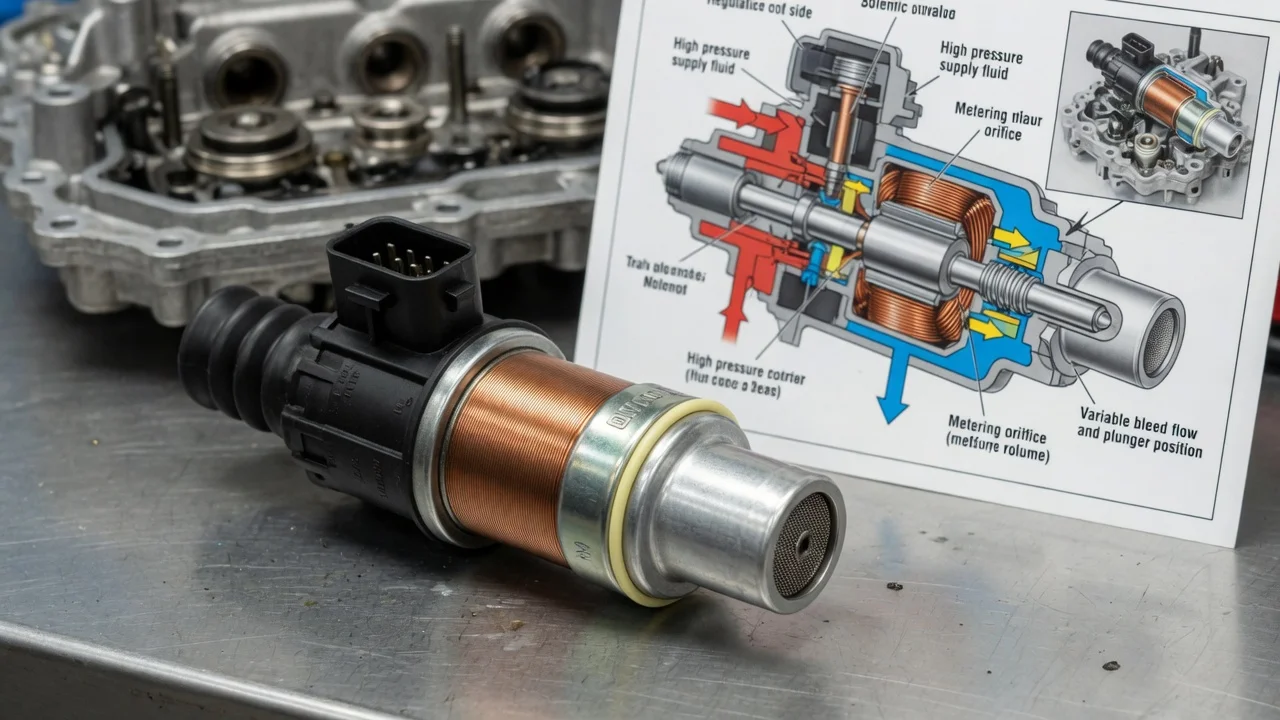
A scan tool, a shop or an online forum may have pointed you at the pressure control solenoid on your 2007 Pontiac Grand Prix. Before buying parts, confirm which transmission the car has, where the solenoid sits and what it does. This guide covers how to identify the part, how it controls line pressure, what changes the diagnosis, and what an owner can check before approving a repair.
Which transmission and where the solenoid sits
The 2007 Grand Prix left the factory with a four-speed automatic transaxle from GM's 4T65-E family. Higher-output versions use a heavy-duty variant of the same basic design. The pressure control solenoid is an internal, electrically operated valve mounted on the control valve body behind the side cover on the driver's side of the transaxle. It cannot be seen from outside the car. The visible part is the transmission's electrical connector on the case, which feeds an internal harness that runs to the solenoids. The solenoid itself is a compact cylindrical unit with a two-terminal electrical connection, held in place by a retainer or bracket.
Before ordering anything, confirm the exact unit fitted to your car. Use the service parts identification label, usually found in the glove box or trunk area, which lists the transmission option code, and the identification tag on the transmission case. A diagnostic code or a shift complaint tells you where to look. Neither one proves the solenoid itself has failed.
How the pressure control solenoid works
The powertrain control module decides how much hydraulic line pressure the transmission needs. It then sends a controlled electrical current to the pressure control solenoid, a variable force type. That current positions the solenoid's internal valve, which adjusts a signal pressure acting on the pressure regulator valve. In this design, more current lowers line pressure and less current raises it. With no current at all, the system defaults to high pressure, so the car can usually still move, but shifts become noticeably firm. The module changes commanded pressure based on throttle position, engine load and fluid temperature, and it adapts over time to wear in the clutches.
This is why symptoms overlap with other faults. Harsh shifts, delayed engagement, flare between gears or slipping can come from the solenoid. They can also come from low or degraded fluid, a sticking valve in the valve body, worn clutches, a leaking seal, a damaged internal harness, a faulty fluid pressure switch assembly or incorrect adaptive values. The solenoid is one link in a hydraulic and electrical chain, and the whole chain has to be considered.
What changes the answer
Configuration matters most for fitment. Standard and heavy-duty versions of the transmission and different calibrations can call for different internal parts. A car that has received a remanufactured or used transmission may not match its original label. Parts listings often cover several model years and vehicles, so match the transmission code and, ideally, the removed part rather than relying on the model year alone. A solenoid made for a different GM transmission family, such as rear-wheel-drive four-speed units, is not interchangeable even if it looks similar.
Operating conditions also change the picture. A fault that appears only when cold, only when fully warm or only intermittently points toward different causes than a constant one. A code that is currently active means something different from one stored in history. Service history matters as well. A recent fluid change with the wrong fluid, earlier valve body work or a past rebuild can all explain shift behavior that looks like a solenoid problem.
What the owner can check
Start with diagnostic codes, using a scan tool that can read transmission data, not just engine codes. Pressure control solenoid faults are commonly reported as P0748 or as circuit codes in the P0960 to P0963 range, depending on calibration. Write down every code, including other transmission or electrical codes, and save freeze-frame data if the tool provides it. Better tools can display commanded and actual solenoid current, and a large mismatch between them is useful information for a technician.
Next, check fluid level and condition using the procedure in the owner's manual, with the transmission at the specified temperature. GM specified Dexron VI for this era, but confirm the fluid specification on the dipstick, fill cap or manual. Dark, burnt-smelling fluid or debris suggests mechanical wear, not just a solenoid fault. Inspect the external connector on the transmission case for oil intrusion, corrosion, bent pins or a damaged harness. Keep a short log of shift behavior: which shifts are affected, whether the problem occurs hot or cold, and whether it follows a code.
Repair options range from replacing the solenoid alone, to servicing or replacing the valve body, to repairing or replacing the transmission if internal wear is found. Reaching the solenoid means removing the side cover, and access on this platform is tight, often requiring work around the subframe, axle and mounts. After any repair, clearing codes and performing an adaptive relearn may be needed for normal shift quality. Ask for a written diagnosis showing how the solenoid was confirmed as the cause.
Limitations and next step
Confirming a failed solenoid requires electrical testing of the solenoid and its circuit against factory specifications, and often a line pressure test with a gauge. That work needs vehicle-specific service information and equipment beyond basic code reading. If the transmission is slipping, flaring badly or refusing to engage, limit hard driving, because continued slipping can damage clutches and turn a solenoid-level repair into a much larger one.
The practical next step is to gather your VIN, the transmission code from the parts label, all stored and active codes, your notes on shift behavior, and any service records. Bring that information to a transmission specialist or a qualified shop. With it, they can test the circuit, verify pressure, and tell you whether the pressure control solenoid, another component or the transmission itself needs attention.