Identifying a 2006 Chevy Monte Carlo Pressure Control Solenoid
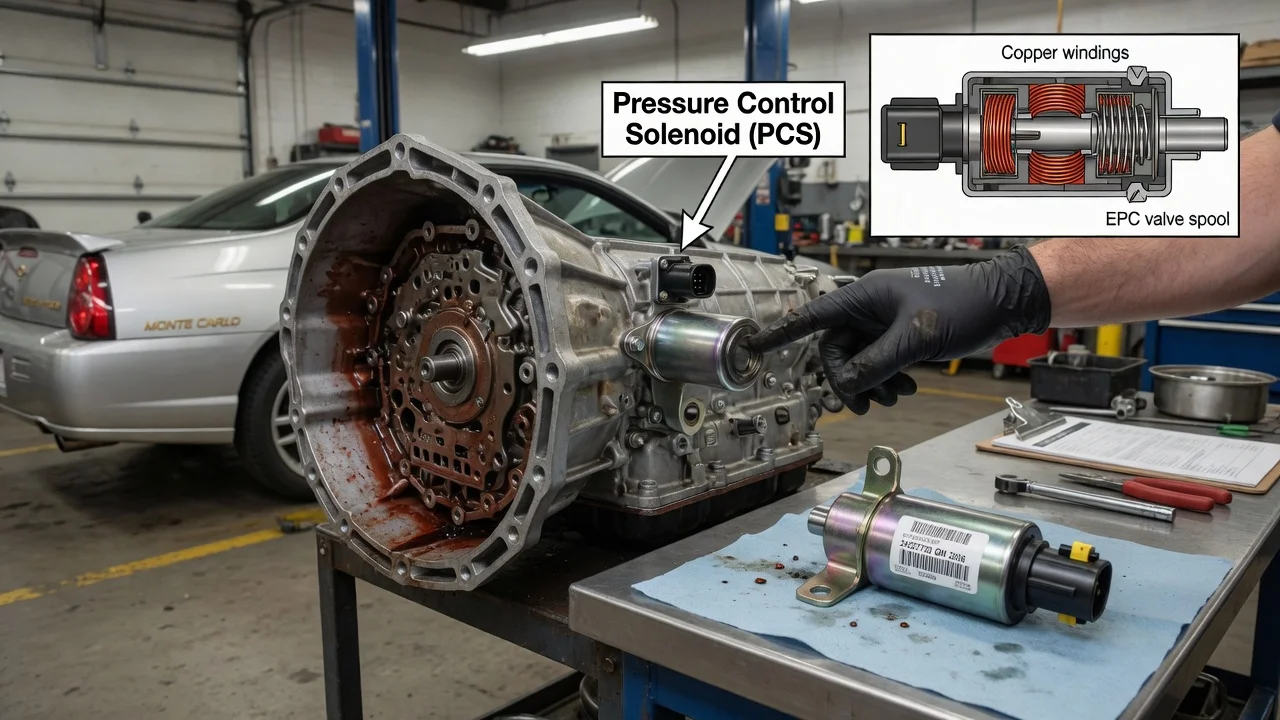
If a scan tool or a shop has pointed to the pressure control solenoid on a 2006 Chevy Monte Carlo, start by confirming exactly which transmission and part you are dealing with. This guide covers where the solenoid sits, what it does, how configuration affects fitment and diagnosis, and what you can check before buying parts or approving a repair. A fault code or a harsh shift points toward the solenoid circuit, but neither proves the solenoid itself has failed.
The short answer
The 2006 Monte Carlo uses a front-wheel-drive four-speed automatic from GM's Hydra-Matic 4T65-E family. The V6 versions, with the 3.5-liter or 3.9-liter engine, do not share identical calibrations with the 5.3-liter V8 in the SS, and the V8 car uses a heavier-duty version of the transmission. Confirm the transmission type rather than assuming it. The pressure control solenoid is mounted on the valve body behind the transmission's side cover, not on the outside of the case. You cannot identify or replace it just by looking under the hood.
To find the correct part, check the RPO codes on the service parts identification label, which on GM cars of this era is usually in the trunk or glove box area, and the identification tag on the transmission case. Then match the solenoid by part number for that model year and transmission version. A listing that only says Monte Carlo, without the engine or transmission, is not specific enough to confirm fitment.
How the pressure control solenoid works
Line pressure is the hydraulic pressure that applies the clutches and bands inside the transmission. The pressure control solenoid is a variable force solenoid that lets the powertrain control module adjust that pressure. The module varies the electrical current sent to the solenoid. The solenoid produces a matching signal pressure, and that signal positions the pressure regulator valve. The module raises or lowers line pressure based on throttle position, engine load, vehicle speed and the shift being made.
On this design, current and pressure work inversely: less current produces more line pressure. This is a fail-safe. If the circuit opens, the transmission defaults to high pressure so the clutches still apply. That is why an electrical fault often shows up as very firm shifts rather than a loss of drive. The module also uses adaptive learning, trimming pressure over time to keep shift times on target. If it reaches the limit of its adjustment, it may set a code indicating long shifts or maximum adapt. That code reports how the shifts behaved, not which component caused the problem.
What changes the answer
Several factors affect which part fits and whether it is likely to be the problem: • The engine and transmission version, since calibration and part numbers can differ. • Revisions to valve body components across the 4T65-E production run. • A transmission that has been rebuilt or replaced, which may not contain original-specification parts. Service history matters for the same reason. Previous fluid changes, a rebuilt unit or an earlier solenoid replacement all change what is actually inside the case.
Symptoms also vary. Harsh engagement, firm upshifts, delayed shifts, and flare or slip between gears can all involve line pressure. The same symptoms can also come from: • Low or degraded fluid; • Worn clutches; • A sticking pressure regulator valve or valve body wear; • Damaged wiring or a damaged connector; • Low system voltage; • A control module issue; The type of diagnostic code is an important clue. A pressure control solenoid electrical code, commonly P0748, points to the circuit, the connector, the internal harness or the solenoid winding. A GM performance code such as P1811, maximum adapt and long shift, points more toward hydraulic or mechanical causes. Note whether symptoms appear only when cold or only when hot, because that narrows the possible causes further.
What the owner can do
Start by gathering information: • Read and record all stored and pending codes, including freeze frame data, with a scan tool that can access transmission data. • Write down the shift behavior: which shifts feel wrong, whether the problem appears cold or hot, and whether it is consistent or intermittent. • Check the fluid level and condition using the procedure in the owner's manual or service information. Fluid level on automatics is normally checked at operating temperature with the engine running. Dark fluid, a burnt smell or visible debris suggest internal wear. A new solenoid alone will not correct internal wear.
Use only the correct fluid specification. GM superseded earlier Dexron III fluid with Dexron VI, but confirm the requirement in the owner's manual or on the fill or dipstick marking. Inspect the external transmission connector for damage, corrosion or fluid seeping into it, and confirm the battery and charging voltage are normal. Two tests do the most to separate a bad solenoid from a hydraulic problem: • On a capable scan tool, compare commanded pressure control solenoid current with actual current. • Have a technician perform a line pressure test with a gauge and compare the results to the specification.
Repair options usually fall into three categories: • Replace the solenoid alone. • Install a reconditioned valve body. • Rebuild or replace the transmission if internal wear is confirmed. Replacing the solenoid requires removing the side cover and installing a new gasket. Access in this transverse layout is tight, and some procedures call for supporting the powertrain. After any repair, the adaptive values may need to be reset and relearned according to the service procedure.
Limitations and next step
This guide does not provide resistance values, torque specifications or part numbers, because those must come from service information specific to your vehicle and transmission. A code or symptom is a lead to test, not a confirmed failed part. Get professional help if the transmission slips, the fluid is burnt, codes return after a repair, or the side cover work is beyond your tools and experience. Before visiting a transmission specialist, have your VIN, RPO codes, recorded codes and shift notes ready, and ask for a diagnosis that includes a line pressure test before any parts are replaced.