Diagnose 2005 Ram 2500 ABS and brake lights
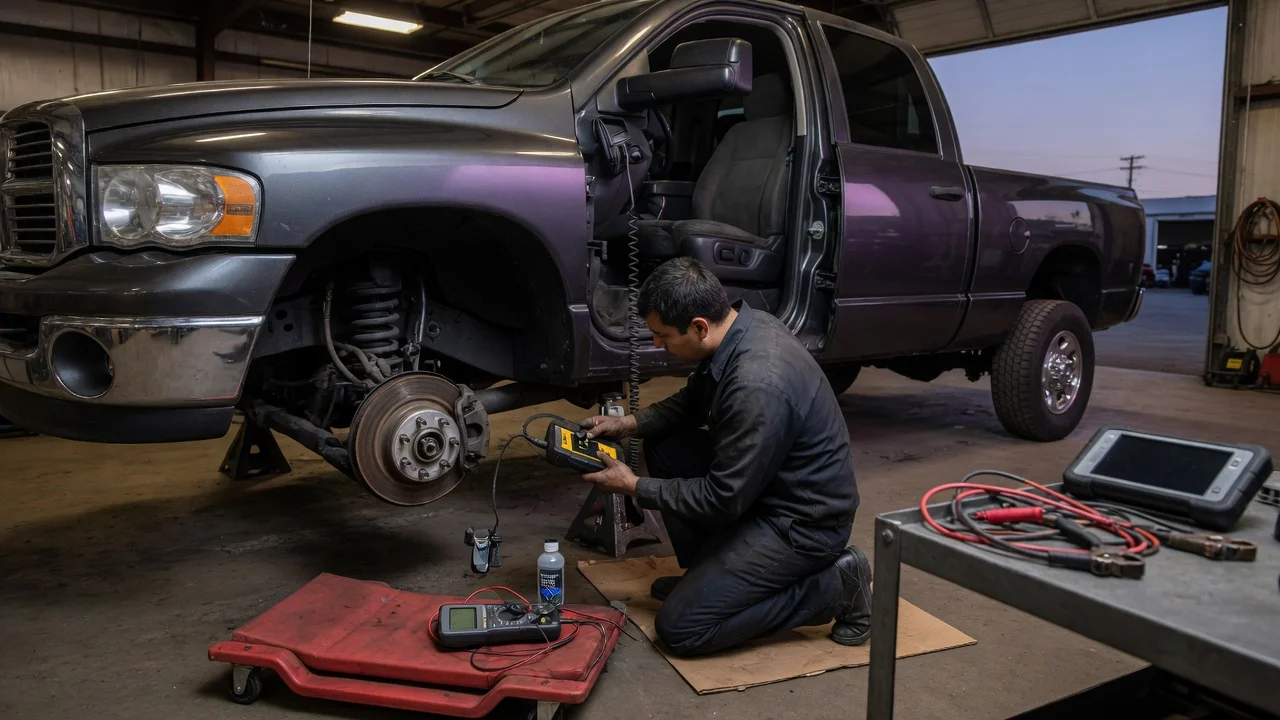
The short answer
When the amber ABS light and the red BRAKE light are on together in a 2005 Dodge Ram 2500, the two most likely explanations are a problem in the base hydraulic brake system that the red light monitors, or a fault stored by the antilock brake controller that has also disabled electronic rear brake proportioning. On Chrysler trucks of this era, the antilock controller also manages how much braking force goes to the rear wheels, a function Chrysler calls electronic variable brake proportioning (EVBP). When the controller detects certain faults, it can switch off that function along with antilock braking, and the red lamp comes on to warn that rear brake balance is no longer being managed electronically.
The red light has simpler causes that should be ruled out first: an engaged or partly engaged parking brake, a faulty parking brake switch, or low brake fluid. If those check out, the next step is reading the antilock system's stored trouble codes with a scan tool that can access the ABS module, because a basic engine-code reader usually cannot.
This guide applies to the 2005 Ram 2500, which belongs to the third-generation heavy-duty Ram. The general logic of the warning lights is shared across the 5.7-liter Hemi gasoline and 5.9-liter Cummins diesel versions, but connector locations, sensor part numbers, and test values can differ by drivetrain (2WD or 4WD) and build. For those details, use the factory service information for the specific truck. No measurements, specifications, or test results were supplied for this article, so it does not give resistance values or air-gap figures.
When to stop driving
The red BRAKE light can indicate a problem with the brakes themselves, not just the antilock function. Park the truck and have it inspected or towed if any of the following apply:
The brake pedal feels soft or spongy, sinks toward the floor, or needs more travel than usual. The brake fluid reservoir is low, or fluid is visibly leaking at a wheel, a line, or the master cylinder. The truck pulls hard to one side, grinds, or takes noticeably longer to stop. The red light stays on even though the parking brake is fully released and the fluid level is correct, and you cannot confirm the cause. The truck is loaded or towing. A heavy-duty pickup with rear proportioning disabled may lock its rear wheels earlier under hard braking.
If the pedal feels normal, the fluid is full, and only an ABS-related code is stored, the base brakes generally still work. However, antilock function, and possibly electronic rear proportioning, may be off. Drive gently with extra following distance until the fault is repaired, and avoid towing or carrying heavy loads in the meantime.
Step 1: Rule out the simple causes of the red light
Parking brake: release it fully, then pump the pedal or pull the release once more. A parking brake that is partly applied, or a switch that sticks, keeps the red lamp lit. Brake fluid level: check the master cylinder reservoir against its markings. Fluid level drops slowly as the pads wear, so a low reading can mean worn pads rather than a leak. A sudden drop, or wet spots near wheels or lines, points to a leak. Pad and rotor condition: if the fluid is low and there is no leak, inspect the pads. Topping up fluid without addressing worn pads only hides the warning. Bulb check at start-up: with the key turned on, both lamps should light briefly as a self-test and then go out. If they stay on immediately with the engine off, the fault is usually already stored and present. If they come on only after you start driving, the fault is usually detected while the wheels are turning.
Step 2: Read the ABS codes
Antilock faults are stored in the antilock brake controller, not the engine computer. They typically appear as chassis codes, which start with C. Many inexpensive OBD-II readers show only engine and emissions codes, so a clean result from one of them does not mean the ABS system is fault-free. Use a scan tool that supports ABS on Chrysler vehicles, or have a shop read the module.
A code tells you which circuit or signal the controller judged to be out of range. It does not prove that a particular part has failed. For example, a wheel speed sensor code can come from the sensor itself, but also from damaged wiring, a corroded connector, a damaged or contaminated tone ring, or excessive play in a wheel bearing. Write down every code, including its status (current or stored), before clearing anything. Then clear the codes and see which ones come back, and under what driving conditions.
Step 3: Match the symptom pattern to likely causes
Pattern | Plausible causes | What to check next; Lights on immediately at key-on and never go out | Loss of power or ground to the ABS controller, a blown fuse, a disconnected or corroded controller connector, an internal controller fault, or a communication fault | Check the ABS-related fuses, battery terminals, and grounds. Inspect the controller connector. Confirm whether the scan tool can communicate with the module at all. Lights come on after driving begins, often at low speed | A wheel speed sensor signal that is missing or implausible | Inspect sensor wiring and connectors for chafing, corrosion, or damage. Inspect the sensor and tone ring for debris or damage. Compare live wheel-speed readings on a scan tool while driving slowly. Lights come on intermittently, over bumps, or in wet weather | An intermittent wiring or connector fault, often near a wheel or the rear axle | Flex the harness while watching live data. Look for green corrosion in the connectors and check for broken wires inside the insulation. Lights appear along with dim headlights, slow cranking, or other electrical warnings | Low system voltage or a charging problem | Test the battery and charging output. Low voltage can set ABS faults that clear once voltage is restored. Red light only, with no ABS light | Parking brake, parking brake switch, low fluid, or a base hydraulic fault | Repeat Step 1. Inspect for leaks and check pedal feel.
Wheel speed sensors and wiring
Each wheel speed sensor produces a signal from a toothed tone ring that turns with the wheel or the axle. The antilock controller compares these signals. When one is missing, erratic, or does not agree with the others, the controller stores a fault and disables antilock braking. On many heavy-duty Ram configurations of this generation, the rear wheel speed is read by a single sensor mounted at the rear axle rather than one sensor at each rear wheel. Confirm the layout for your truck in its service information, because front sensor mounting also differs between 2WD and 4WD trucks.
Sensors and their wiring sit low on the truck, where they are exposed to road salt, water, gravel, and heat. Look for metallic debris stuck to the sensor tip, harness clips that have broken loose and let wires rub, and corrosion inside connectors. Replacing a sensor without checking its wiring and tone ring often leaves the real fault in place.
The ABS controller
Suspect the controller when the scan tool reports an internal controller fault, cannot communicate with the module, or when power, ground, and connector checks pass but the fault returns. Before condemning it, confirm that the module is receiving correct battery voltage and has a clean ground, and that its connector pins are not corroded or pushed back. Controller replacement or repair and any related brake bleeding procedure are usually jobs for a professional. On many antilock systems, the hydraulic unit has to be bled with a scan tool that can cycle its valves, so air left in the system can make the brakes unsafe.
When to hand it to a professional
Seek professional diagnosis if any of these apply:
The red light remains on after you have confirmed that the parking brake and fluid level are normal. You find a fluid leak or experience any change in pedal feel. The scan tool cannot communicate with the ABS module. Codes return after you have repaired the wiring and replaced the sensor. The repair requires opening the hydraulic system.
Give the technician your stored codes and a description of when the lights appear. Both will narrow the diagnosis and reduce the chance of replacing parts that are not at fault.
What this guide cannot confirm
No supplied evidence covers specific trouble code definitions, sensor resistance or voltage specifications, technical service bulletins, or recalls for the 2005 Ram 2500's brake system. Those details should come from the factory service information or a dealer. Checking the truck's VIN with the manufacturer will show whether any open recall applies.