Identifying a 2005 Buick LeSabre Pressure Control Solenoid
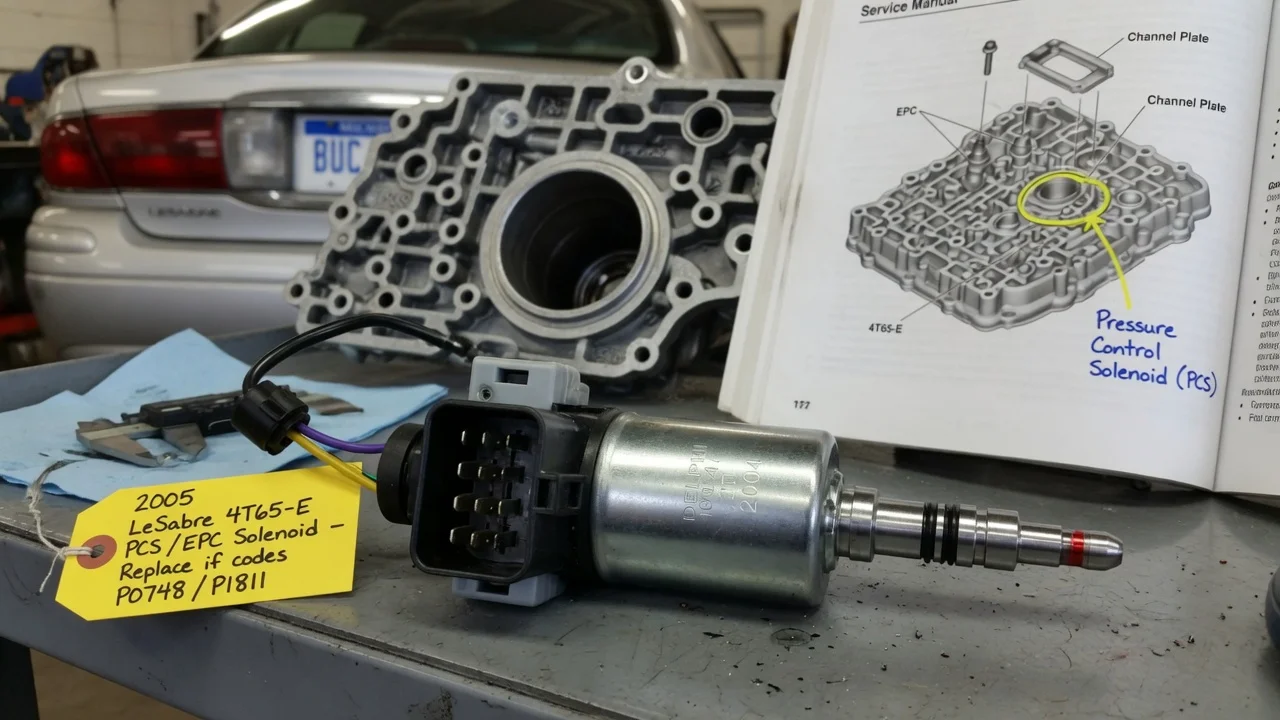
The 2005 Buick LeSabre uses an electronically controlled four-speed automatic, and the pressure control solenoid is one of the parts that sets how firmly it shifts. Owners usually start looking for it after harsh shifts, delayed engagement or a stored trouble code. This guide covers how to identify the correct solenoid, what it does, which details change the diagnosis and the part choice, and where an owner's own checks should stop.
Which solenoid the 2005 LeSabre uses
The 2005 LeSabre was built with the 3800 V6 and the 4T65-E transaxle. GM used this front-wheel-drive four-speed automatic in many of its large sedans of that period. The pressure control solenoid is also listed as the PC solenoid or line pressure control solenoid. It is an electrically operated valve mounted on the valve body inside the transmission, not a sensor bolted to the outside of the case. To identify the correct part, confirm the transmission type from the VIN, the service parts identification label and the transmission's own ID tag. Then match the part to that configuration rather than to the model name alone.
A trouble code or a shift complaint that points to line pressure does not prove the solenoid has failed. Damaged wiring, a leaking or corroded connector, low or degraded fluid, internal leaks and control module faults can all produce the same symptoms. Confirm the solenoid by testing before you replace it.
How the pressure control solenoid works
The 4T65-E uses hydraulic pressure to apply its clutches and bands. The pump creates that pressure, and a pressure regulator valve sets main line pressure. The pressure control solenoid is a variable-force solenoid. The powertrain control module sends it a varying current, and the solenoid sends a signal pressure that positions the regulator. In this design, more current produces lower line pressure and less current produces higher line pressure. The module changes its command based on throttle position, engine load, vehicle speed and fluid temperature. That is why shifts are firmer under hard acceleration and softer during light cruising.
Because of this inverse relationship, losing electrical control of the solenoid usually sends the transmission to high line pressure. This is a deliberate fail-safe: shifts become harsh, but the clutches are held firmly and don't slip. A solenoid that sticks, is contaminated by debris or has partly failed can behave differently, causing erratic, soft or inconsistent shifts. The module also learns adaptive pressure corrections over time. Worn clutches or low fluid can therefore push it to command pressure changes that look like a solenoid problem.
What changes the answer
Fitment comes first. Every 2005 LeSabre left the factory with the 4T65-E, but GM revised internal parts on this transaxle family during production. A used, rebuilt or remanufactured unit may also have been installed since. Confirm what is actually in the car before ordering a solenoid or valve body parts. Service history matters as well. A previous rebuild, a valve body replacement or a fluid change with the wrong fluid all change how you should read the symptoms.
Diagnostic codes set the direction. On GM vehicles of this era, an electrical fault in the pressure control solenoid circuit is commonly reported as P0748, but check the exact definition and test steps in the service information for your VIN. A circuit code points to the whole circuit: harness, connector, internal wiring, solenoid and module driver. Shift-quality or slip codes, or symptoms with no code at all, lead to different diagnostic paths. Operating conditions also matter. A fault that appears only with hot fluid, only after a cold start or only under load suggests different causes than a harsh shift that is always present.
The fluid specification also affects the outcome. The 4T65-E was originally filled with Dexron III, and GM later replaced that specification with Dexron VI. Wrong, contaminated or overheated fluid can change shift feel and make a valve stick. Fluid condition is therefore part of the diagnosis, not just maintenance.
What the owner can do
Start with the fluid. Check the level using the procedure in the owner's manual, which specifies the fluid temperature, the gear selector position and whether the engine should be running. Look at the condition as well as the level. Dark fluid, a burnt smell, or visible particles or metallic debris suggest internal wear, and a new solenoid alone is unlikely to fix that.
Next, read the codes with a scan tool that can access transmission data, and record any freeze-frame information before clearing anything. Many capable scan tools show commanded pressure control solenoid current and transmission fluid temperature, which helps link a complaint to actual operating conditions. Write down the exact shift behavior: which shift is harsh or delayed, whether reverse engages slowly, whether engine speed flares during a shift, and whether the problem changes as the car warms up. Inspect the transmission's electrical connector and the nearby wiring for oil intrusion, broken locks, chafing or corrosion.
Repair options depend on what testing shows. A confirmed solenoid fault is usually fixed by replacing the solenoid. That means removing the transmission side cover to reach the valve body, and access on this car is tight. A harness or connector fault is repaired at the wiring. A valve body problem may need valve body service or replacement. If clutches are slipping or the fluid shows heavy wear, the solenoid is not the main issue, and the transmission needs a fuller evaluation.
Limitations and next step
This overview cannot confirm a failed part on a specific car. Resistance values, connector pinouts, removal steps, torque values and fluid capacity depend on the exact configuration, so take them from factory service information for your VIN. A line pressure test with a gauge, comparing actual pressure with commanded pressure, is the clearest way to tell an electrical fault from a hydraulic one. It is usually a job for a transmission shop. Get professional help if the transmission slips, the fluid is burnt or contains debris, the code returns after a repair, or you can't safely reach the side cover. Bring your codes, freeze-frame data, notes on shift behavior and service history, which shortens the diagnosis.