2004 Dodge Durango Transfer Case Shift Motor Identification
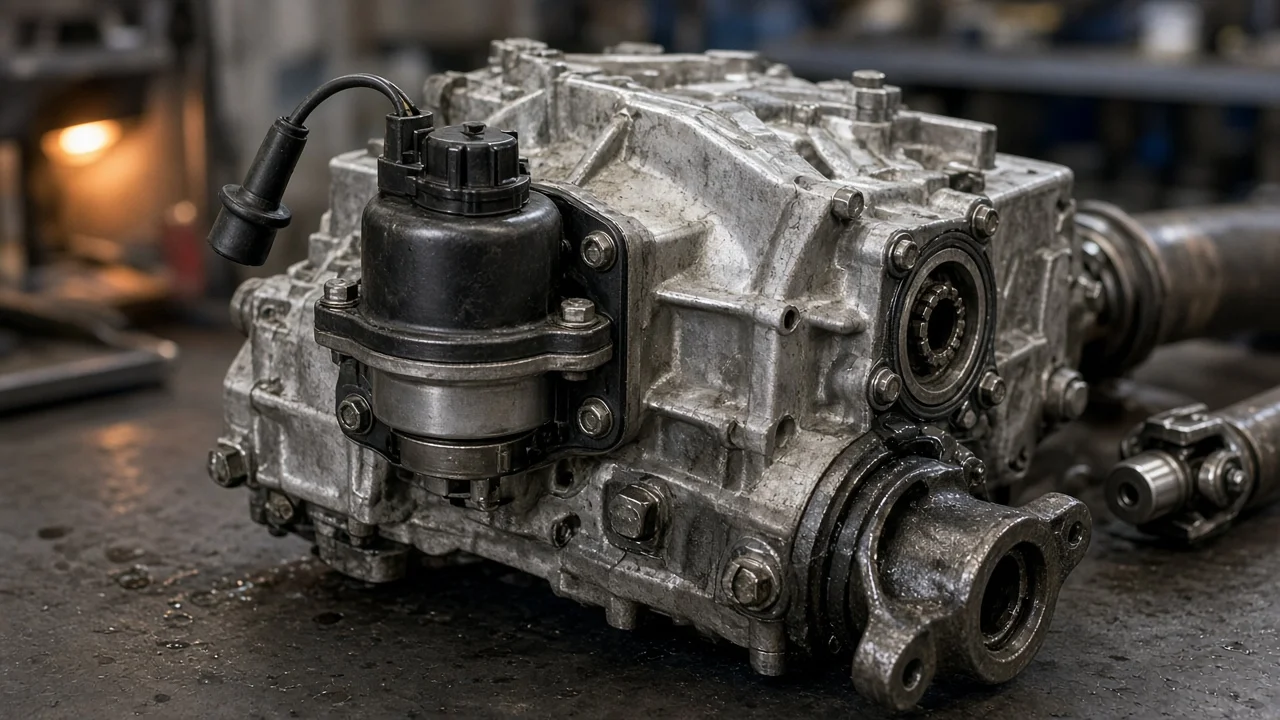
Not every four-wheel-drive Durango from this era uses an electric shift motor on its transfer case, and a motor that fits one truck may not fit another. This guide covers how to tell whether your 2004 Dodge Durango has a shift motor, how that motor works, which configuration details change the answer, and how to confirm the correct part before you buy or replace anything.
Does Your 2004 Durango Have a Shift Motor?
A 2004 Durango has a transfer case shift motor only if it is a four-wheel-drive model with an electronically shifted transfer case. Two-wheel-drive trucks have no transfer case at all. Among four-wheel-drive trucks, the quickest clue is inside the cabin. An electronically shifted case is controlled by a selector switch on the instrument panel, and the motor mounted on the case carries out those selections. If your truck drives all four wheels full time and offers no way to select modes or low range, its transfer case may not use a shift motor.
Identification therefore happens in two steps: confirm the transfer case type for your vehicle configuration, then match the motor itself. The most reliable references are the identification tag on the transfer case, the label or markings on the motor housing, and a parts lookup run against your 17-character VIN.
How the Shift Motor Works
On an electronically shifted transfer case, there is no mechanical lever between you and the case. When you press the selector switch, a control module reads the request, checks conditions such as vehicle speed and transmission position, and powers the shift motor. The motor turns a shaft on the side of the transfer case, which moves internal components to change between the modes the case offers, such as full-time four-wheel drive, locked four-wheel drive, low range and neutral.
The motor assembly typically includes a position sensor, sometimes called a mode sensor, that reports where the shaft actually ended up. The module uses that feedback to confirm the shift and update the indicator lights on the switch. This is why a shifting problem is not always the motor. A worn switch, a wiring or connector fault, a sensor reading error or an internal transfer case issue can produce similar symptoms, such as a flashing indicator or a mode that will not engage.
Configurations That Change the Correct Part
The drivetrain option matters most. Durangos of this generation were offered with more than one four-wheel-drive system, and only a transfer case with selectable modes uses an electric shift motor. Do not assume two trucks of the same year and trim share the same transfer case; check the one actually installed in yours.
Model year is another boundary. The 2004 Durango was the first year of a redesigned generation, so parts from earlier Durangos should not be assumed to fit. Shopping for a 2005 Durango transfer case shift motor follows the same process, because that year belongs to the same generation and often uses a similar design. Production changes within a generation can still alter connectors, mounting or the internal sensor, so confirm fitment for the specific vehicle rather than trusting the year range printed in a listing. The same caution applies to motors marketed as fitting related Dodge trucks.
Identifying the Motor on Your Truck
Start with the engine off, the parking brake set and the truck safely supported if you need to get underneath. The transfer case sits behind the transmission, and the shift motor is the electric assembly bolted to its outside with a wiring connector attached. Look for an identification tag on the transfer case housing; it usually shows the case model and assembly number. Then check the motor housing for a part number on a label or cast into the body. Dirt and corrosion often hide these markings, so clean them gently rather than scraping or grinding.
With those numbers and your VIN, ask a dealer parts department or a reputable parts supplier to confirm the exact match. Compare any replacement against the original before installation: connector shape and pin count, mounting bolt pattern and the way it engages the transfer case shaft should all be identical. If the case tag is missing or unreadable, the VIN lookup and the presence of the dash selector switch become your main references.
Before ordering, note how the fault behaves. Record which modes fail, whether indicators flash, and whether the problem appears only when cold, after driving through water or under other specific operating conditions. Confirm you are following the shift procedure in the owner's manual; range shifts on electronically shifted cases typically require the truck to be stopped or rolling very slowly with the transmission in neutral. A shift that fails because the procedure was not met is not a motor fault. Your service history also helps, since earlier switch, wiring or transfer case repairs can narrow down the likely cause.
Limitations and When to Get Help
Identifying the shift motor does not replace a diagnostic inspection. Stored fault codes, a check of power and ground at the motor connector, and a test of the position sensor are what separate a failed motor from a wiring, switch or internal fault. Those tests require factory service information for your exact vehicle and suitable scan equipment.
Get professional help if the truck is stuck in a mode, will not leave neutral or shows a drivetrain warning, because driving it that way can be unsafe or cause further damage. If the transfer case is stuck in neutral, the transmission may not be connected to the wheels, so Park may not hold the vehicle; use the parking brake. There is no universal replacement interval for the shift motor. Follow manufacturer specifications and the maintenance schedule for transfer case fluid, and replace the motor only after it is confirmed as the cause.