2004 Chevy Silverado Transmission Shift Solenoid Location
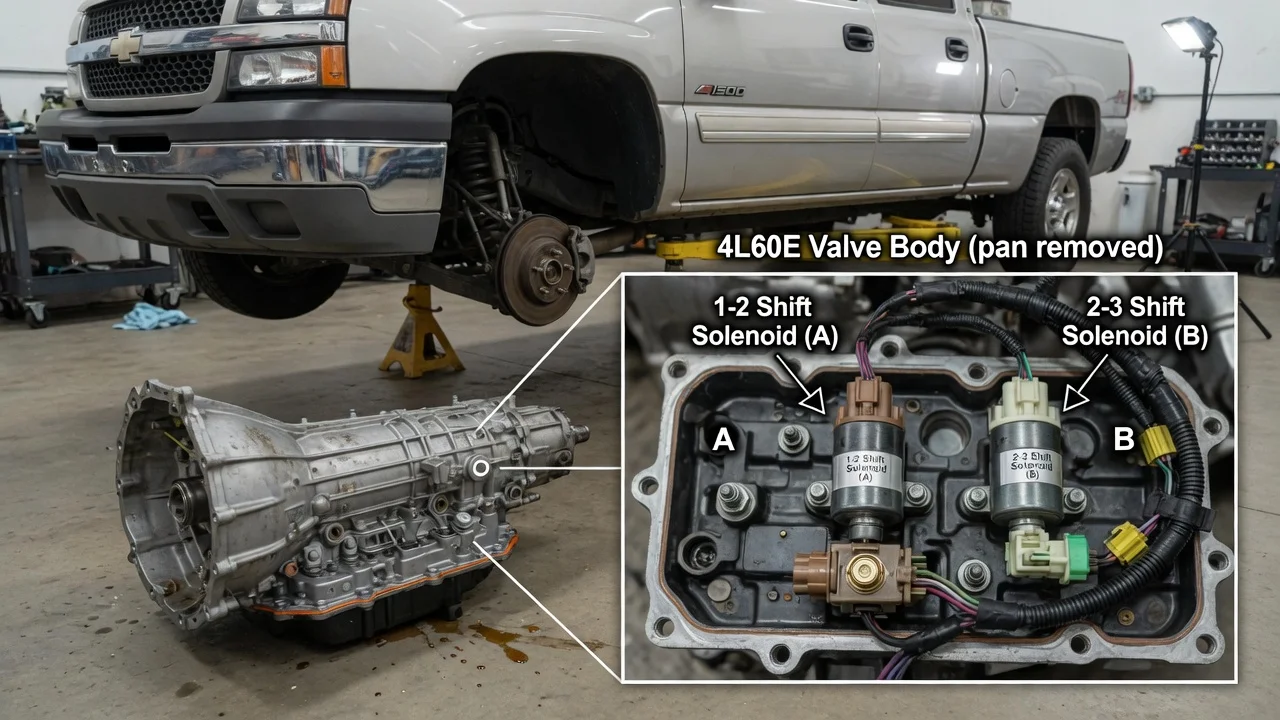
On a 2004 Chevrolet Silverado, the shift solenoids are not mounted on the outside of the transmission where you can reach them from under the truck. They sit inside the unit, attached to the valve body under the oil pan. Which solenoids you will find, and how much work it takes to reach them, depends on the transmission behind your engine. Identify the unit first, before you buy parts or pull the pan.
Where the shift solenoids are located
Most half-ton trucks from this year use the 4L60-E four-speed automatic. On that unit, shift solenoid A (the 1-2 solenoid) and shift solenoid B (the 2-3 solenoid) are mounted on the valve body at the bottom of the transmission case. To reach them, you drain the fluid and remove the transmission oil pan. That exposes the valve body. The solenoids sit in bores in the valve body, are held by retaining clips, and plug into an internal wiring harness. The same harness serves other electrical parts on the valve body, including the pressure control solenoid, the torque converter clutch solenoid and the 3-2 control solenoid. Not every solenoid you see under the pan is a shift solenoid, so confirm which part is which before you remove anything.
Heavier-duty 2004 Silverado configurations can use a different transmission: the 4L65-E, the 4L80-E, or the Allison 1000 paired with the Duramax diesel and some large gas engines. These transmissions also keep their shift solenoids inside, below the pan, but the number of solenoids, their arrangement, the part numbers and the access steps are not the same as on the 4L60-E. On the Allison, the solenoids are grouped on a control valve assembly at the bottom of the case, and the job is laid out differently from the GM four-speeds.
How the shift solenoids control gear changes
A shift solenoid is an electrically operated valve. When the control module energizes it, it opens or blocks a fluid passage in the valve body. That redirects hydraulic pressure to the shift valves, which in turn apply or release clutches and bands. On the 4L60-E, the on and off combination of solenoids A and B tells the transmission which gear to select. The truck's control module decides when to shift based on vehicle speed, throttle position, engine load and other inputs. On most gas versions this is the powertrain control module; the Allison uses its own transmission control module.
When a solenoid has an electrical fault or sticks mechanically, the transmission may not reach the gear the module commands. Typical shift behavior complaints include harsh or late shifts, no upshift, a truck that seems stuck in one gear, or a failsafe mode with a check engine light. These same symptoms can also come from low or degraded fluid, worn clutches, valve body wear, wiring damage, a faulty speed sensor or a module problem. A symptom alone does not confirm that a shift solenoid has failed.
What changes the answer for your truck
The biggest variable is transmission type. Check the Service Parts Identification label, usually in the glove box, which lists the option codes for the truck's equipment. Also check the identification tag or stamping on the transmission case. Engine size and model series (1500 versus heavier-duty versions) narrow down the likely unit, but confirm against the label rather than assuming. Correct fitment of a replacement solenoid, pan gasket and filter depends on knowing the exact transmission, and sometimes its build period.
The rest of the configuration matters too. Two-wheel drive and four-wheel drive trucks differ in what sits near the pan, such as crossmembers, exhaust components and transfer case hardware, so clearance and access vary. The fluid specification also depends on the unit. GM originally called for Dexron III on these GM automatics, a fluid that has since been superseded, and the Allison has its own published requirements. Confirm the current recommendation for your transmission in the owner's manual or service information. Service history matters as well: a transmission with overdue fluid changes, previous overheating or an earlier rebuild may behave differently from one with a clean record.
What the owner can check and do
Start with diagnostic codes rather than parts. A scan tool that reads powertrain codes can show whether the module has flagged a specific circuit or performance problem. Generic codes such as P0751 and P0756 point to shift solenoid A or B performance. P0753 and P0758 point to an electrical problem in those solenoid circuits. Write down every stored code and any freeze-frame data before clearing anything. Then check the fluid level and condition using the procedure for your transmission, which normally means checking at operating temperature with the engine running. Low fluid, a burnt smell or heavy debris changes the diagnosis considerably.
If the codes point to a circuit fault, inspect the external connector at the transmission case and the harness routing for damage, corrosion or chafing before opening the pan. Resistance checks at the connector against factory specifications can separate a wiring problem from a solenoid problem. Repair options range from replacing a single solenoid to replacing the solenoid set, a valve body, or rebuilding the transmission. Any job that removes the pan also needs a new gasket, normally a new filter, and a refill with the correct fluid and quantity. After the repair, the shift pattern may take some driving to settle as the module relearns. Some shops reset the adaptive values with a scan tool.
Limitations and next step
This article gives the general location and logic of the shift solenoids. It does not replace factory service information for exact solenoid positions, connector pinouts, resistance values, bolt torque or fluid capacity for your specific transmission. A new solenoid will not fix worn clutches, a damaged valve body or a failing torque converter. Fluid full of friction material or metal is a sign to stop and get a professional diagnosis before spending money on parts.
If you cannot identify the transmission with confidence, if codes keep returning after electrical checks, or if the truck uses the Allison 1000, a transmission specialist with the right scan equipment is usually the most efficient next step. Bring the stored codes, a description of when the problem happens, and whatever service history you have. That information shortens diagnosis and helps separate a solenoid fault from a deeper internal problem.