2004–2008 Ford F-150 4WD Actuator Fitment: Which Part Your Truck Needs
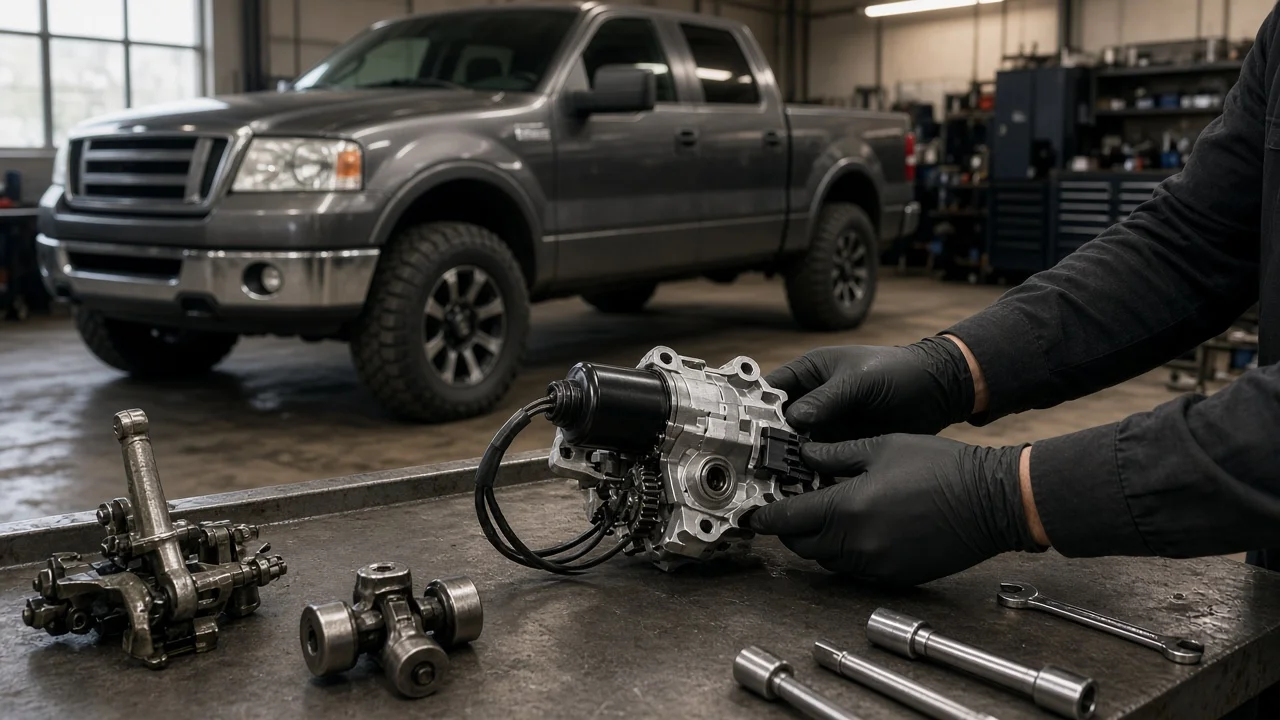
If you are shopping for a 4WD actuator for a 2004–2008 Ford F-150, the first job is figuring out which part the truck actually needs. On this generation, "actuator" can mean the electric transfer case shift motor, the vacuum solenoid that controls the front hubs, or the vacuum-operated hubs themselves. Matching the right component to your exact vehicle configuration avoids paying for a part that does not fit or does not fix the problem.
Short answer: which actuator fits
Most 2004–2008 F-150 4x4 trucks with a dash-mounted 4WD selector knob share the same basic layout. An electric shift motor bolts to the side of the transfer case and moves it between 2H, 4H and 4L. At the front, the wheels are connected and disconnected by vacuum-operated integrated wheel ends, usually called IWEs, which are controlled by a vacuum solenoid. Because the hubs handle front engagement on this design, a part sold as a "2004 F-150 front axle actuator" is usually the IWE solenoid or an IWE hub unit rather than a motor on the axle housing.
A part listed for 2004–2008 can be correct for a 2005 or 2008 truck, but the listing alone does not prove it. The 2004 model year also included the F-150 Heritage, which carried over the previous-generation truck and its 4WD hardware, so parts for the redesigned 2004 model should not be assumed to fit it. If your truck shifts the transfer case with a floor lever instead of a dash knob, it does not use the electric shift motor in the same way. A 2WD truck has none of these components.
How the 4WD system engages
When you turn the 4WD knob, the truck's control module commands the shift motor to rotate a shaft inside the transfer case. The motor assembly includes a position sensor, often called the encoder, that reports where the shaft stopped. If the reported position does not match the request, the shift may not complete and the 4x4 indicator may flash. Shifting into 4L has additional requirements, such as vehicle speed and transmission position, described in the owner's manual. A shift that does not happen because those conditions were not met is not an actuator failure.
The front hubs work differently. In 2WD, the solenoid applies engine vacuum to the IWEs to hold them disengaged, so the front axle shafts are not driven by the wheels. When 4WD is selected, the vacuum is released and the hubs engage. A leak anywhere in that circuit, whether in the solenoid, a cracked line or a worn hub seal, can let the hubs partly engage while the truck is in 2WD. That causes the grinding or ratcheting noise from the front wheels many owners report, which is why a lot of "bad actuator" complaints on these trucks turn out to be vacuum problems.
What changes the fitment
Model year and body style come first. The redesigned 2004 truck and the 2004 Heritage are different vehicles for parts purposes, and the F-150 was redesigned again for 2009, so parts for later trucks should not be assumed to interchange with 2004–2008 models. Within the 2004–2008 range, the transfer case and shift arrangement matter. Many transfer cases carry an identification tag on the case, and a VIN-based lookup at a parts counter can confirm what was installed at the factory.
The failed component matters just as much as the truck. A shift motor, an IWE solenoid, an IWE hub, a vacuum line and a wiring fault are separate repairs with separate parts, and they can produce overlapping symptoms. Service history can complicate things: if a previous owner installed an aftermarket motor or hub, its connector or mounting may differ from the original. Operating conditions also play a role. Road salt corrodes connectors and vacuum fittings, and a truck that rarely uses 4WD can develop a sticky shift mechanism that makes a good motor look faulty.
Checks before you order a part
Confirm the configuration first: 4x4 or 4x2, dash knob or floor lever, and the transfer case tag if you can reach it. Then write down the symptom precisely. Note whether the truck will not shift into any 4WD mode or only refuses 4L, whether the indicator flashes, and whether there is grinding in 2WD. Note when it happens, such as right after a cold start, at low speed or only after the truck has been in 4WD. That record narrows the search to one part of the system.
For the transfer case side, listen near the shift motor while a helper selects 4H under the conditions the owner's manual specifies. A motor that runs but does not complete the shift points toward the encoder, the motor's internal parts or the transfer case itself. Silence points toward power, ground, fuses, the connector or the motor. For the front hubs, inspect the vacuum lines from the solenoid to each wheel for cracks, loose ends and damage. A hand vacuum pump can show whether a hub or line holds vacuum, which separates a leak from a solenoid fault.
When you buy, match the replacement by VIN and compare it with the original: connector shape, mounting points and any markings on the old part. If one IWE has failed, inspect the other side too, since both hubs share the same vacuum circuit. These parts do not have a replacement interval on a maintenance schedule; replace them because inspection shows a fault, not because of mileage.
Limits and when to get help
This guide explains the system layout and how to narrow down the failed part, but it cannot confirm a part number for your specific truck. Catalog listings vary, and a broad 2004–2008 label is not a guarantee. Use a VIN-based lookup or a dealer parts counter for the final match, and follow manufacturer specifications and service information for fastener torque, procedures and any transfer case fluid requirements.
See a technician with a capable scan tool if the 4x4 indicator keeps flashing after a new shift motor is installed, if there are stored codes you cannot interpret, if hubs grind even though the vacuum circuit tests tight, or if noise seems to come from inside the transfer case. Those cases point to control, wiring or internal mechanical faults that a bolt-on actuator will not fix. Until the problem is diagnosed, avoid driving in 4WD on dry pavement, because the part-time system is not meant for high-traction surfaces and can bind.