Identifying a 2003 Toyota RAV4 Transmission Shift Solenoid
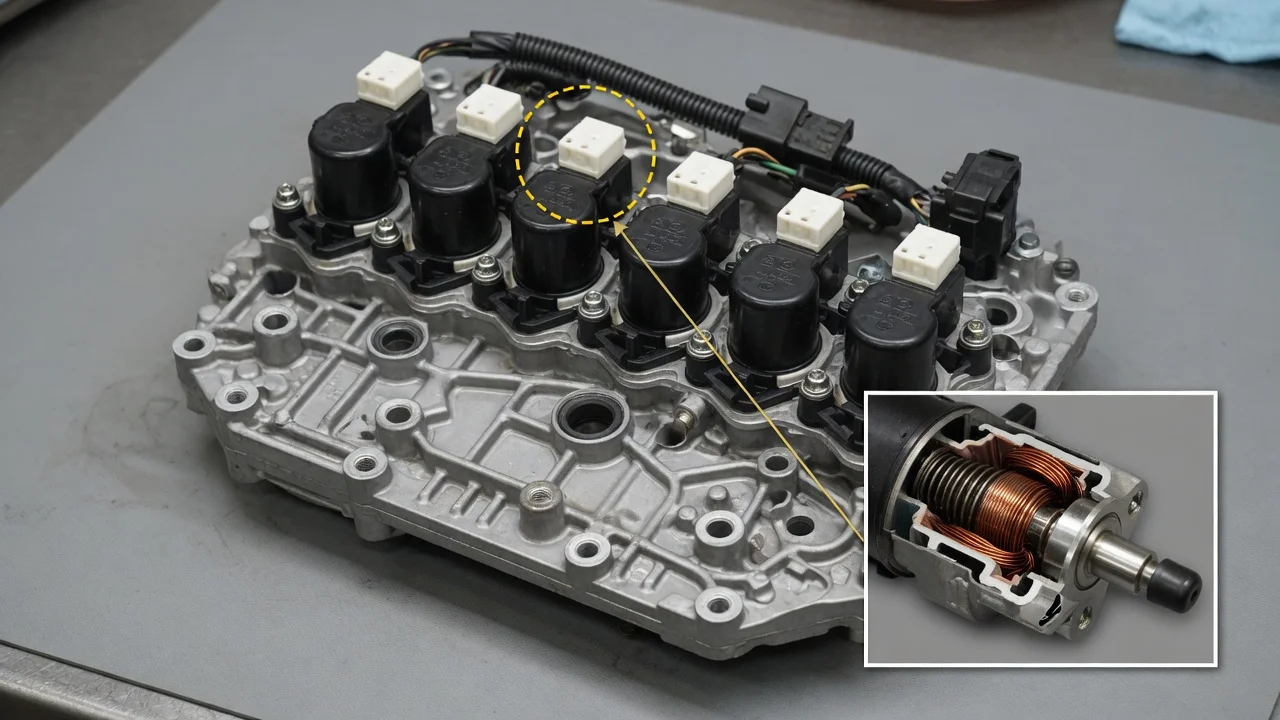
When a 2003 Toyota RAV4 starts shifting harshly, refuses to upshift or sets a transmission trouble code, the shift solenoids are a common suspect. To find the right solenoid, first confirm which transmission the vehicle has, then match the code to a specific valve. This guide explains how the solenoids work, what changes the answer for your vehicle, and how to tell a true solenoid fault apart from wiring, fluid or internal problems.
The short answer
Only 2003 RAV4s with the four-speed automatic have shift solenoids. The five-speed manual does not use them. On the automatic, the solenoids are electrically operated valves mounted on the valve body inside the transmission, above the oil pan. Toyota service information identifies each one by a letter, and the diagnostic code tells you which circuit the computer flagged. To identify the correct part, read the codes, confirm the exact transmission model and drivetrain from the vehicle labels or VIN, and match the code to the solenoid using the repair information for that transmission.
A stored code points to a circuit, not necessarily to a failed solenoid. Damaged wiring, a corroded connector, low or degraded fluid and internal wear can all produce the same complaints. Treat the code as the starting point of the diagnosis, not as proof that a particular part has failed.
How the shift solenoids control gear changes
The powertrain computer reads inputs such as vehicle speed, throttle position, engine load and transmission fluid temperature, then decides which gear the vehicle should be in. It switches the shift solenoids on and off in set combinations. Each combination routes pressurized fluid through passages in the valve body to apply the clutches and brakes for a given gear. Some solenoids act as simple on-off valves. Others are modulated to control line pressure or torque converter lockup, which affects how firm each shift feels and when the converter locks at cruising speed.
If a solenoid circuit opens or shorts, the computer usually detects the electrical fault and stores a code. If a solenoid sticks mechanically, or debris blocks its valve, the computer may instead notice that the gear ratio it measures does not match the gear it commanded, which sets a performance-type code. Many Toyota automatics of this era then switch to a fail-safe strategy that limits the available gears so the vehicle can still be driven. A RAV4 that seems stuck in one gear may therefore be protecting itself, rather than showing the direct mechanical effect of a single failed valve.
What changes the answer for your RAV4
Transmission type comes first. Manual versus automatic settles whether solenoids apply at all. Among automatics, front-wheel-drive and four-wheel-drive versions can differ in case design and internal parts, so solenoid part numbers may not be interchangeable. Fitment should be confirmed by VIN through a parts department or a VIN-based catalog, not by model year alone. The identification label on the transmission case and the vehicle's build information help remove any doubt.
The type of code also matters. Generic OBD-II codes P0750, P0755, P0760 and P0765 refer to shift solenoid A, B, C and D circuit faults, which point toward an electrical problem in the solenoid or its wiring. Codes in the same family that describe performance or a stuck condition suggest a hydraulic or mechanical problem instead. Torque converter lockup solenoid faults are reported under separate codes. The generic letters A, B, C and D do not always line up with Toyota's own solenoid labels, so cross-check the code definition against the repair information for your transmission before ordering anything.
Service history and operating conditions round out the picture. A transmission that has never had a fluid service, has overheated while towing, or has had previous valve body work behaves differently from a well-maintained one. Note whether the problem appears only when the transmission is cold, only when it is fully warm, or after driving over rough roads. Intermittent electrical faults often follow temperature or vibration, while hydraulic problems tend to change with fluid condition and temperature.
What the owner can check before buying parts
Start by reading all stored and pending codes with a scan tool and record the freeze frame data, which shows speed, temperature and load when the fault was logged. Then write down the shift behavior in detail: which shift is late or harsh, whether the transmission holds one gear, and whether the problem started suddenly or gradually. If the O/D OFF indicator on the dash blinks while driving, the computer has likely stored a transmission-related fault, which is worth noting even if the check engine light is off.
Next, check the fluid level and condition using the procedure in the owner's manual, which for this era of Toyota automatic is typically done with the engine running, the fluid at operating temperature and the vehicle on level ground. Confirm the fluid specification printed on the dipstick or in the owner's manual; Toyota automatics of this period commonly call for Type T-IV fluid, and using the wrong fluid can change shift behavior. Dark, burnt-smelling fluid or visible particles suggest internal wear that a new solenoid alone will not fix.
If the code points to an electrical circuit, inspect the harness connector at the transmission case for corrosion, bent pins or a loose fit, and look along the wiring for chafing. With factory specifications in hand, solenoid resistance can be measured at the connector; a reading within spec shifts suspicion toward the wiring or the computer. If replacement is justified, the pan usually has to come off to reach the solenoid on the valve body. Inspect the pan magnet for heavy metal debris, keep dirt out of the valve body, use new seals and a new gasket, refill with the correct fluid to the correct level, clear the codes and road test.
Limitations and next step
Without factory repair data you cannot confirm resistance specifications, solenoid letter assignments or exact positions on the valve body for your transmission, and general guidance cannot replace those details. Repair options range from replacing a single solenoid, to a complete solenoid set, to a valve body, to a rebuilt or replacement transmission. The right choice depends on what testing shows, not on the symptom alone.
If there are several transmission codes at once, the transmission slips, the fluid is burnt, or the pan contains significant metal debris, have a transmission specialist evaluate it before buying parts. A shop with a capable scan tool can command individual solenoids, watch live data and pressure readings, and confirm whether the fault is electrical, hydraulic or mechanical. Bring the codes, freeze frame data, VIN and any service records so the diagnosis starts from facts rather than guesses.