Identifying a 2003 Honda Accord Transmission Shift Solenoid
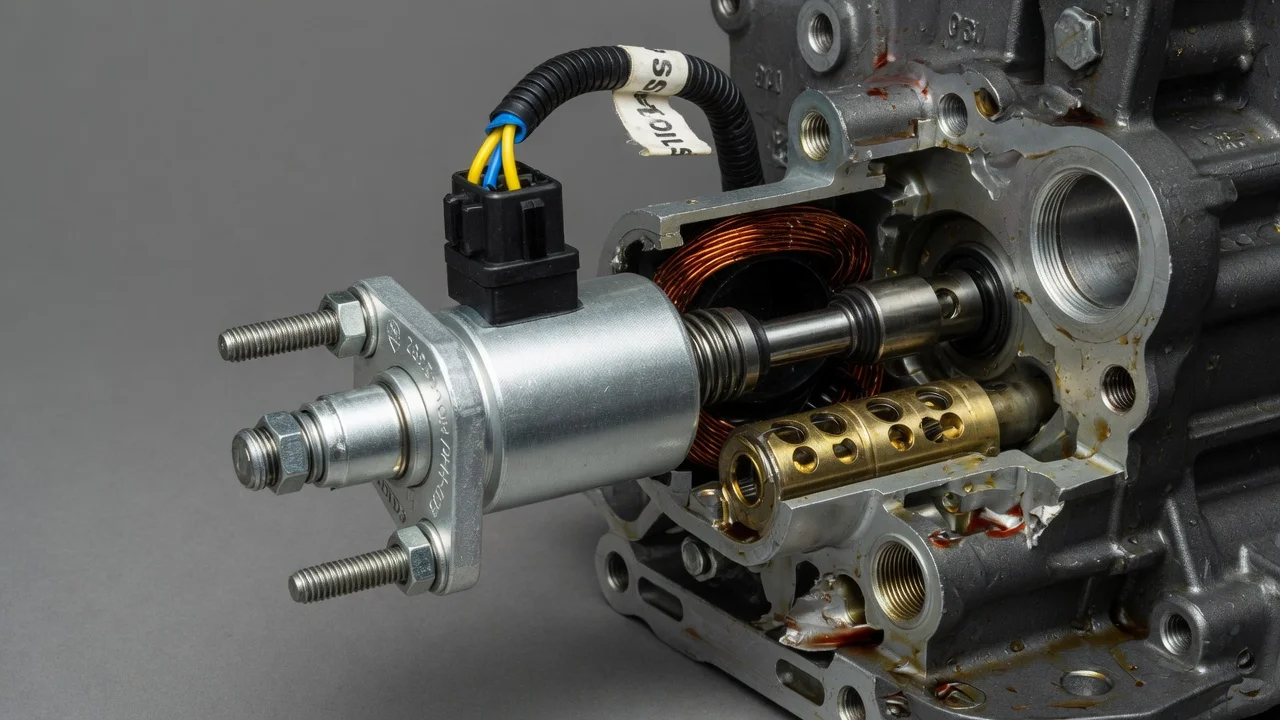
If your 2003 Honda Accord shifts harshly, flares between gears or sets a transmission code, a shift solenoid is one possible cause, not a confirmed one. Identifying the right solenoid starts with knowing which transmission the car has, then matching a diagnostic code or test result to a specific valve. This guide explains how to narrow it down, what these parts do, and when the problem is more likely inside the transmission than in a bolt-on component.
Which shift solenoid does a 2003 Accord use?
There is no single shift solenoid on a 2003 Accord. The 2003 model year began the seventh-generation Accord, and both the 2.4-liter four-cylinder and the 3.0-liter V6 were offered with a five-speed automatic. That automatic uses several solenoid valves: on/off shift solenoids that select gear circuits, plus linear pressure control solenoids that manage how firmly clutches apply. If your car has a manual gearbox, it has no shift solenoids at all, and shifting complaints point elsewhere.
To identify the correct part, you need two things: the transmission fitted to your specific car, confirmed by the VIN and ideally the transmission identification label on the case, and a reason to suspect a particular solenoid, usually a stored code that names it by letter. Without both, ordering a solenoid is guesswork. The four-cylinder and V6 transmissions are different units, and their solenoids are not assumed to be interchangeable.
How Honda shift solenoids work
Honda automatics of this era use separate clutch packs for each gear rather than planetary gearsets. The powertrain control module reads vehicle speed, throttle position, engine load and fluid temperature, then energizes or releases the shift solenoids to route pressurized transmission fluid to the clutch for the gear it wants. The linear pressure control solenoids vary that pressure so engagement is smooth rather than abrupt. Pressure switches report back to the module so it can tell whether a commanded clutch actually received pressure.
On most units of this generation, the solenoids bolt to the outside of the transmission case with an electrical connector, a gasket or O-rings, and often a small fluid screen. That placement makes them more accessible than solenoids buried behind an oil pan, but it also means their performance depends heavily on clean fluid. Debris from clutch wear can restrict a solenoid or its screen, so a solenoid fault can be a symptom of wear elsewhere rather than the root cause.
What changes the answer
Engine and transmission type matter first. A four-cylinder sedan and a V6 coupe use different automatic transmissions, so solenoid location, part number and connector can differ. Service history is the next variable: many 2003 Accords have had their original transmission replaced with a remanufactured or used unit, and the replacement may not match what the VIN suggests. Check the transmission label rather than relying only on the model year when fitment is in doubt.
The type of diagnostic code also changes the conclusion. Generic codes in the P0750 to P0770 range generally describe a shift solenoid circuit, with the letter A through E identifying which valve; separate codes cover pressure control solenoids. A circuit code points toward the solenoid, its wiring or its connector. Codes for incorrect gear ratio or shift malfunction, such as those in the P0730 range or P0780, describe a result rather than a part, and they are frequently caused by worn clutches, low fluid or hydraulic problems. Symptoms that appear only when the transmission is cold or only after it is fully warm add another clue about whether the fault is electrical, mechanical or fluid related.
What the owner can do
Start by reading codes with a scanner that can access transmission codes, not only engine codes, and write down the exact code and its description. Note the shift behavior that accompanies it: which gear change is affected, whether the car slips, flares, bangs into gear or stays in one gear, and whether the problem depends on temperature. This record is more useful to a technician than a description of noise alone.
Check the fluid level and condition using the dipstick procedure in the owner's manual, which specifies engine temperature and timing. The fluid specification for this car was originally Honda ATF-Z1; Honda later replaced it with ATF DW-1 for service use. Generic multi-vehicle fluids are a common source of shift complaints on Honda transmissions, so the service history of fluid changes is worth confirming. Dark fluid, a burnt smell or visible particles suggest internal wear that a solenoid will not fix.
If a solenoid circuit code is present, inspect the connector for corrosion, bent pins or fluid intrusion and look for chafed wiring near the transmission. Resistance can be measured across the solenoid terminals, but the result only means something when compared with the specification in the service manual for your exact transmission. When replacing a solenoid, order it by VIN, use new seals, and clear codes afterward so you can tell whether the fault returns.
Limitations and next step
Solenoid locations, resistance values, torque figures and part numbers vary by transmission, so treat any general guide, including this one, as orientation rather than a procedure. A failed solenoid is confirmed by testing, not by a symptom. Harsh shifts and slipping on this generation of Accord can come from clutch wear inside the transmission, and replacing an external solenoid in that situation adds cost without solving the problem.
If codes point to gear ratio or slip, if the fluid shows wear debris, or if a new solenoid does not clear a circuit code, a transmission specialist is the practical next step. A shop with Honda-capable diagnostic equipment can command individual solenoids, watch pressure switch feedback and separate electrical faults from hydraulic ones. Repair options then range from a connector or solenoid repair and correct fluid service to a rebuild or replacement transmission, and that diagnosis is what determines which option makes sense for your car.