Identifying a 2002 Ford Focus Transmission Shift Solenoid
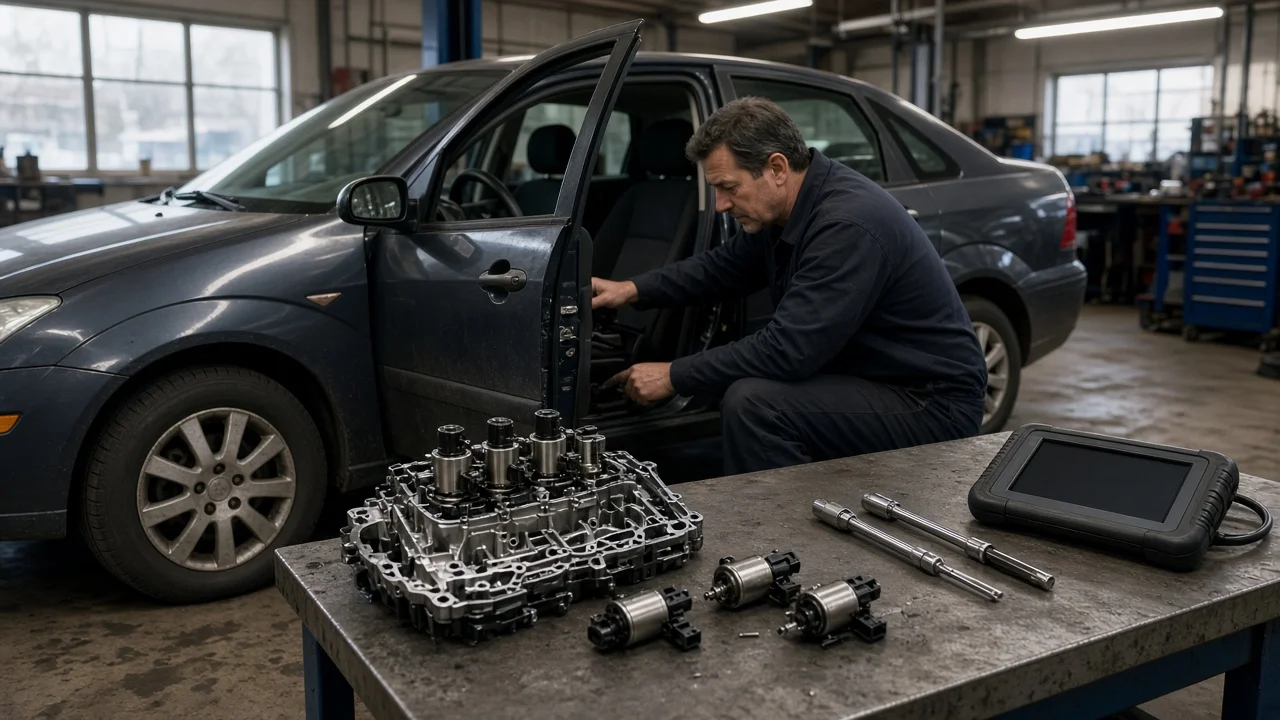
If your 2002 Focus shifts harshly, refuses to upshift, or has set a transmission code, a shift solenoid is a common suspect. Before you order a part, confirm which transmission the car has, how its solenoids are arranged, and what the diagnostic codes and shift behavior suggest. A symptom alone rarely proves that a specific solenoid has failed, and the wrong assumption can cost more than a proper diagnosis.
Which Shift Solenoids a 2002 Focus Uses
Shift solenoids only apply to a 2002 Focus with an automatic transaxle. In this model year the automatic is the 4F27E, a four-speed unit also known as the FN4A-EL. Manual-transmission Focus models, including the SVT version, have no shift solenoids because the driver selects gears mechanically.
On the 4F27E, the shift solenoids are electrically controlled valves mounted on the valve body inside the transaxle. They are identified by letter, such as shift solenoid A, B, and so on, and they sit alongside other solenoids that control torque converter clutch apply and line pressure. Because they are internal, identifying the one involved usually starts with a stored trouble code and the matching circuit, not with a visual inspection. On many units these solenoids are serviced as a combined solenoid block rather than as separate parts, so check how the replacement is supplied for your exact transmission before planning the repair.
How Shift Solenoids Control Gear Changes
The powertrain control module decides when to shift using inputs such as vehicle speed, throttle position, engine load, and transmission range. It then switches the shift solenoids on or off in specific combinations. Each solenoid opens or closes a fluid passage in the valve body, which routes pressurized fluid to the clutches and bands that engage a particular gear.
This means a gear change depends on three things working together: the electrical command from the module, the solenoid itself moving freely, and clean fluid at the correct pressure. A fault in any of these can produce the same complaint. A broken wire, a corroded connector, contaminated fluid, a sticking valve, or low line pressure can all mimic a failed solenoid. When the module detects an electrical problem in a solenoid circuit, it typically stores a code and may place the transmission in a fail-safe mode that holds one gear to protect the unit.
What Changes the Answer
Fitment depends on the exact transmission, not just the model year. Confirm the transaxle type from the VIN, the original window sticker, or the identification tag on the transaxle case. Engine choice, build date, and any earlier transmission replacement can all matter, because a used or remanufactured unit may not match the original specification. Service history is useful here: a previous rebuild or valve body replacement changes what parts are inside.
The type of fault also changes the answer. An electrical code points toward the solenoid circuit, which includes the wiring, connector, and the solenoid coil. A shift-performance or ratio code, with no circuit fault, more often points toward hydraulic or mechanical causes such as worn clutches, a sticking valve, or fluid problems. Operating conditions matter too: a problem that appears only when the transmission is hot or cold, or only in one gear, narrows the possibilities in a way a single symptom cannot.
What You Can Check Yourself
Start by reading the codes with a scan tool that can access transmission data. Generic codes in the P0750 to P0770 range relate to shift solenoid circuits, while other codes cover torque converter clutch and pressure control. Write down every stored code before clearing anything, since the combination is often more informative than any single code. On many Ford automatics of this era, a flashing overdrive-off indicator also signals a stored transmission fault.
Next, check the fluid level and condition using the procedure in the owner's manual, with the engine and transmission at the specified temperature. Low, burnt, or debris-filled fluid can cause shift problems on its own and can also make new solenoids fail early. Use only the fluid specification listed in the owner's manual or on the dipstick for your transmission; the wrong fluid can affect shift quality.
Then inspect the external wiring and the transmission connector for damage, oil intrusion, bent pins, or corrosion. Note the shift behavior carefully: which gears are missing, whether the car starts in a higher gear, and whether the problem changes with temperature. These observations, together with the codes, give a technician a clear starting point and help you compare repair options such as a connector repair, a solenoid block replacement, or a more extensive transmission service.
Limitations and When to Get Help
Without electrical testing and access to factory diagnostic procedures, you cannot confirm that a solenoid has failed. Proper diagnosis involves checking circuit resistance and continuity against published specifications, commanding solenoids with a capable scan tool, and sometimes measuring line pressure. Replacing the solenoids also requires removing the valve body cover and handling internal components, and the work must follow the correct procedure and torque values for the 4F27E.
If codes point to a circuit fault and the wiring looks sound, or if the transmission is stuck in one gear, have a transmission specialist test it before buying parts. Bring your code list, fluid observations, and any service history. If the diagnosis confirms a solenoid fault, ask whether the fluid and filter should be serviced at the same time and whether the valve body shows wear, since those factors affect how long the repair will last.