Identifying a 2001 Honda Civic Automatic Transmission Shift Solenoid
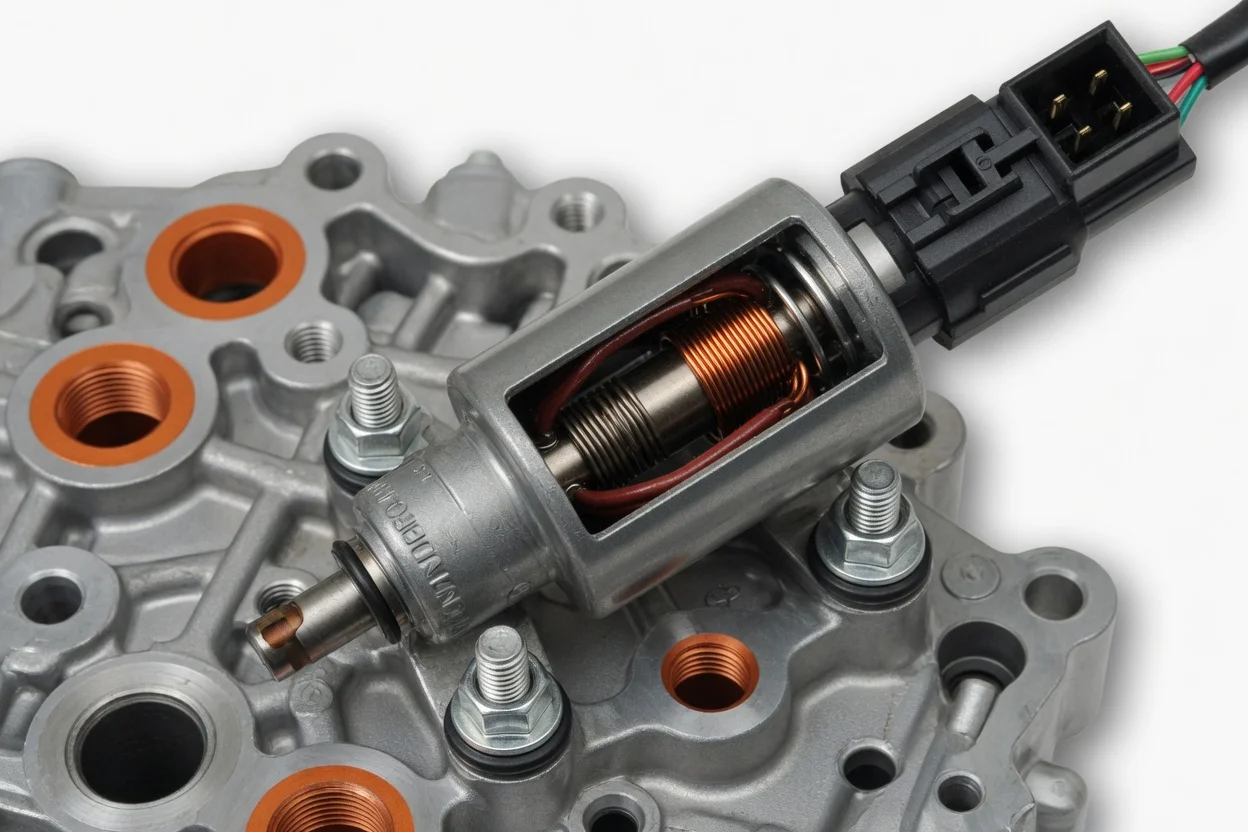
A 2001 Honda Civic with harsh shifts, a missing gear or a transmission trouble code often leads owners to suspect a shift solenoid. Finding the right part starts with three questions: which transmission the car has, which solenoid circuit the computer is flagging, and whether the fault is really the solenoid rather than wiring, fluid or internal wear. This guide explains how to narrow that down before you buy parts.
Short answer: confirm the transmission, then the solenoid
Most automatic 2001 Civics use Honda's conventional four-speed automatic. It relies on several electrically operated solenoid valves bolted to the outside of the transmission case, which the powertrain control module (PCM) switches on and off to select gears and control torque converter lock-up. The HX trim could be ordered with a continuously variable transmission (CVT) instead. A CVT has no conventional gear shift solenoids and uses a different control system, so a part meant for the four-speed will not apply to it.
To identify the solenoid, first read the stored diagnostic codes and note which circuit the code names, such as shift solenoid A, B or C, or the lock-up circuit. Then match the part using the vehicle identification number and the transmission model code on the case label. A code that names a solenoid circuit confirms an electrical problem somewhere in that circuit. It does not prove the solenoid itself has failed.
How the shift solenoids control gear changes
Honda automatics of this era engage each gear with its own hydraulic clutch rather than with bands. The valve body routes pressurized fluid to the clutch for the selected gear. The shift valves inside it move according to fluid pressure that the solenoids either allow or block. The PCM reads vehicle speed, throttle position and engine load, then energizes a specific combination of solenoids for each gear. Because gears depend on combinations, one faulty solenoid can cause several different symptoms: skipping a gear, starting off in the wrong gear, or holding a single fixed gear.
A separate solenoid controls the torque converter clutch, which locks the converter at cruising speed to reduce slip. Depending on the unit, another solenoid may regulate clutch pressure to smooth each shift. These valves have very small fluid passages. Many Honda solenoid assemblies also carry a fine screen or filter at the mounting face. Debris from worn clutches or degraded fluid can restrict them, so a solenoid that is electrically sound can still behave as if it has failed.
What changes the answer for your car
Transmission type is the biggest variable. After that, fitment can vary by transmission model code and production date within the same model year. A catalog listing by year and model alone may cover more than one part. Some solenoids are sold individually and others as an assembly containing more than one valve. Letter designations in aftermarket catalogs do not always line up with Honda's naming. Checking the transmission label and decoding the VIN with a parts supplier or dealer is the reliable way to confirm fitment.
Operating conditions and service history also matter. A fault that appears only when the transmission is hot, or only after a cold start, can point to a connector or wiring issue rather than a dead solenoid. The fluid specification matters as well. The four-speed automatic calls for genuine Honda ATF; the original Z1 has since been superseded by DW-1. The CVT requires its own Honda CVT fluid. Using the wrong fluid, or overdue fluid changes, can change shift behavior and make solenoid diagnosis misleading.
Symptoms versus a confirmed solenoid fault
Shift behavior that commonly raises suspicion includes: • Delayed or harsh engagement; • Engine flare between gears; • Being stuck in one gear; • Higher than normal highway rpm because the converter no longer locks up; • A check engine light, or a blinking D indicator, which on many Honda automatics of this period signals a stored transmission fault; The same symptoms can also come from low or worn fluid, slipping clutches, faulty pressure switches, damaged wiring or a PCM problem.
The generic OBD-II definitions help separate electrical faults from performance faults. P0753, P0758 and P0763 refer to the electrical circuits of shift solenoids A, B and C, and P0740 refers to the torque converter clutch circuit. Codes such as P0780, a shift malfunction, mean the transmission did not respond as commanded, which may be hydraulic or internal rather than electrical. Honda-specific definitions can differ, so confirm each code against the service information for your transmission.
What the owner can do
Start with an OBD-II scan. Record every code and any freeze-frame data before clearing anything. Next, check the fluid level and condition using the procedure in the owner's manual. Note if the fluid looks dark, smells burnt or carries visible debris. Then inspect the connectors and harness at the solenoids for corrosion, bent pins, loose locks or chafed insulation. Wiring faults are common on older vehicles and cost far less to fix than a solenoid.
With the factory service manual in hand, you can measure solenoid resistance at the connector and compare it with the published specification. Follow only the bench or activation tests the manual describes. If you replace a solenoid, use new gaskets or O-rings, keep the mounting surface clean and top up with the correct fluid. Then clear the codes and road test through every gear. Honda generally specifies drain-and-fill fluid service rather than a pressure flush.
Repair options range from fixing the wiring or connector, to replacing a single solenoid or solenoid assembly, to a fluid service, to rebuilding or replacing the transmission when internal wear is confirmed. Matching the repair to the actual test results avoids paying for a part that will not cure the problem.
Limitations and next step
General guidance cannot tell you exactly where each solenoid sits on your specific unit, its correct resistance value, or the right part number. That information comes from vehicle-specific service data. A shop with a scan tool that can read Honda transmission data and command individual solenoids can often confirm a fault faster than parts swapping. If the fluid carries heavy clutch material or the transmission slips under load, a new solenoid is unlikely to restore normal operation, and a professional transmission evaluation is the better next step.
Before ordering parts or booking diagnosis, gather the VIN, the transmission model code, all stored codes, a note on fluid condition and the vehicle's service history. With those details, a parts supplier can confirm fitment and a technician can decide whether the solenoid, the wiring or the transmission itself needs attention.