Identifying a 2001 Dodge Ram 1500 Transmission Shift Solenoid
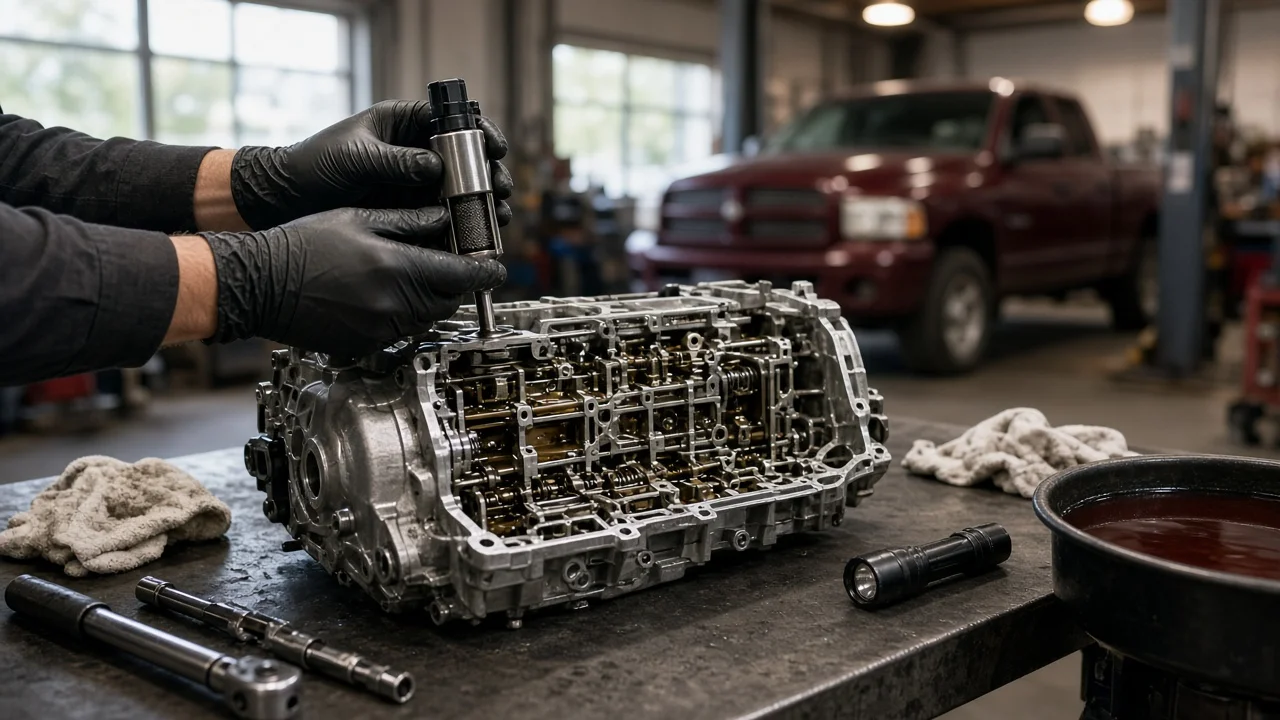
Owners searching for a shift solenoid for a 2001 Dodge Ram 1500 often expect a single part that controls every gear change. This truck works differently. Its automatic transmissions rely mostly on hydraulic valves, with electronic solenoids handling only specific jobs. Before ordering anything, you need to know which transmission is in the truck, which solenoid governs the behavior you are seeing, and whether the symptom points to a solenoid at all.
Which Solenoids a 2001 Ram 1500 Actually Has
Automatic versions of the 2001 Ram 1500 use a four-speed transmission from Chrysler's RE family, most commonly the 42RE or the heavier-duty 46RE depending on engine and drivetrain. These units do not have a conventional set of shift solenoids that select first, second and third. Instead, they use two electrical assemblies inside the pan. The first is the overdrive and torque converter clutch solenoid assembly, a single component containing two solenoids: one controls the shift into fourth gear, and the other applies the converter clutch for lockup. The second is the governor pressure solenoid, which works alongside a governor pressure sensor to regulate the pressure that tells the valve body when to upshift.
So when a parts listing says shift solenoid for this truck, it usually means the overdrive/converter clutch assembly, and sometimes the governor pressure solenoid. Trucks with a manual transmission have no shift solenoid at all, so the first step is confirming that the truck is an automatic.
How Shifting Works in the RE-Family Automatics
In these transmissions, the 1-2 and 2-3 shifts are decided by hydraulic balance in the valve body. Two inputs drive that balance: throttle pressure, set mechanically by a throttle valve cable linked to the accelerator, and governor pressure, which rises with vehicle speed. Since the mid-1990s, governor pressure has been controlled electronically. The powertrain control module reads the governor pressure sensor and commands the governor pressure solenoid to produce the pressure appropriate for the truck's speed. If that pressure is wrong, upshifts arrive late, early or not at all.
The overdrive and converter clutch solenoids act after that. When conditions are right, the control module energizes the overdrive solenoid to allow the 3-4 shift, and the converter clutch solenoid to lock the torque converter at cruising speed. The overdrive off switch on the shifter lets the driver block fourth gear, and its indicator light reflects that state. Because control is split between hydraulics, a cable and electronics, a shift complaint can come from any of the three.
Configurations That Change the Answer
Transmission type is the main variable. The 42RE and 46RE share the same control concept, but internal parts, valve bodies and some components differ, and part catalogs may split fitment by transmission model, engine, two-wheel or four-wheel drive, and production date. Parts listed for a later Ram generation or a different transmission family may look similar but will not necessarily fit, so match the part to your specific unit rather than to the model year alone.
The symptom also changes which component deserves attention. No shift into fourth, or a flashing overdrive off light, points toward the overdrive circuit. No converter lockup at highway speed, or stalling when coming to a stop, points toward the converter clutch circuit. Erratic upshifts, staying in first or second, or very harsh shifts suggest governor pressure control, but a misadjusted throttle valve cable can cause similar behavior. Low or degraded fluid and worn internal parts can imitate any of these. A symptom narrows the search; it does not confirm a failed part.
Practical Steps Before Buying Parts
Start by identifying the transmission. The original build information tied to the VIN can be decoded by a dealer, and the transmission case usually carries a stamped or tagged identification number. If the transmission has been replaced, the service history may show a different unit than the truck was built with, so the case marking is the more reliable reference.
Next, check the basics. Verify fluid level and condition with the engine running and the transmission at operating temperature, following the procedure for your transmission. These units call for fluid meeting Chrysler's ATF+4 specification, which superseded the earlier ATF+3; the wrong fluid can affect shift behavior. Confirm the overdrive off switch is not engaged, and have the throttle valve cable adjustment checked, especially after any throttle body or cable work.
Then read stored diagnostic codes with a scan tool that can access transmission-related data. Codes for the governor pressure circuit, overdrive solenoid circuit or converter clutch circuit indicate an electrical fault that may lie in the solenoid, the wiring, the case connector or the control module. A capable scan tool can also show live governor pressure and allow the solenoids to be commanded, which helps separate electrical faults from hydraulic ones. Both solenoid assemblies sit inside the transmission, so replacement means dropping the pan, and it is sensible to replace the filter and refill with the correct fluid at the same time.
Limitations and When to Get Help
This overview cannot replace the factory service information for your exact transmission, which provides resistance specifications, pressure values, cable adjustment steps and connector pinouts. If codes are absent, readings are inconclusive, or the fluid shows heavy debris or a burnt smell, the problem may be internal wear rather than a solenoid, and a new solenoid will not fix it. In that case, a transmission specialist who can perform pressure tests and road-test the truck with live data is the better next step. Comparing the cost of solenoid replacement with the likely condition of the transmission helps you choose among repair options before committing to parts.