Choosing Transmission Cooler Lines for a 2001 Dodge Ram 1500
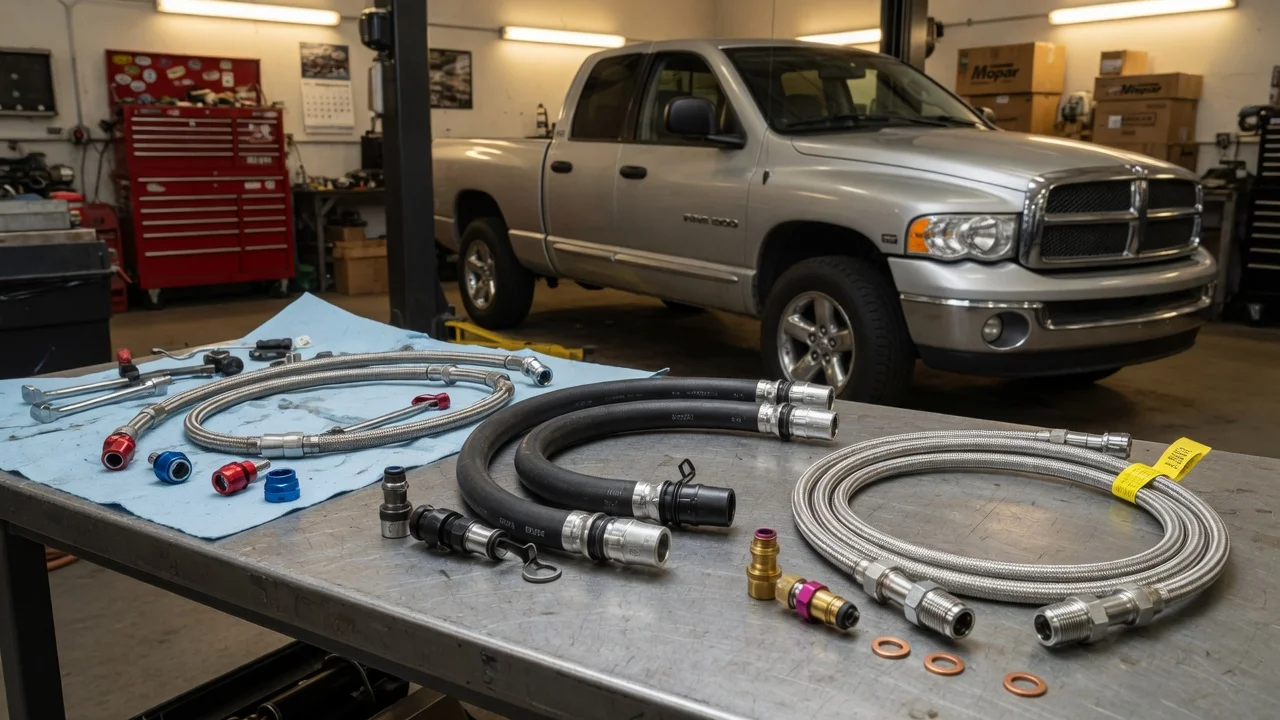
On a 2001 Dodge Ram 1500 with an automatic, the transmission cooler lines carry fluid to the cooler and back. A rusted, kinked or leaking line can drain fluid quickly. Buying replacement lines is simple only after you know exactly what your truck has. This guide covers how to match lines to your transmission and cooling setup, which construction choices matter, and what the job costs beyond the parts.
Define the job the product must do
Start with why you are shopping, because that decides what you buy. There are four common reasons. Road salt may have corroded steel sections of the lines. The crimp where rubber hose joins steel tube may be weeping. An earlier patch may have failed. Or you may be adding or replacing an auxiliary cooler for towing. Depending on the reason, you may need a full preformed line set, a single supply or return line, or only a short hose section. Decide how you will use the truck after the repair too. Regular towing or hauling puts more heat into the fluid and makes routing and line quality more important.
Confirm the source of the leak before you order anything. Fluid on a cooler line does not prove the line has failed. ATF runs along lines, crossmembers and the frame, so the real source could be the pan gasket, a fitting at the case, the radiator's internal cooler, an auxiliary cooler or the front pump seal. Clean the area, run the truck and look for where fresh fluid first appears. Also note any change in shift behavior and check the service history. Slipping, delayed engagement or burnt-smelling fluid that showed up alongside the leak may mean the transmission needs a diagnosis before you spend money on lines. A leak by itself rarely sets diagnostic codes. Treat a scan and a fluid level check as part of the picture, not as proof of a specific failed part.
Check compatibility for your truck
First, identify the transmission type. The 2001 Ram 1500 was offered with a manual gearbox, which has no cooler lines, and with four-speed automatics from Chrysler's RE family. Which automatic your truck has depends on engine and drivetrain. Confirm it from the identification tag on the transmission case, the original build documentation or a VIN decode at a parts counter, rather than guessing from engine size. Line routing also differs by engine (3.9L V6, 5.2L V8 or 5.9L V8), by two-wheel or four-wheel drive, and by whether an auxiliary transmission cooler was fitted at the factory or added later.
For fitment, check these details: tube outside diameter, the fitting type at the transmission and at the radiator (threaded or quick-connect with a retaining clip, depending on configuration), overall length and bend pattern, bracket and clip locations, and whether each line is the supply or the return. Photograph the routing and every clip before you remove anything, and lay the old line beside the new part to compare. Be wary of a listing that says only that it fits a Ram 1500 without naming engine, drive type and cooler setup. The fluid specification does not affect which line you buy, but plan for it now. These RE automatics call for ATF+4, which supersedes the ATF+3 named in some original literature. Confirm the requirement in your owner's manual and buy enough to cover what drains out.
Features that affect the choice
Preformed steel lines are closest to the original design. They have the factory bends and end fittings and clip into the existing brackets. The drawback is that long, rigid pieces can be hard to work past the exhaust, frame and steering components, and they can arrive bent from shipping. Some are coated, and some are made of stainless steel to resist rust. Stainless lasts well in salted regions, but it is stiffer to adjust and harder to flare if a bend needs correcting.
Hose-based repairs replace a corroded section with transmission oil cooler hose clamped over the remaining steel tube. They cost less and tolerate small routing differences. To be reliable, they need hose rated for transmission fluid at operating temperature and pressure, proper clamps, and a bead or barb on each steel end so the hose cannot push off. Ordinary fuel or heater hose is not a substitute. Many technicians avoid compression unions on these pressurized, vibrating lines and prefer a double-flared splice or a correctly clamped hose section. A braided outer cover mainly resists abrasion, so check the rating of the inner hose instead of relying on how the cover looks.
Treat labels such as heavy duty or OE quality as marketing unless the listing backs them up with material, diameter, fitting type and hose rating. More useful evidence includes a match to your original part number, clear photos of both ends, and fitment notes that name engine, drive type and cooler configuration.
Limitations and ownership costs
New lines will not fix an overheating transmission, a restricted cooler or internal wear. If the fluid was dark or contained debris, or if the transmission has failed or been rebuilt, flush the cooler and the lines, or replace the cooler. Contamination left in the cooling circuit flows straight back into the transmission. Rebuilders commonly make cooler flushing a condition of their warranty, so check those terms before you choose your repair options.
Budget for more than the lines themselves. You will likely need fresh ATF+4, a drain pan, line wrenches or a quick-connect release tool, new retaining clips or seals where used, hose clamps and penetrating oil. Access may require removing a skid plate or splash shield, and seized fittings can twist the tube, turning a single-line repair into a bigger job. After installation, check the fluid level using the procedure specified for your transmission. Then drive until the fluid is fully warm and inspect every joint again. If the fittings are badly corroded or you have no safe way to lift the truck, a shop repair may cost less than fighting stuck hardware at home.
Build a practical shortlist
Before you compare prices, make sure each candidate passes this checklist. You have confirmed the transmission type and traced the leak to the line itself. The part matches your engine, drive type and cooler configuration. You know which lines you are replacing: supply, return or both, and full length or a section. The end fittings and tube diameter match the originals. The material suits your climate. Any hose is rated for transmission oil cooler service. Clips, clamps and seals are included or sourced separately. The seller states fitment clearly and accepts returns for incorrect bends. Finally, you have enough fluid and a plan for flushing the cooler.
Narrow the field to two or three options that meet every point. Then weigh what still differs between them: corrosion protection, completeness of the kit and price. If no listing clearly shows both end fittings or names your configuration, give the seller your VIN, or take the old line to a parts counter for a side-by-side match before you buy.