Diagnose a 2000 Honda Accord dash brake warning
The short answer
On a 2000 Honda Accord, the red BRAKE warning light usually points to one of two conditions: the parking brake is applied or not fully released, or the brake fluid level in the master cylinder reservoir has dropped below the minimum mark. The light should also come on briefly when you turn the key to the on position as a bulb check, then go out. If it stays on, or comes on while driving, check those two things first.
One qualification changes how to read the light: low fluid is rarely the problem on its own. Fluid level falls gradually as brake pads wear, but it can also fall because of a leak. A low reading therefore means you need to find out why the level dropped, not just top it up.
Scope: this guide covers the sixth-generation Accord sold for the 2000 model year, including sedan and coupe versions. Equipment varied by trim, engine and market, most notably whether the car has an anti-lock braking system (ABS), which uses its own separate amber warning light. Confirm exact procedures, fluid specification and switch locations in the owner's manual or factory service manual for your specific car, because those details are not covered here.
Red BRAKE light versus amber ABS light
It helps to identify which light you are seeing. The red BRAKE light relates to the basic hydraulic brake system and the parking brake. On cars equipped with ABS, an amber ABS light indicates a fault in the anti-lock system. When only the ABS light is on, normal braking is generally still available but anti-lock function may be disabled. When the red BRAKE light is on, treat it as a potential problem with the main braking system until you have ruled that out. If both lights are on at the same time, have the car diagnosed before relying on it.
What could explain the light, and what to check next
Work through the checks below with the car parked on level ground, the engine off and the parking brake set only when the step calls for it. Each check is something you can observe without special tools.
Check | What you are looking for | What the result suggests; Parking brake lever | Release it fully, then watch the light with the key on | Light goes out: the lever was not fully released. Light goes out only when you push or lift the lever slightly: the parking brake switch may be misadjusted or sticking. Bulb check at key-on | Light comes on briefly, then goes out | Normal behavior. If it never comes on at all, the bulb or circuit may have failed, which means the warning cannot alert you to a real problem. Brake fluid level | Level in the master cylinder reservoir relative to the MIN and MAX marks | Below MIN: likely cause of the light. Near MIN and light flickers when braking or cornering: fluid is sloshing past the level sensor. Front and rear brake pads | Remaining pad thickness, viewed through the wheel or with the wheel removed | Worn pads with no visible leak: low fluid is probably explained by normal wear, and the pads are due for inspection or replacement. Leaks | Wet spots or residue at each wheel, along brake lines, at the master cylinder, or fluid on the ground near a wheel | Any visible leak: a hydraulic problem that needs repair before the car is driven. Brake pedal feel | Pedal firmness and height with the engine running | Soft, spongy or slowly sinking pedal: possible air in the system, a leak or a master cylinder problem.
Parking brake engaged or switch out of adjustment
This is the simplest explanation and the first thing to rule out. A lever that is released but sits slightly up, or a switch that does not open fully, can keep the light on even though the brakes are fine. If the light reliably goes out when you move the lever by hand, the switch or its adjustment is the likely cause. That is a fault to fix, but it is not by itself a hydraulic failure.
Low fluid from pad wear
Disc brake pistons move outward as pads wear, and fluid from the reservoir fills the extra space in the calipers. A slow drop toward the MIN line over many miles, combined with worn pads and no leaks, fits this pattern. If you top up the fluid now and then fit new pads, the pistons are pushed back and the level rises again, which can cause the reservoir to overflow. Inspecting the pads before adding fluid avoids that and gives you a clearer picture.
Low fluid from a leak
A level that drops quickly, or keeps dropping after a top-up, suggests fluid is escaping. Common places to look are the calipers and wheel cylinders, flexible brake hoses, metal lines and their fittings, and the master cylinder itself, including where it meets the brake booster. Brake fluid is generally clear to amber when fresh and darker with age, and it damages paint. A leak means reduced braking capacity, so the car should not be driven until it is repaired.
Fluid level sensor or wiring
If the fluid is clearly at the correct level, the parking brake is fully released and the light still stays on, the fault may be in the reservoir level sensor, the parking brake switch circuit or related wiring. Diagnosing that normally requires checking the sensor and circuit with a multimeter against the wiring information in a service manual. This guide does not include those specifications.
About fault codes and scanners
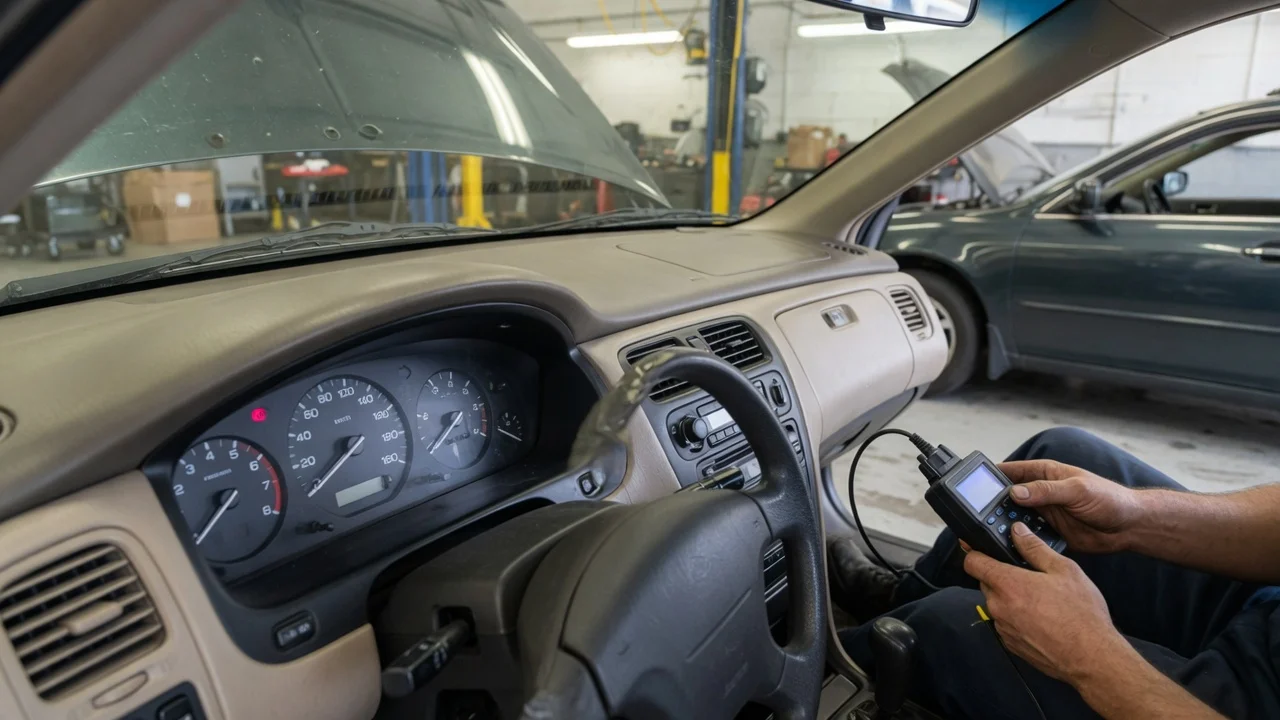
Do not expect a generic OBD-II code reader to explain the red BRAKE light on a 2000 Accord. OBD-II on vehicles of this era is focused mainly on engine and emissions systems, and the parking brake and fluid level warnings are typically simple switch circuits rather than code-generating systems. ABS-equipped cars may store ABS fault information, but reading it may require a Honda-capable tool or the service procedure in the manual. Even when a code is available, treat it as a starting point for inspection rather than proof that a particular part has failed.
When to stop driving or get a professional diagnosis
Stop driving and arrange inspection or towing if any of the following apply: The brake pedal feels soft, spongy, sinks toward the floor or travels farther than usual. You can see brake fluid leaking at a wheel, line, hose or the master cylinder. The fluid level drops again soon after being topped up. The car pulls to one side, grinds, or takes noticeably longer to stop. The red BRAKE light and the amber ABS light are on together. The light stays on with correct fluid level and a fully released parking brake, and you cannot confirm the cause.
A professional diagnosis is also sensible if you are not comfortable inspecting brake components, or if the fix involves bleeding the hydraulic system, replacing lines or working on the master cylinder. Brakes are a safety-critical system, and a correct-looking fluid level does not guarantee the system is sound.
Practical next steps
Confirm the parking brake is fully released and see whether moving the lever changes the light. Check the fluid level against the reservoir marks before adding anything. Inspect pad wear and look for leaks to explain any low reading. If fluid is needed, use only the type specified on the reservoir cap or in the owner's manual, from a sealed container. If the light persists with no obvious cause, or any stop-driving sign is present, have the brake system inspected before further use.