Dodge Durango Transfer Case Linkage: Identification and Diagram
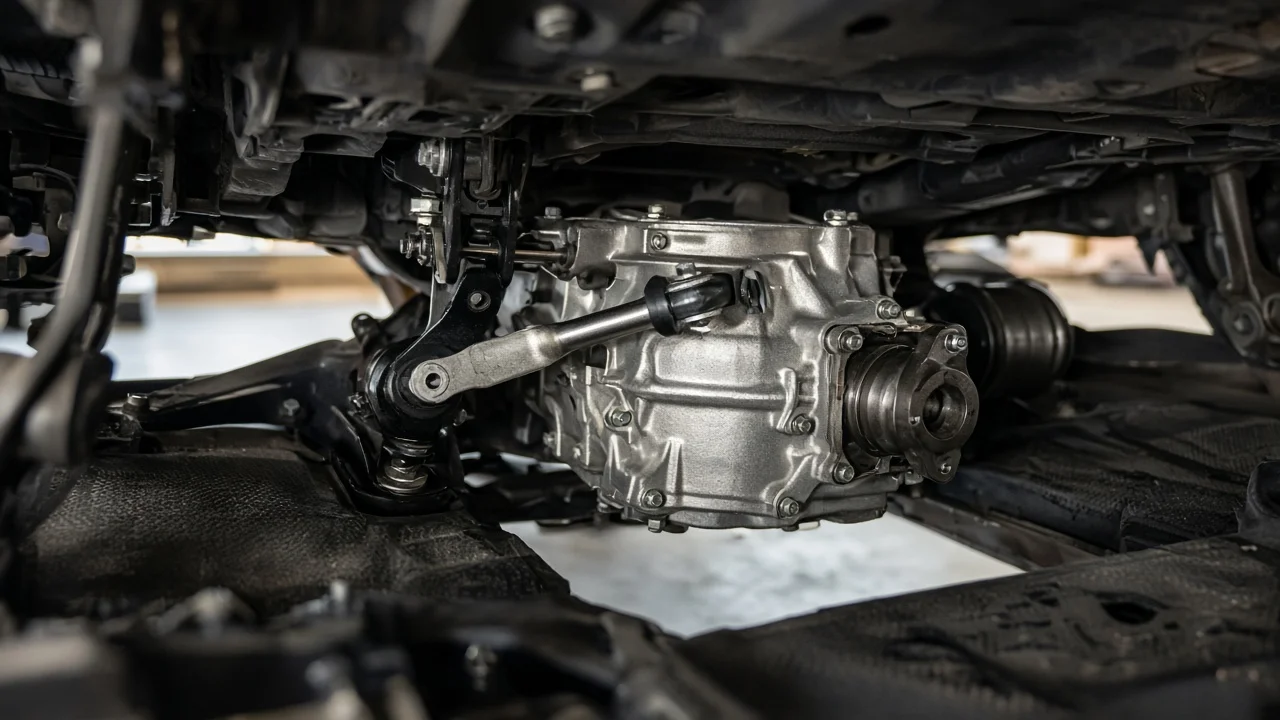
On a four-wheel-drive 2000 Dodge Durango, the transfer case is shifted mechanically. A floor-mounted lever beside the transmission tunnel moves a rod, and that rod rotates the range lever on the transfer case. A linkage diagram helps when the lever feels loose, will not reach a position, or does not match the 4WD indicator. This guide explains how to identify the parts and read the layout. It does not replace the factory service information for your exact vehicle.
The short answer
A transfer case linkage diagram for a 2000 Durango shows a simple mechanical chain. It starts with the shift lever inside the cabin and its pivot bracket below the floor. An adjustable shift rod connects them to the range lever on the transfer case. This model year has no electronic shift motor, so the lever you move is physically connected to the case. Most diagrams also show the bushings or grommets where the rod attaches, the clip or nut holding each end, and the adjustment point that sets the rod length.
The exact routing, bracket shape and position labels depend on which transfer case your Durango was built with. Two-wheel-drive Durangos have no transfer case and no linkage. On 4WD models, confirm the transfer case type before relying on any drawing. A diagram for a different unit can show positions or levers that do not match yours.
How the shift linkage works
When you move the lever, it pivots on a bracket mounted beneath the vehicle. The lower end of the lever pushes or pulls the shift rod, and the rod turns the range lever on the transfer case. Inside the case, the range lever moves a sector that positions the shift forks. Depending on the unit, this selects two-wheel drive, four-wheel drive high, neutral or four-wheel drive low. Each detent you feel at the lever is the internal sector settling into a position.
Because the system is purely mechanical, its accuracy depends on the rod length and on the condition of the connection points. If the rod is adjusted slightly too long or too short, the lever can reach its marked position while the case sits between detents. Worn bushings add free play, so moving the lever does not move the case by the same amount. Either condition can cause hard shifting, a lever that will not engage a range, grinding, or a 4WD indicator that does not light as expected.
Identifying the parts under the vehicle
With the vehicle safely supported, trace the rod from the bottom of the shifter assembly back to the transfer case, which sits directly behind the transmission. The range lever is a short arm on the side of the case, with the rod attached at its end. Near one end of the rod you should find the adjustment point. It is typically a swivel or trunnion clamped by a lock bolt or nut, and it is where the rod length is set.
The transfer case identification tag is usually attached to the case and lists the model and assembly number. Record that information along with the VIN. Together they are the most reliable way to match a diagram and parts listing to your vehicle configuration. While you are under the vehicle, look for missing clips, cracked or absent bushings, bent rod sections or a loose bracket. A linkage diagram helps you identify each of these parts by name.
What changes the answer for your Durango
The main variable is the transfer case. First-generation Durangos with four-wheel drive were offered with either a part-time unit or a unit that includes a full-time four-wheel-drive mode, and the shift patterns differ. A part-time case typically offers two-wheel drive, four-wheel drive high, neutral and four-wheel drive low. A full-time-capable case adds a full-time position. The shifter markings in the console are a quick clue, but the case tag is the confirmation.
Other factors affect how the linkage behaves rather than how it is laid out. A replacement transmission, transfer case or shifter from another vehicle can change the bracket and rod geometry. If the truck has had drivetrain work, check the service history. Operating conditions also matter. Road salt, mud and off-road use speed up corrosion and bushing wear, and a linkage that shifts normally when warm may bind in cold weather.
What you can check yourself
Start by observing the problem. Note which positions are difficult, whether the lever feels loose before it resists, and whether the 4WD indicator agrees with the lever. Shift only as the owner's manual directs. On many transfer cases, selecting low range requires the vehicle to be stopped or nearly stopped with the transmission in neutral. Forcing the lever can damage internal parts as easily as the linkage. Grinding, or a lever that pops out of a range under load, needs attention before further off-road use.
For a basic inspection, turn the engine off and secure the vehicle against rolling. Have a helper move the lever slowly through each position while you watch the range lever on the case. The two should move together with little lost motion. Excess play at a connection points to worn bushings, which are inexpensive and commonly replaced individually. Next, try the range lever by hand. If the case reaches every detent when moved directly, but not through the shifter, the likely cause is adjustment or worn linkage parts rather than an internal fault.
If adjustment is needed, follow the factory procedure for your transfer case. It specifies which range to place both the shifter and the case in before you tighten the adjustment fastener, and it gives the torque value for that fastener. Using the wrong reference position can leave one range engaging correctly and another stopping short of its detent.
Limitations and next step
A written description cannot replace the illustration and specifications in the factory service manual for your exact build. This article does not give torque values, part numbers or adjustment dimensions. Those must come from manufacturer specifications matched to your transfer case model. If a shop or parts source supplies a diagram, confirm that it covers the same transfer case and model year before you use it.
Get professional help in any of these cases: the case will not reach a range even when you move the range lever directly, fluid is leaking near the range lever shaft, or grinding continues after the linkage has been adjusted. These symptoms suggest a problem inside the transfer case or in the front axle engagement system, which a linkage diagram will not resolve. A technician can verify the linkage, check the fluid against the maintenance schedule and inspect internal components in one visit.