Identifying a 1999 Honda CR-V Transmission Shift Solenoid
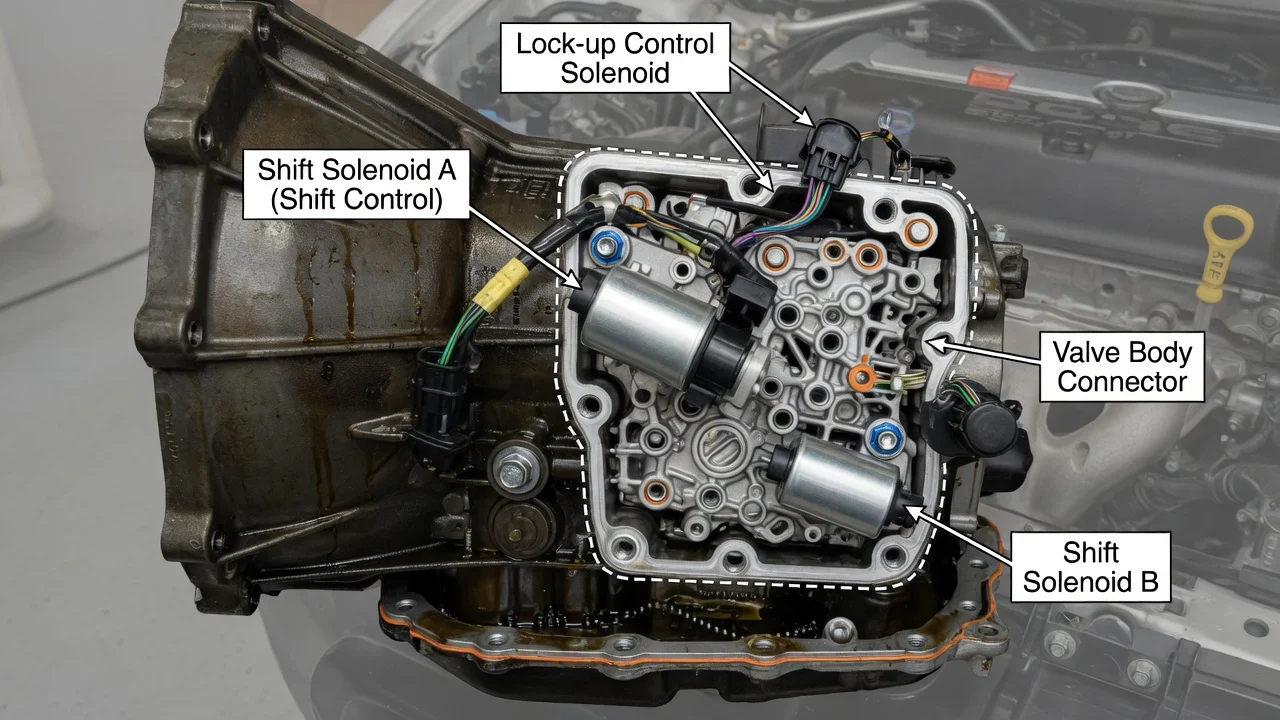
When a 1999 Honda CR-V shifts late, holds a gear or shows a transmission warning, the shift solenoids are often the first suspects. Before ordering a part, you need to know which transmission the vehicle has, where its solenoids are and what the trouble codes actually point to. This guide explains how to identify the correct shift solenoid for a first-generation CR-V, how these parts work and what an owner can check without assuming a failure.
The Short Answer
Shift solenoids are only on the automatic transmission. The 1999 CR-V was sold with either a four-speed automatic or a five-speed manual, and the manual has no shift solenoids. On the automatic, the solenoids are electrically operated valves controlled by the vehicle's computer. On Honda automatics of this period they are typically bolted to the outside of the transmission case rather than buried inside the oil pan, so they can usually be reached without removing the transmission. They are often supplied as an assembly that carries more than one valve, so a part listed as a shift solenoid may actually be a combined unit. Torque converter lock-up is usually handled by a separate solenoid assembly, and confusing the two is a common ordering mistake. Confirm the location and layout on your own vehicle before buying anything.
The most reliable way to get the right part is to match the part number stamped or printed on the existing assembly, or to have a parts counter look it up by VIN. Year, make and model alone are not enough. Also keep in mind that a trouble code or a shift complaint tells you where to look. It does not prove that the solenoid itself has failed.
How Shift Solenoids Work
Honda's automatic of this era uses parallel shafts with a separate hydraulic clutch for each forward gear instead of the planetary gear sets found in many other brands. The computer reads inputs such as vehicle speed, throttle position, engine speed and selector position. It then switches the shift solenoids on and off in specific combinations. Those combinations move valves in the valve body, which route pressurized fluid to the clutch for the target gear. The lock-up solenoid works in a similar way to engage the torque converter clutch at cruising speed, which reduces slip and engine speed on the highway.
A solenoid has two sides, and either one can cause trouble. The hydraulic side depends on clean fluid at the correct level. Low fluid, worn fluid or debris can make a healthy solenoid appear faulty, and some solenoid assemblies have small screens or filters that can clog. The electrical side includes the solenoid coil, its connector, the wiring harness and the driver circuit in the computer. A break, short or corroded pin anywhere in that path can set the same fault as a failed coil.
What Changes the Answer
Transmission type is the first factor. A manual-transmission CR-V has no shift solenoids, so its shifting problems lie elsewhere, such as the clutch, synchronizers or linkage. On automatics, drivetrain matters too. The 1999 CR-V was offered with front-wheel drive and with Honda's Real Time four-wheel drive, and the transmission variants are not always identical. Honda also made running changes and superseded part numbers over the years, so an aftermarket listing based only on the model year may not guarantee fitment. Service history matters as well. If the transmission was ever replaced with a used or remanufactured unit, the parts on it may not match the original specification for that VIN.
Diagnostic codes shape the answer as much as the hardware does. A 1999 CR-V uses OBD-II. Generic codes in the P0750 range relate to shift solenoid circuits, and P0740 relates to the torque converter clutch circuit. Honda also used manufacturer-specific codes that a basic reader may not display. The letter designations in generic code descriptions do not always match how Honda labels its physical valves, so use the factory service information to find out which solenoid and circuit a code refers to. Operating conditions matter too. A fault that appears only when the transmission is hot, or only over bumps, points toward different causes than one that is present all the time.
What the Owner Can Do
Start by writing down the shift behavior in detail. Note which shift is affected, whether it happens cold or warm, at what speed and throttle, and whether a dashboard indicator flashes. On many Honda automatics of this period, a blinking drive indicator signals that the computer has stored a transmission fault. Next, check the fluid level and condition using the procedure in the owner's manual. Honda's checking method differs from many other brands. The fluid specification matters on this transmission. It was designed for Honda automatic transmission fluid, and the current Honda fluid that supersedes the original type is the usual recommendation. Generic multi-vehicle fluids are a frequent source of shift complaints on Honda units. Dark, burnt-smelling fluid or visible debris is worth noting before any parts are replaced.
Read the codes with a scanner that can show manufacturer-specific codes and freeze-frame data, and record them before clearing anything. With the engine off, inspect the solenoid connectors on the transmission case. Look for corrosion, fluid inside the connector, bent pins and chafed or melted wiring. If you have a multimeter and the factory specification, you can measure the coil resistance at the solenoid and compare it with the published range. An open or shorted reading supports a failed coil. A reading within range points back toward the wiring or the computer.
If the evidence supports replacement, confirm the part number from the old assembly or a VIN lookup first. Use new gaskets or O-rings and any screen that comes with the part, and be ready for some fluid loss when the assembly is removed. Afterward, top up with the correct fluid, recheck the level using the proper procedure, clear the codes and road test to confirm that the original symptom is gone.
Limitations and When to Get Help
A solenoid replacement only corrects an electrical or valve fault in that component. Slipping under load, flare between gears, harsh engagement into drive or reverse, or metallic debris in the fluid usually point to internal wear, and a new solenoid will not fix those problems. Faults in the computer or in its power and ground circuits can also imitate solenoid failure. Diagnosing them takes wiring diagrams and sometimes a scan tool that can command individual solenoids.
Because procedures, specifications and part numbers vary with drivetrain and production details, use service information that matches your VIN rather than general figures. If the codes, the electrical tests and the fluid condition do not point clearly to one cause, or if the transmission shows signs of mechanical damage, have a transmission specialist perform a scan-tool and pressure diagnosis. Compare repair options, from a solenoid or wiring repair to a rebuild or replacement unit, only after the fault has been confirmed.