1998 Jeep Cherokee TCC Solenoid: Identification and Location
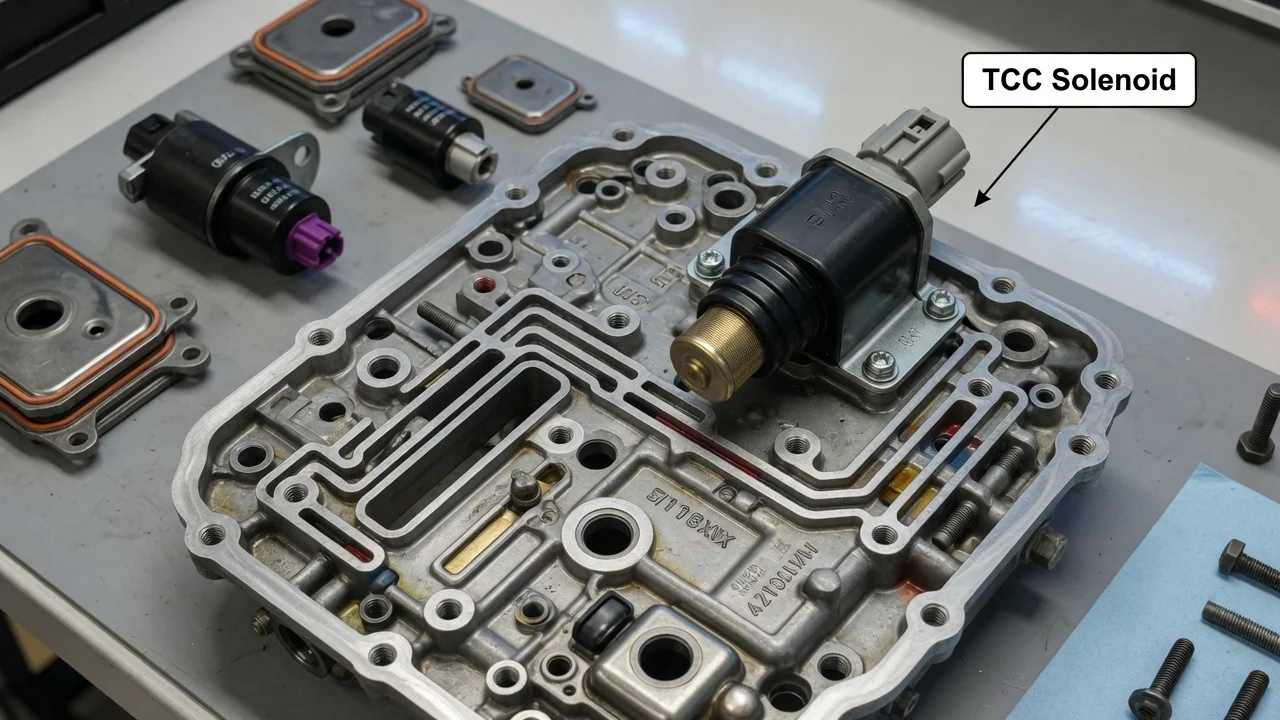
On a 1998 Jeep Cherokee, the torque converter clutch (TCC) solenoid is not a part you can see from under the hood or reach without opening the transmission. Where it sits, what controls it and which replacement fits all depend on which automatic transmission the vehicle has. This guide explains how to identify the transmission, where the lockup solenoid is on each one, and how to approach a suspected fault without replacing parts on a guess.
Where the TCC solenoid is on a 1998 Cherokee
Most 1998 Cherokees with the 4.0L inline six and an automatic use the Aisin AW4 four-speed. On that transmission, converter lockup is handled by one of three solenoids mounted on the valve body inside the oil pan. Service literature commonly identifies it as solenoid No. 3, the lockup solenoid, next to the two shift solenoids. Reaching it requires draining the fluid and removing the pan. The solenoid wiring runs through the case to an external harness connector, which is the most practical place to start electrical checks before anything is taken apart.
Four-cylinder Cherokees with an automatic typically used a three-speed unit with a lockup torque converter. Its lockup solenoid is also on the valve body inside the pan, but it is usually commanded by the engine controller rather than a separate transmission computer. Cherokees with a manual transmission have no torque converter, so they have no TCC solenoid at all.
How converter lockup works
A torque converter is a fluid coupling, so it always allows some slip between the engine and the transmission. To reduce that slip at steady cruising speeds, the converter contains a clutch that can lock the engine side to the transmission side. The TCC solenoid controls this by opening or closing a hydraulic passage that applies or releases the clutch. The controller decides when to command lockup based on inputs such as vehicle speed, throttle position, gear, engine temperature and brake application.
In practice, when lockup applies you see a small drop in engine rpm at a steady cruise. When it releases, during braking or heavier throttle, rpm rises slightly. If lockup never applies, the engine runs higher rpm on the highway, the transmission runs warmer and fuel economy suffers. If the clutch stays applied when it should release, the engine may stumble or stall as the vehicle comes to a stop. These symptoms point toward the lockup system, but they do not prove the solenoid itself has failed. Wiring, sensor inputs, fluid condition and the converter clutch can all produce the same behavior.
What changes the answer
Transmission type is the biggest variable, and it also changes the diagnostic path. On the AW4, a separate transmission control module runs the solenoids, and its stored faults may not show up on a basic generic code reader. On the three-speed, lockup is typically managed by the engine controller, so TCC circuit faults are more likely to appear as powertrain diagnostic codes. Before you interpret a missing code as a healthy system, make sure your scan tool can read the controller that actually runs the lockup solenoid.
Fitment and service history matter as well. Solenoids are not interchangeable between these transmissions, so parts should be matched by engine, transmission model and connector style rather than by year alone. Some AW4 solenoids are sold individually and some as a set. A Cherokee that has had a rebuilt, swapped or aftermarket-controlled transmission may not match the factory configuration. Fluid specification also differs by transmission, so confirm it from the owner's manual or the transmission's documentation instead of assuming.
What the owner can do
Start by confirming what you have. Check the engine size, which is encoded in the VIN and shown on the engine itself. Count the forward gears during a drive, and look for an identification tag on the transmission case. Then check the fluid level and condition using the procedure in the owner's manual. Low, burnt or contaminated fluid can affect lockup and should be corrected before the solenoid is blamed.
Next, observe shift behavior with the engine and transmission fully warm. On a flat road at a steady moderate speed with light throttle, watch the tachometer for the small rpm drop that indicates lockup. Note whether it releases when you touch the brake. Confirm that the brake lights work, because the brake switch signal is commonly used to release lockup. Scan for diagnostic codes with a tool that supports the relevant controller, and write down any codes before clearing them.
If the codes or symptoms point to the lockup circuit, inspect the harness and connector at the transmission for damage, corrosion or heat exposure near the exhaust. Resistance and short-to-ground checks of the solenoid circuit can be made at the connector, but compare readings only to the specification in the service manual for your transmission. If you remove the pan, look at the debris in it. Heavy clutch material or metal suggests internal wear beyond a solenoid problem. Use a new pan gasket, refill with the correct fluid and recheck the level by the specified procedure.
Limitations and next step
This guide describes typical factory configurations. It cannot account for every individual vehicle, prior repair or replacement transmission. Without the service manual specifications and a scan tool that reads the right controller, a TCC solenoid cannot be confirmed as faulty. A new solenoid also will not fix a worn converter clutch, a sticking valve in the valve body or a bad input signal.
Repair options range from fixing a wiring fault or correcting a sensor input, to replacing the solenoid, to converter or internal transmission repair. If shudder persists after a fluid service, if the fluid is burnt, or if lockup codes return after a repair, have a transmission shop diagnose the system with equipment that can read the controller. Whichever route you take, the sensible first step is the same: confirm the transmission type and retrieve the codes before buying parts.