Identifying a 1997 Honda Accord Transmission Shift Solenoid
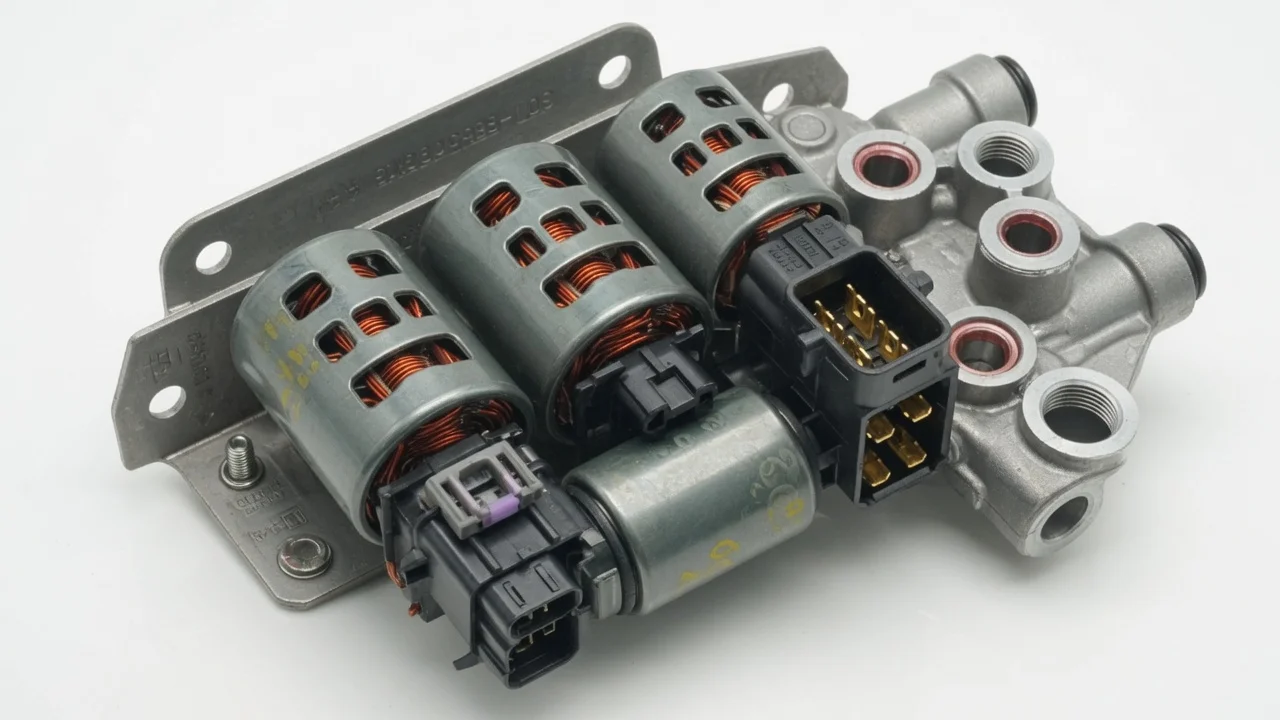
Harsh shifts, a gear that will not engage or a stored transmission code on a 1997 Accord often lead owners to the shift solenoids. This guide explains which solenoid assembly the car uses, how it controls gear changes, what determines the correct replacement part and how to narrow down a fault before buying anything. A symptom or code points to a circuit or system. It does not prove that the solenoid itself has failed.
Which shift solenoid a 1997 Accord uses
Only Accords with an automatic transmission have shift solenoids. Manual-transmission cars shift mechanically and have no such part. The 1997 model year was the last of the fifth-generation Accord, and its automatic is an electronically controlled four-speed unit. The engine control module commands gear changes through a shift control solenoid assembly. Honda service literature normally describes it as two solenoid valves, labeled A and B, sharing one housing and connector. A separate lock-up control solenoid assembly manages the torque converter clutch. Owners sometimes confuse the two, so it is worth confirming which one a code or symptom actually refers to.
On Honda automatics of this era, these solenoid assemblies are bolted to the outside of the transmission housing rather than hidden inside a valve body behind an oil pan. That usually makes them reachable without removing the transmission, although nearby components may need to come off first. The exact part number depends on the engine and transmission fitted to your car, as explained below.
How the shift solenoids control gear changes
Each solenoid is an electrically operated valve. The control module reads inputs such as vehicle speed, throttle position and engine load, then switches solenoids A and B on or off in set combinations. Each combination routes hydraulic pressure to particular shift valves, which apply the clutches for a given gear. In effect, each gear corresponds to a specific on/off pattern of the two solenoids. If one solenoid sticks, loses its electrical circuit or is starved of clean fluid, the pattern breaks and the transmission may skip a gear, shift late or harshly, or stay in one gear.
The lock-up solenoids work the same way, but they control the torque converter clutch instead of gear selection. Lock-up faults tend to show up as shudder or rpm flare at steady cruising speeds, or as rough running when coming to a stop, rather than as missed shifts. When the control module detects an electrical fault in a solenoid circuit, it can switch the transmission into a fallback mode with limited gears so that the car remains drivable. Low fluid, worn clutches or a sticking valve can produce shift behavior that looks very similar, which is why a symptom alone is not a diagnosis.
What changes the correct part
The 1997 Accord was offered with a 2.2-liter four-cylinder and a 2.7-liter V6. The automatic transmissions paired with each engine are different units, and solenoid layout and part numbers can differ between them. The transmission type is identified by a code stamped on or labeled on the transmission case. Match that code, together with the VIN, against a Honda or reputable parts catalog instead of relying on a broad listing that simply says fits 1994 to 1997 Accord.
Service history also matters. Many cars of this age have received a used or remanufactured transmission, and the replacement unit may not be the one originally installed. Check the code on the transmission that is actually in the car. Fitment questions also extend to the connector style, gaskets and any filter screen used with the assembly. Finally, consider operating conditions. A fault that appears only when the transmission is hot, or only over bumps, often points toward wiring, connections or fluid condition rather than the solenoid coil.
How to check before buying a solenoid
Start with the fluid. Check the level and condition using the procedure in the owner's or service manual, which specifies the temperature and conditions for an accurate reading. Fluid that is low, burnt-smelling or full of debris can cause shift problems on its own and can also clog solenoid passages. Honda transmissions are sensitive to fluid specification. Honda's current genuine automatic transmission fluid supersedes the types originally specified for these cars, so confirm the correct fluid for your transmission before topping up or doing a drain-and-fill.
Next, read the diagnostic codes. The 1996 and 1997 Accords use an OBD-II port, so a generic scan tool can retrieve standard codes. Under the generic definitions, P0753 and P0758 refer to the electrical circuits of shift solenoids A and B. Honda-specific codes, including some lock-up solenoid codes, may need a more capable scanner. On many Hondas of this period, a flashing D4 indicator on the dash signals a stored transmission fault. Write down every code before clearing anything, and note exactly when the shift behavior goes wrong: cold or hot, which gear, and at what speed.
An electrical code calls for checking the circuit before the part. Inspect the solenoid connector for corrosion, bent pins or oil intrusion, and check the harness for chafing near the transmission. Confirm that the battery and ground connections are sound. The service manual gives a resistance specification for each solenoid and a procedure for testing the wiring back to the control module. Use those figures rather than guessed values. A reading out of specification supports replacing the solenoid. A normal reading points back toward wiring, connections or the control side.
Repair options once the cause is narrowed down
If the circuit tests point to the solenoid, the usual repair is to replace the complete shift control solenoid assembly, along with new gaskets and any screen or seals listed for your transmission code. Genuine Honda parts carry the most predictable fitment. Aftermarket assemblies vary in quality, so compare connector, mounting and included parts carefully. Used solenoids are cheaper but come with an unknown history. After replacement, clear the codes, recheck the fluid level and road test through all gears, and follow any post-repair steps in the service manual.
If the codes and electrical tests are clean but shifting is still wrong, or if the fluid shows heavy wear material, the problem may be inside the transmission, such as worn clutches or a sticking valve. A new solenoid will not fix that. In that situation the realistic repair options are a professional diagnosis, a rebuild, or a remanufactured or used transmission matched to your transmission code.
Limitations and next step
This guide cannot confirm your exact part number, resistance specifications or fluid quantity. Those depend on the engine, the transmission code and the parts catalog or service manual for your specific car. Online symptom descriptions also cannot distinguish an electrical solenoid fault from an internal mechanical failure with certainty. Seek professional help if the car will not move, slips under load or flares in rpm during shifts, if the fluid is badly contaminated, or if codes return immediately after a solenoid replacement. A transmission specialist can measure line pressure and monitor solenoid commands with a scan tool. That testing separates a failed solenoid from wiring, control or internal faults before you spend money on parts.