12-Volt Batteries in Hybrids and EVs: Role, Lifespan, and Replacement
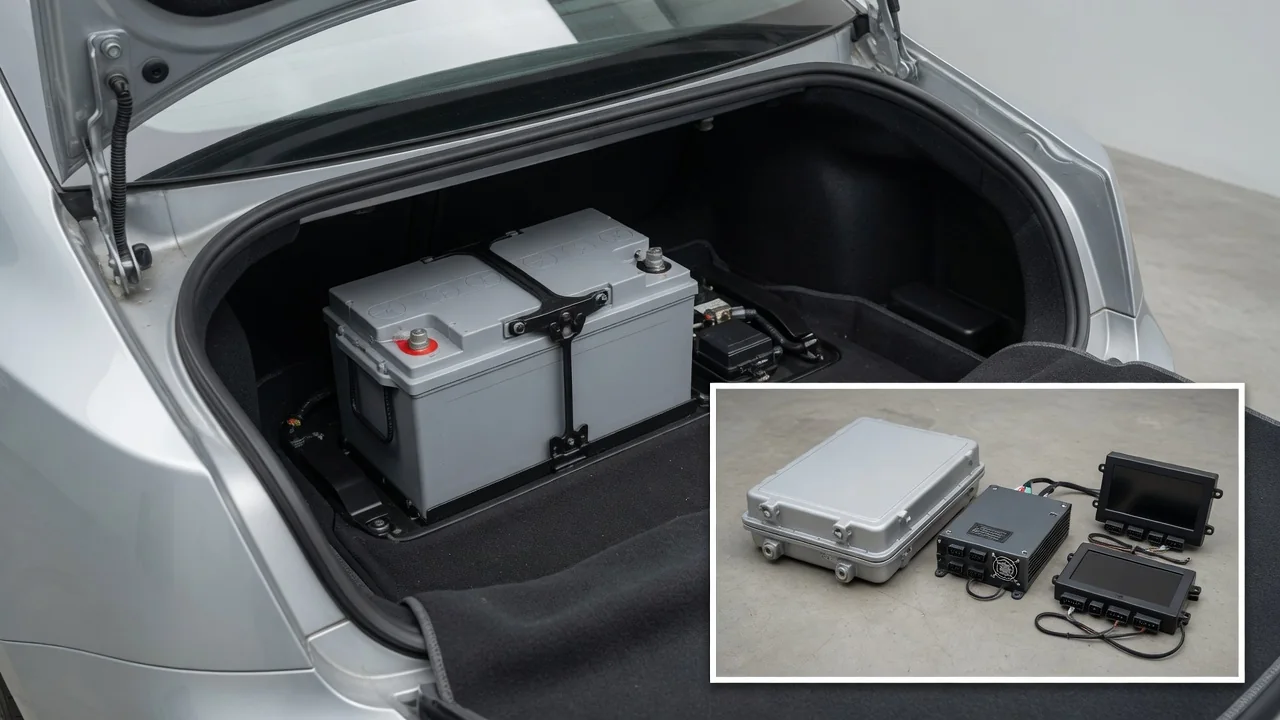
Hybrids and many electric vehicles still rely on a separate 12 volt battery for hybrid car electronics even when a large traction battery powers the drivetrain. That auxiliary battery supports the low-voltage electrical system that wakes control modules, powers lighting and locks, and helps the vehicle enter ready mode. Understanding how an EV 12v battery is charged, how long it lasts, and how replacement is specified prevents mixing the 12v hybrid battery with the high-voltage pack.
Why Hybrids and EVs Need an Auxiliary Battery
A 12v battery for hybrid car designs and a 12v battery in EV layouts typically feed accessories, body electronics, and the control modules that must be alive before propulsion can be enabled. The traction battery's job is to supply drive energy; the auxiliary battery's job is supporting that low-voltage electrical system. Not every electrified vehicle uses a 12-volt architecture, but many hybrids and EVs still do, because lighting, infotainment, door locks, and many computers still run at conventional low voltage.
A charged traction battery does not guarantee that a vehicle with a depleted auxiliary battery can enter ready mode. If the 12 volt battery for hybrid car computers cannot support the modules that authorize startup, the high-voltage pack may remain isolated even though it still holds energy. Searches for a 12v hybrid battery, hybrid 12 volt battery, or hybrid 12v battery often mean this auxiliary unit, not the traction pack. Confirm which battery a diagnosis or replacement quote concerns.
How the Traction Battery Supplies 12-Volt Charging
In many hybrids and EVs, a DC-DC converter is how an EV charges the 12v battery: it steps energy from the high-voltage traction battery down to the low-voltage electrical system and recharges the auxiliary battery. The 12V EV battery is therefore maintained by the high-voltage system rather than by a conventional engine-driven alternator. Charging availability still depends on vehicle operating state and manufacturer controls, so the converter may not keep the EV 12 volt battery topped up in every parked or accessory condition.
Parked maintenance charging and charging while plugged in vary by vehicle. Connecting an EV to a charger does not, by itself, establish that the EV 12-volt battery is healthy or that its battery state of charge is being restored. Some designs periodically support the auxiliary battery; others leave it more exposed to parasitic draw when the vehicle is asleep. Follow the owner documentation for storage and accessory-use guidance rather than assuming a universal charging routine for every hybrid 12v battery or 12v EV battery.
Symptoms That Call for a Low-Voltage System Check
EV 12v battery problems and similar hybrid issues can show up as failure to enter ready mode, intermittent electronics, unresponsive locks, dim lighting, or clusters of warning messages. Those signs can also come from loose connections, a charging-system fault in the DC-DC converter path, or other electrical trouble, so a weak auxiliary battery remains only one possibility. Record the messages, note whether trouble follows long parking or accessory use, and track whether the same incident repeats.
A single voltage reading is a snapshot of battery state of charge, not a complete picture of battery state of health. Resting voltage can look acceptable after a charge, then collapse under load, so professional battery, charging-system, and parked-current testing is often needed when symptoms persist. Heat, swelling, leakage, or unusual odors are reasons to stop handling the battery and seek professional assistance, including any concern about battery venting. A warning light or stored code is evidence to interpret, not proof that the auxiliary battery itself has failed.
What Determines Auxiliary Battery Life
How long a 12v battery lasts in EV service depends on chemistry, climate, charging strategy, and how the vehicle is used, so there is no universal replacement age for a hybrid 12 volt battery either. Heat, cold, long storage, repeated deep discharge, and persistent electrical loads all influence service life. An AGM battery for EV applications and a lithium auxiliary battery can age differently under the same parking pattern. Calendar time alone is a weak predictor when one vehicle sits unused and another sees daily DC-DC converter support.
A temporarily low battery state of charge is not the same as lost battery state of health. Recharging an EV 12v battery can restore starting support for a while without proving remaining life, especially after deep discharge. History matters: recurring no-ready events, repeated jump starts, and appropriate load or conductance test results inform replacement timing better than a calendar guess. Combine symptoms, charging-system checks, and documented test data before concluding that the 12v battery in EV duty should be replaced.
Choosing an Approved Battery Chemistry and Specification
The best 12v battery for EV use is the one that meets the vehicle's documented electrical, physical, and charging requirements, not a generic high-output label. AGM chemistry is a sealed lead-acid construction used in many auxiliary applications; an AGM battery for EV service still must be confirmed as specified or approved for that exact vehicle. Physical size and terminal layout are only part of the decision. Required ratings, hold-down provisions, and any battery venting connection also have to match the documented design.
A lithium auxiliary battery is not a universal drop-in replacement. It generally needs compatible charging control and a battery management system matched to the vehicle, so substituting lithium without documented approval can create charging or protection mismatches. Interest in an AGM battery for Ford Maverick Hybrid models should be settled by the exact year and configuration, using owner information or a qualified parts source. That check confirms whether AGM is specified; it does not authorize an unapproved conversion or a guessed part number.
Confirming Fitment for a Toyota Camry Hybrid
A 12v battery for Toyota Camry Hybrid, including a 12v battery for 2007 Toyota Camry Hybrid, still needs year, market, and configuration confirmation. A 2007 Toyota Camry Hybrid 12v battery is not automatically the same unit used on later generations. Owner documentation or a qualified parts provider using the vehicle identification number is the reliable path. Toyota Camry Hybrid battery 12v listings that skip that check can mix auxiliary and traction parts.
Confirm chemistry, nominal voltage, case dimensions, terminal arrangement, hold-down provisions, required ratings, and any vent connection against the vehicle's documentation. Physical fit alone does not confirm compatibility, because charging strategy, monitoring, and battery venting requirements can differ even when a case slides into the tray. Unsupported locations, sizes, and part numbers should not be assumed from a generic 12v hybrid battery listing. The same identification discipline applies whenever a Camry Hybrid 12 volt battery is quoted for replacement.
Planning a Safe Auxiliary Battery Replacement
When a Ford Fusion Hybrid, including a 2019 Fusion Hybrid, a Toyota Highlander Hybrid, a Hyundai Sonata Hybrid, or an EV needs 12v battery replacement, start with a vehicle-specific service assessment. Confirm the auxiliary battery's architecture and whether it is a conventional standalone unit before assuming a simple swap. Some electrified vehicles integrate monitoring, unique hold-downs, or restricted access that change the job. Shutdown requirements, access, battery monitoring setup, and post-replacement checks depend on that vehicle.
Qualified service is the safer path when access, system isolation, or required setup is unclear, because an apparently off vehicle may still activate electrical systems. Generic disconnection sequences and high-voltage handling steps should not replace vehicle-specific instructions. Recurring discharge needs diagnosis alongside replacement so parasitic draw, a DC-DC converter fault, or accessory misuse is not left unaddressed. Return the old unit through a responsible battery recycling path rather than household disposal.