00473 Electronic Parking Brake Control Module J540: Fault Diagnosis
Establish the symptoms
Record when the 00473 fault appears and what the vehicle is doing at that moment. The electronic parking brake control module J540 may log this code without illuminating a warning lamp, or it may appear together with a parking brake warning, an inoperative switch, or a parking brake that will not apply or release. Note whether the problem occurs at startup, after driving, on a slope, or only when the parking brake is operated repeatedly.
Other associated signs matter. A parking brake that makes unusual noise at one rear wheel, releases unevenly, or leaves one caliper warm after driving can point toward a mechanical or electrical issue at that corner. Recent work around the brake pads, brake rotors, caliper, or rear wheel speed sensor should also be recorded, because a disturbed connector or incorrect reassembly can introduce a fault that the control module reports.
Distinguish plausible causes
A 00473 code is a control module circuit fault, not proof that the J540 module itself is defective. The underlying problem can be in the control module power supply, ground, wiring, connector, the parking brake switch, an actuator motor, or another input the module monitors. Because the electronic parking brake depends on several signals, a fault in a related component can be reported as a control module malfunction even when the module is healthy.
Several observations can help separate likely causes. If the parking brake operates normally and the code returns only after clearing, an intermittent wiring or connector issue is more plausible than a hard internal failure. If the brake will not release and the rear caliper or its motor is hot, the problem may be inside that caliper or motor. If the fault appears immediately after pad replacement, inspect whether the caliper piston was wound back correctly, the connector was refitted, and the friction material and wear limits are appropriate for the application.
Checks in a useful order
Begin with safe observations before using tools. Confirm that the parking brake switch responds and that no brake warning message accompanies the fault. Check whether the parking brake applies and releases evenly on both sides. Look for visible damage at the rear brake areas, such as a torn boot, corroded connector, chafed wiring, or fluid leakage around a caliper. Do not attempt to free a seized electric parking brake by forcing it.
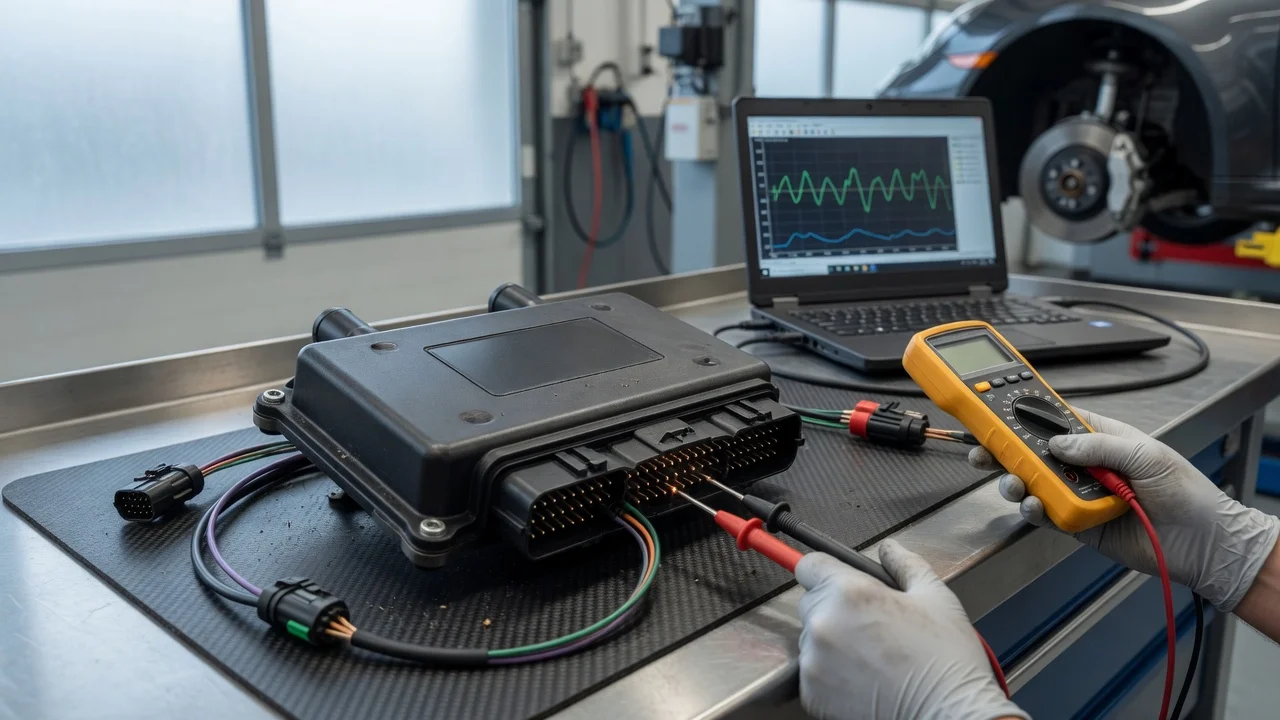
More advanced checks require the correct vehicle fitment information, wiring diagrams, and test equipment. A workshop can verify the power, ground, and communication circuits at the J540 module, inspect terminal tension, and compare measured values with the manufacturer specifications. A diagnostic scan tool can read the fault environmental data and live data, operate the parking brake in output test mode, and monitor switch and actuator signals. Brake pads, rotors, and brake fluid condition should also be checked, but they must not be used as an excuse to skip the electrical diagnosis.
Interpret the findings
Each result reduces or increases the likelihood of a particular cause. A stable parking brake operation during output testing weakens the internal-module failure theory. Good power and ground with clean connectors but an inoperative circuit points toward a control module or component command issue. A signal that changes correctly on one side but not the other points toward the affected caliper, motor, or wiring rather than the module.
Do not replace the J540 module based only on the code being present. The module should be condemned only after power, ground, wiring, connectors, inputs, and outputs have been checked against the correct specifications, and only if the measured results cannot be explained by the connected components. Some modules require coding or adaptation if replaced, so confirmation is important before committing to the part.
Urgency and next action
A vehicle with an inoperative or partially applied electric parking brake can be unsafe. Stop using the vehicle and arrange professional service if the parking brake will not hold the vehicle, will not release fully, engages while driving, or if a brake warning indicates a serious system malfunction. Do not rely on chocks or the transmission alone as a substitute for a failed parking brake.
For repair, a technician needs the complete fault data, vehicle fitment details, and any recent service history. If the vehicle must be moved, have it recovered or follow the manufacturer procedure for emergency release only after confirming that the normal service brake can stop the vehicle safely. No diagnostic article can promise a safe remaining mileage, because braking faults can change quickly and without warning.