00283 ABS Wheel Speed Sensor G47: Fault Diagnosis
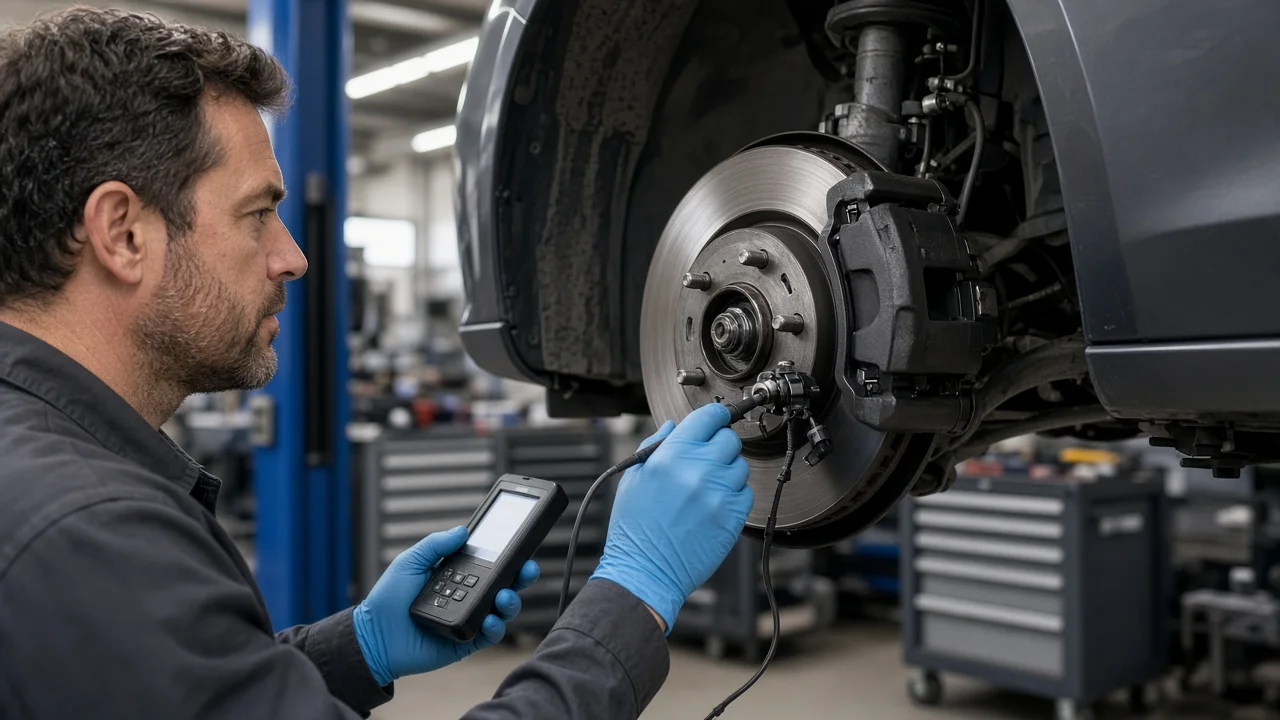
Fault code 00283 on Volkswagen, Audi, Seat and Skoda vehicles refers to the front left wheel speed sensor, labelled G47, or its circuit. The ABS control unit stored the code because the signal from that corner was missing, implausible or outside its expected range. The code does not prove that the sensor itself has failed. This guide explains how to record the symptoms, separate competing causes, check them in a sensible order and judge how urgently the car needs attention.
Establish the symptoms
Start by writing down exactly what the car does. Note which warning lamps are lit: the amber ABS lamp alone, ABS together with the stability or traction control lamp, or the red brake warning lamp as well. Record whether the lamp comes on immediately after start-up, only once the car is moving, at a particular speed, over bumps, while turning, or in wet or salty conditions. On some models a failed wheel speed signal also affects the speedometer, cruise control or hill-start functions, so note those too.
If you or a shop has a scan tool, save the full fault description, not just the number. The text after 00283 usually adds a subtype, such as no signal, implausible signal, signal outside tolerance, or open or short circuit, and may mark the fault as intermittent or sporadic. Freeze frame data, if the tool shows it, records vehicle speed and conditions when the fault set. Finally, list any recent work or events on the front left corner: replaced brake pads or brake rotors, a caliper change, wheel bearing or drive shaft work, suspension repairs, new tires, a curb strike, or a pressure wash around the wheel arch.
Distinguish plausible causes
Wiring and connector faults are among the most common causes. The sensor lead runs along the strut and through the wheel arch, where it flexes with steering and suspension movement and can chafe, stretch or corrode. An open or short circuit subtype, a fault that appears when the steering is turned or the suspension compresses, or visible damage near recent brake or suspension work all point this way. A fault that only appears at higher road speed with no electrical subtype makes a broken wire less likely.
The sensor can also fail internally, or produce a weak signal because of contamination or an incorrect air gap. Many VAG sensors read a magnetic encoder, so metallic debris on the tip can distort the signal, and rust building up in the sensor bore can push the sensor away from the encoder. Implausible signal or signal outside tolerance, especially intermittently at speed, supports these causes. The encoder itself may be damaged: older designs use a toothed ring, while many newer cars use a magnetic encoder built into the wheel bearing seal. A signal that drops out regularly once per wheel revolution suggests encoder damage, and noise or play at the wheel suggests a worn bearing affecting the reading.
Less likely causes include a mismatched tire on that corner, which usually produces a tolerance fault, and a fault in the ABS control unit. Treat the control unit as a last consideration, only after wiring, sensor and encoder have been verified, because module failures that affect a single sensor channel are uncommon compared with problems at the wheel.
Checks in a useful order
Some checks are safe for any owner and need no tools. With the car parked securely and the engine off, look along the sensor lead behind the front left wheel for cuts, melted insulation, missing clips or a cable rubbing against the tire, brake hose or caliper. Check that the connector is fully seated and not green with corrosion. Confirm that all four tires are the same size and correctly inflated, and look at the brake fluid reservoir level without opening it. Note anything unusual rather than trying to repair it.
The next stage needs a scan tool that shows live data. Compare the G47 reading with the other three wheel speeds while the car is driven slowly by an assistant on a safe private surface, or with the wheel turned by hand on a lift. All four values should rise together. Clear the code and note whether it returns immediately, after driving off, or only under certain conditions.
Further tests require the vehicle-specific wiring diagram and specifications, and in many cases a qualified technician. These include continuity and short-to-ground checks between the sensor and the ABS unit, supply voltage checks for active sensors, and oscilloscope checks of the signal. A resistance check is only meaningful for passive inductive sensors and only against the published value for that vehicle; active sensors cannot be judged that way. Removing the sensor to clean the bore and inspect the encoder needs proper lifting, care to avoid breaking a seized sensor, and correct torque on reassembly. While the wheel is off, it is sensible to check pads, friction material and rotors against their wear limits and to test the hub for bearing play.
Interpret the findings
If G47 reads zero while the other wheels show speed, the signal is absent: the cause lies in the sensor, its wiring or its connector, and a continuity and supply check will narrow it down. If the reading is present but drops out or jumps erratically, suspect the air gap, contamination, encoder damage or an intermittent connection. A reading that fails only when the lead is gently moved or the steering is turned strongly suggests a wiring break inside the insulation. A reading that matches the other wheels but a fault that still returns at speed points toward encoder condition, bearing play or tire size rather than a dead sensor.
Before buying parts, confirm that the wiring tests good end to end and that the encoder is undamaged. A new sensor will not fix a broken wire, a damaged magnetic encoder or rust lifting the sensor away from its target. When ordering, check vehicle fitment by the vehicle identification number, because sensors differ between models, axles and production periods. After any repair, clear the code, road test, confirm that all four wheel speeds match in live data and check that the ABS lamp goes out after its start-up self-test.
Urgency and next action
When only the ABS lamp, and possibly the stability control lamp, is on, normal hydraulic braking usually still works, but anti-lock function and stability control may be disabled. The wheels can lock during hard braking, steering control is reduced and stopping distances on wet, icy or loose surfaces can increase. Drive gently, leave extra distance and arrange diagnosis promptly. No fixed safe distance can be given for driving with this fault.
Stop using the car and have it inspected professionally if the red brake warning lamp lights, the pedal feels soft or sinks, the car pulls under braking, you hear grinding or a loud bearing noise, there is a fluid leak, the wheel feels loose, or the ABS pulses unexpectedly during gentle low-speed stops. These signs indicate a braking or wheel problem beyond a simple sensor signal fault.
To speed up the repair, bring the vehicle identification number, the full fault text with its subtype and frequency, any freeze frame data, a note of the conditions when the lamp appears, and a list of recent work on the front left corner, including brake pad, rotor, caliper, bearing or tire changes. Saved live data showing the four wheel speeds is especially useful to a technician.